Official Launch of US-led IPEF... 1st Ministerial Meeting Held
Joined by 13 Member Countries at Launch... GDP Size Larger than RCEP
Ministerial Meeting to be Held Next Month... Agenda-based Consultations Begin in Earnest
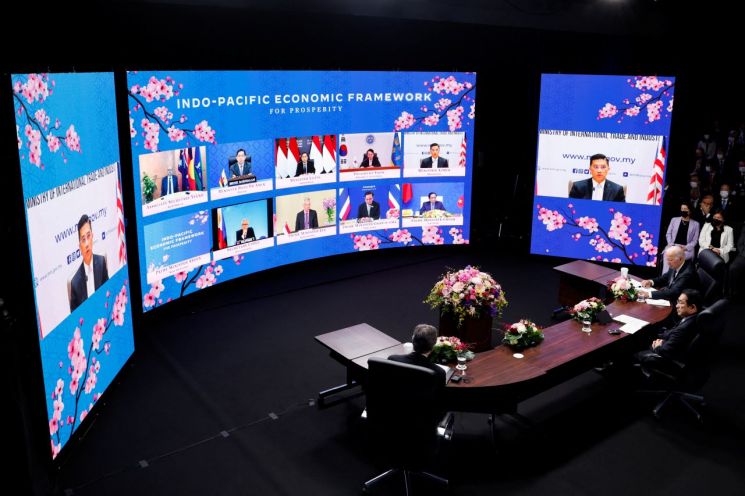
[Asia Economy Sejong=Reporter Lee Jun-hyung] The first ministerial meeting was held following the launch of the Indo-Pacific Economic Framework (IPEF) led by the United States. IPEF plans to hold another ministerial meeting next month to intensify discussions on specific agendas.
The Ministry of Trade, Industry and Energy announced that Ahn Deok-geun, the head of trade negotiations, attended the participating countries’ ministerial meeting held immediately after the IPEF launch summit on the 23rd. Ministers from 13 countries that joined as founding members of IPEF attended this ministerial meeting. Director Ahn discussed future agenda-specific consultation procedures with ministers from IPEF member countries.
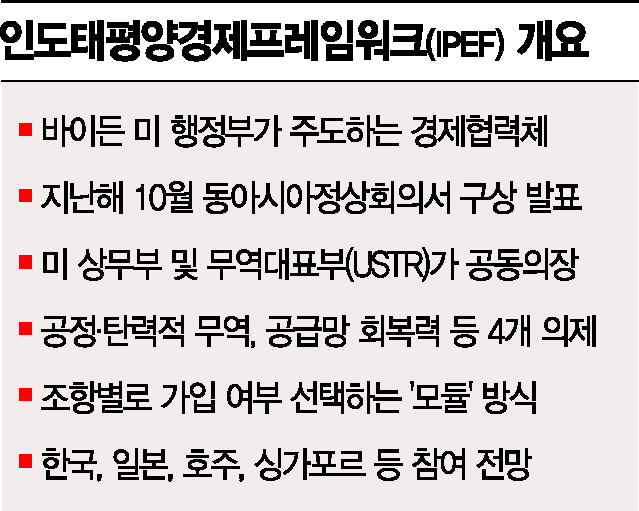
IPEF is an economic cooperation body in the Indo-Pacific region led by the United States. On this day, the United States declared the launch of IPEF during President Joe Biden’s visit to Japan. Thirteen countries, including South Korea, Japan, Australia, New Zealand, Singapore, and India, joined as founding members of IPEF.
The expected impact of IPEF is considerable. IPEF is regarded as an economic bloc larger than the Regional Comprehensive Economic Partnership (RCEP) and the Comprehensive and Progressive Agreement for Trans-Pacific Partnership (CPTPP). In fact, the combined gross domestic product (GDP) of IPEF member countries is $34.6 trillion, which is $8.5 trillion more than RCEP’s $26.1 trillion. Compared to CPTPP, which the government is pursuing membership in, with a GDP of $10.8 trillion, the GDP difference is nearly three times. Additionally, IPEF member countries account for 40% of South Korea’s total trade. This underscores the significant economic importance of IPEF.
IPEF’s Goal as a ‘Rule Maker’
The government believes that joining IPEF at its early stage is essential to play the role of a ‘rule maker.’ This is because IPEF is structured in a ‘module’ format, where key agendas are concretized through negotiations among member countries immediately after its launch. A government official explained, “If we participate proactively at the early stage of IPEF, we can lead discussions on trade norms in the Indo-Pacific region, including supply chains and decarbonization.”
With the launch of IPEF, opportunities for domestic companies to expand overseas are also expected to increase. The government anticipates a significant strengthening of supply chain cooperation among IPEF member countries. Through IPEF, the government plans to expand public-private cooperation in new industries such as artificial intelligence (AI), digital new technologies, and clean energy. The participation of major emerging countries such as India, Indonesia, and Vietnam in IPEF also raises expectations that domestic companies will have greater chances to participate in large-scale projects like regional infrastructure investments.
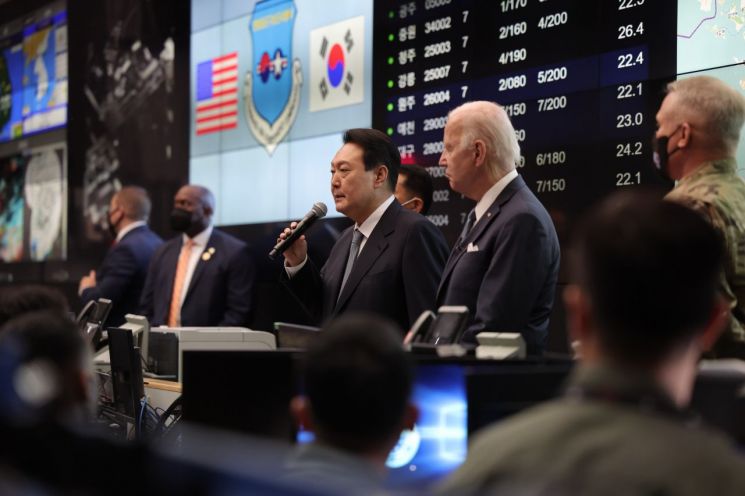 South Korean and U.S. Leaders Visit Aerospace Operations Command
 (Pyeongtaek=Yonhap News) President Yoon Suk-yeol and U.S. President Joe Biden visited the Aerospace Operations Command (KAOC) at Osan Air Base on the afternoon of the 22nd, encouraging the troops. 2022.5.22 [Provided by the Presidential Office. Redistribution and DB prohibited]
Photo by seephoto@yna.co.kr
(End)
<Copyright (c) Yonhap News Agency, unauthorized reproduction and redistribution prohibited>
IPEF will hold another ministerial meeting next month to continue detailed agenda discussions. The main agendas of IPEF are composed of four pillars: fair and resilient trade, supply chain resilience, and others. The government plans to actively incorporate opinions from industry, experts, and other stakeholders in future IPEF discussions.
Challenge of Possible Chinese Opposition
Addressing potential opposition from China is a challenge the government must tackle. One of the core aspects of IPEF is to counterbalance China. This is why labor and environmental standards, areas where China is relatively weak, are included in IPEF. Initially, the United States proposed IPEF as a measure to counter the Regional Comprehensive Economic Partnership (RCEP) led by China. Before the inauguration of the Yoon Seok-yeol administration, the Ministry of Trade, Industry and Energy reported to the presidential transition committee that “IPEF was proposed in the context of countering China” and “there is a possibility of Chinese opposition if South Korea participates in IPEF.”
However, the Ministry of Trade, Industry and Energy maintains that IPEF is unrelated to countering China. A ministry official stated during a back briefing explaining the economic outcomes of the Korea-US summit, “Looking at IPEF member countries, many maintain neutral relations between the United States and China,” adding, “Economies should operate according to national interests, so the approach should be to avoid excluding any particular country.”
© The Asia Business Daily(www.asiae.co.kr). All rights reserved.



















