Samsung, SK, Hanwha, GS, Doosan, etc.
Solar Power, Opportunity to Reverse China's Low-Price Offensive
Nuclear Power, SMR Business Companies Rejoice
Defense Industry, US Defense Procurement Exports Flourish
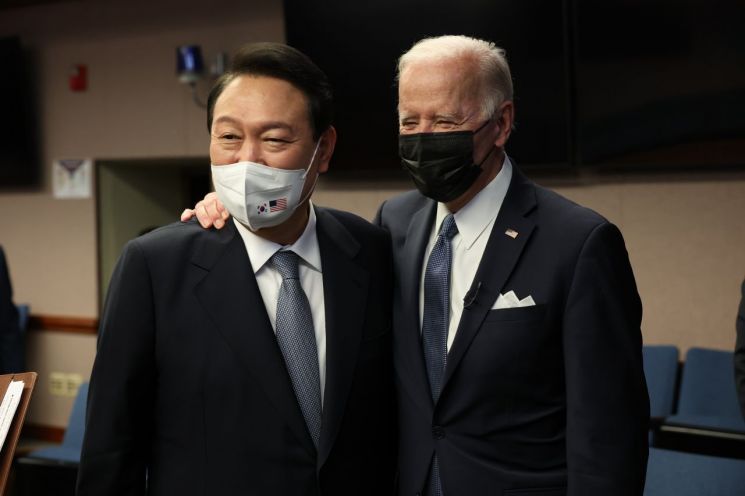 President Yoon Suk-yeol and U.S. President Joe Biden visited the Korea Air and Space Operations Center (KAOC) at Osan Air Base on the afternoon of the 22nd, wearing bright expressions. (Photo by Yonhap News)
[Asia Economy Reporter Moon Chaeseok] As the leaders of South Korea and the United States met to strengthen economic security and technological alliances, Korean companies gained opportunities to enhance supply chain stability and expand export channels. Following semiconductors and automobiles, cooperation was also agreed upon in profitable industries such as solar power, nuclear energy, defense industry, and aerospace, drawing attention from related sectors.
According to the industry on the 23rd, expectations are growing that energy and defense sectors will benefit from the outcomes of the South Korea-US summit. Samsung, SK, Hanwha, GS, and Doosan are mentioned as beneficiary companies.
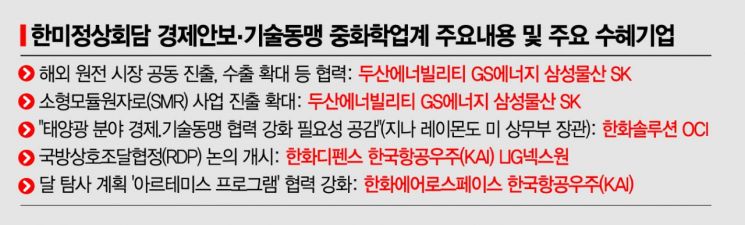
Solar power is analyzed to have gained an opportunity to reverse the atmosphere that had been suffering from China's low-price offensive. The industry had lost momentum in the market share battle after ceding leadership to China. The solar power industry supply chain proceeds from polysilicon → ingot → wafer → cell → module, with OCI producing polysilicon and Hanwha Solutions manufacturing cells and modules respectively. Hanwha Solutions is attracting attention as it is investing in building a local factory in the US. In 2019, it operated the largest solar module factory in the US with a capacity of 1.7GW in Georgia and plans to build an additional 1.4GW module factory recently. Regarding polysilicon production for wafers, which accounts for 95% of China's market share in intermediate goods, Hanwha is accelerating vertical integration by acquiring US polysilicon company REC Silicon. A Hanwha representative said, "Based on this South Korea-US economic alliance, we expect a positive impact on securing and expanding a stable supply chain for Hanwha Solutions' solar business, which has invested in the US market for over 10 years."
In nuclear energy, synergy is expected with South Korea's domestic policy of abandoning nuclear phase-out. The two leaders signed the US-led 'Third Country Small Modular Reactor (SMR) Capability Enhancement Program,' and companies entering the SMR business are welcoming this. However, some opinions suggest that since the commercialization of SMRs will not occur until at least the late 2020s, it is difficult to assign immediate significance. An industry official said, "We expect the cooperation in the SMR field, which has already begun in the private sectors of both countries, to accelerate and expand in scope," adding, "Strengthening cooperation in overseas nuclear power exports will enhance competitiveness in securing orders, and it is important to concretize the business."
The defense sector cannot be overlooked either. Hanwha Aerospace, the aerospace and defense holding company of Hanwha, along with Hanwha Defense, Korea Aerospace Industries (KAI), and LIG Nex1 are cited as beneficiary companies. In defense, the two countries agreed to promote the 'Reciprocal Defense Procurement Agreement (RDP),' opening export routes to the US defense procurement market worth about 500 trillion won annually. Upon signing the RDP, companies can be exempted from the 'Buy American Act (BAA),' which imposes a 50% price penalty unless more than 55% of parts are US-made. This is similar to the US-Mexico-Canada Agreement (USMCA), which grants tariff-free benefits only to electric vehicle batteries made with 75% US local parts starting in 2025.
In aerospace, as the two countries agreed to cooperate on the 'Artemis Program,' aiming to land two astronauts by 2025, and the launch of the Korean-type launch vehicle lunar probe in 2031, opportunities for corporate participation are expected to increase. An industry official said, "We expect that the Artemis project will be concretized through this summit, and cooperation in exploration programs related to in-situ resource utilization in space will also be specified."
© The Asia Business Daily(www.asiae.co.kr). All rights reserved.


















