[Industry and Wealth Landscape Changed by COVID-19]
Global National Lockdowns and Social Distancing
Direct Hit to Passenger Transport-Centered LCCs
Demand and Prices Surge, 'Cha-Hwa-Jeong' Thrive
[Asia Economy Reporter Minji Lee] After the outbreak of COVID-19, Incheon Airport, which once saw 200,000 people passing through daily, was left in silence. The once overcrowded weekend movie theaters also faded from memory. The COVID-19 impact was directly reflected in the performance of these companies.
On the 23rd, Asia Economy compared the performance of the top 500 companies by sales in the previous year with their 2019 results, just before the pandemic fully took hold. The results showed that companies related to hotels, leisure, and travel saw their performance shrink drastically. Some airlines even disappeared from the top 500 rankings as their expenses exceeded their earnings over the year.
Travel and Leisure Hit by Massive Losses
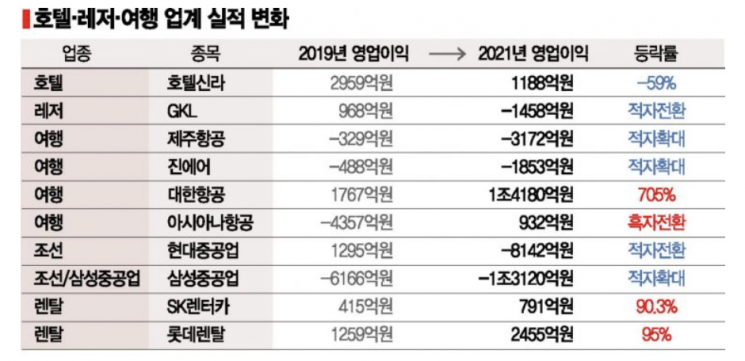
The fortunes of full-service carriers (FSC) and low-cost carriers (LCC) diverged sharply. LCCs, whose revenue mostly comes from passenger transport, suffered greatly as global border closures forced many days without operations. Jeju Air recorded an operating loss of 317.2 billion KRW, a tenfold increase from the 32.9 billion KRW loss in 2019, and Jin Air’s operating loss grew from 48.8 billion KRW to 185.3 billion KRW. Although both were ranked within the top 500 by sales in 2019, they dropped out in 2021 due to diminished performance.
Korean Air (705% growth) and Asiana Airlines (turned profitable) benefited from cargo transport revenue. Filling cargo in seats normally occupied by passengers generated more income. The rise in air freight rates due to global supply chain disruptions also contributed positively.
This performance disparity is expected to continue for some time. Prolonged high oil prices and exchange rates, combined with economic recession effects delaying passenger demand recovery, have lowered performance forecasts for LCCs. Researcher Sooyoung Park of Hanwha Investment & Securities explained, “Domestic airlines have financial structures vulnerable to oil price and exchange rate fluctuations since fuel payments are made in foreign currency. However, FSCs with improved financial soundness due to increased margins from high cargo rates are expected to show differentiated performance compared to LCCs.”
Companies related to hotels, leisure, and casinos also posted dismal results due to COVID-19. GKL recorded a loss of 145.8 billion KRW, turning to the red, and Kangwon Land faced a loss of 52.7 billion KRW. Hotel Shilla’s operating profit dropped by half compared to two years ago, recording 118.8 billion KRW. In shipbuilding, major companies such as Samsung Heavy Industries and Hyundai Heavy Industries continued to post losses due to reduced orders caused by COVID-19 and rising steel plate prices from inflation.
However, the rental car industry defied expectations of poor performance due to COVID-19 and posted strong results. Delays in new car launches shifted demand to used cars, and increased domestic travel demand significantly boosted rental-related earnings. SK Rent-a-Car and Lotte Rental recorded growth rates of 90.3% and 95%, respectively, during this period.
A Boom Comparable to the ‘ChaHwajeong’ Era
The ‘ChaHwajeong’ (automobile, chemical, refining) sector, which dominated the Korean stock market in 2010 and 2011, experienced another boom starting with COVID-19. Although concerns about economic recession initially raised doubts about performance, increased demand and tight supply led to significant price increases.
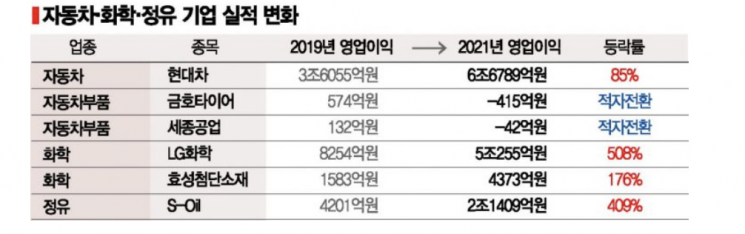
In the chemical sector, increased demand led to significant price rises for key products. With low oil prices reducing cost burdens, demand for durable goods such as IT, home appliances, and daily necessities surged, greatly improving product spreads (the difference between raw material and product prices). Most of the top 500 companies either returned to profitability or recorded double-digit profit growth rates.
Refining companies enjoyed a boom due to increased inventory valuation gains from rising oil prices and exceptionally strong refining margins, a key profitability indicator. During this period, refining margins (the amount left after subtracting raw oil prices and transportation costs from petroleum product prices like gasoline and diesel) exceeded $8?10, about twice the breakeven point of $4?5. The profit growth rates of Korea’s three major refiners?S-Oil, SK Innovation, and GS?were 409.7%, 57.5%, and 29.9%, respectively.
In the automobile sector, performance improvements were notable mainly among finished car manufacturers. Kia grew 152%, from 2.0097 trillion KRW to 5.0657 trillion KRW, and Hyundai Motor increased 85%, from 3.6055 trillion KRW to 6.6789 trillion KRW.
Parts suppliers continued to face a performance slump. The shortage of automotive semiconductors limited operating rates, significantly reducing earnings. Sejong Industrial turned to losses, and Hwasung Corporation recorded a loss of about 40 billion KRW. Tire companies struggled to recover earnings due to logistics cost burdens. With continued low margins, Nexen Tire’s operating profit shrank from 207.4 billion KRW to 4.4 billion KRW (-98%).
Researcher Jinwoo Kim of Korea Investment & Securities analyzed, “As finished car manufacturers shifted their strategy from volume-based to profitability-focused, parts suppliers’ performance was burdened. Korea’s small and medium parts suppliers have concentrated sales channels, leading to structural performance slumps. It is difficult to expect all to profit well as in the past volume-driven growth era.”
© The Asia Business Daily(www.asiae.co.kr). All rights reserved.

![Clutching a Stolen Dior Bag, Saying "I Hate Being Poor but Real"... The Grotesque Con of a "Human Knockoff" [Slate]](https://cwcontent.asiae.co.kr/asiaresize/183/2026021902243444107_1771435474.jpg)
















