-Yoon: "The process of creating broad rules, if excluded, will harm national interests"
-South Korean government refrains from provoking China... "Will discuss building a stable supply chain"
-Chinese state media: "Provocation against China... will pay the price"
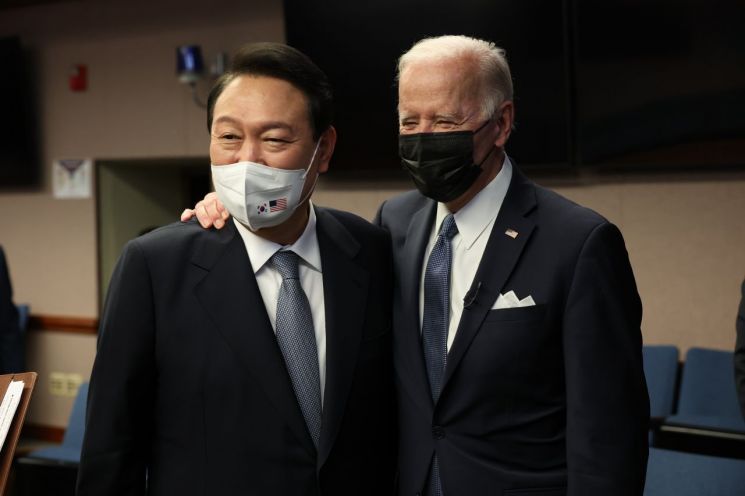
[Asia Economy=Special Correspondent Cho Young-shin, Reporter Bae Kyung-hwan] After completing the 2-night, 3-day schedule of the South Korea-US summit, President Yoon Seok-yeol said on the 23rd regarding the decision to participate in the Indo-Pacific Economic Framework (IPEF), "It is a process of creating broad rules related to economic trade." This statement is interpreted as being mindful of China, which has been expressing dissatisfaction with the strengthening of the South Korea-US alliance. However, China reacted sensitively as the joint statement of the South Korea-US summit mentioned the most sensitive issue, the Taiwan Strait, signaling that South Korea-China relations will not be smooth.
President Yoon said to reporters on his way to the Yongsan Presidential Office building that day, "IPEF is not a trade negotiation with specific content," adding, "If we are excluded, it will cause significant damage to national interests." IPEF is scheduled to officially launch that afternoon, and President Yoon will also attend the launch declaration summit via video conference.
Our government has expressed through various channels its stance to avoid provoking China as much as possible before and after the South Korea-US summit. In particular, the joint statement explicitly stated that regarding participation in IPEF, "We have pledged to cooperate closely based on the principles of openness, transparency, and inclusiveness," reflecting the position that IPEF is not a system aimed at containing China. The explanatory materials for the joint statement also specified, "We will promote harmonious South Korea-US and South Korea-China economic cooperation by strengthening communication with the Chinese side on economic cooperation."
This is analyzed as a logical basis to refute China's claim that IPEF is protectionism. The Chinese government criticized IPEF on the 22nd, just one day after the South Korea-US summit, saying, "We must promote free trade and not engage in disguised protectionism," and "We should promote openness and cooperation, not create geopolitical confrontation."
Foreign Minister Park Jin also mentioned the day before that regarding the criticism that IPEF is aimed at containing China, "South Korea can play a role in inducing China to participate in such norms and order."
Our government has already proposed consultations for building a stable supply chain to China through the Trade Negotiations Headquarters. A presidential office official explained, "Discussing the Indo-Pacific regional economic supply chain excluding China is unrealistic," adding, "We will first identify the interests of both countries and try to create opportunities for dialogue."
However, it is uncertain how sincerely China will view our government's position. A response to the supply chain consultation proposal made shortly after the current administration took office has not yet been received.
Chinese state media are focusing on the 'Taiwan Strait' issue. On the same day, the state-run Global Times highlighted the part of the South Korea-US summit joint statement mentioning "the importance of maintaining peace and stability in the Taiwan Strait," quoting Professor Xin Chang of Fudan University, who said, "It signals that South Korea may provide stronger support to the US, including on the Taiwan issue," describing this as a provocation against China. It warned that if South Korea stirs up the Taiwan issue, it will pay the price, and China has many means to counter South Korea. Chinese media also maintained a negative stance on the expansion of South Korea-US joint military exercises.
Regarding economic issues such as IPEF, Foreign Minister Wang Yi personally stepped forward. After the China-Pakistan foreign ministers' meeting held the previous day, Wang said at a press conference, "We must see through the hidden meaning behind IPEF," defining IPEF as a US conspiracy to contain China's economy, including supply chains, according to the People's Daily. Wang added, "China is a super-large market with 1.4 billion people," and "If trade and economic issues are approached ideologically, it will be the US and its allies, not China, who will be isolated."
Beijing=Special Correspondent Cho Young-shin ascho@asiae.co.kr
Reporter Bae Kyung-hwan khbae@asiae.co.kr
© The Asia Business Daily(www.asiae.co.kr). All rights reserved.

















