Chinese State Media Warns on Taiwan in South Korea-US Joint Statement
Wang Yi: "We See Through the Hidden US Conspiracy in IPEF"
[Asia Economy Beijing=Special Correspondent Jo Young-shin] Chinese state media have expressed the view that South Korea faces the Korean Peninsula (North Korea) issue in relation to U.S. President Joe Biden's Asia tour. This is interpreted as a warning not to cross the line on China's internal Taiwan issue. At the same time, China hinted at a warning stance that it has many means to counter South Korea.
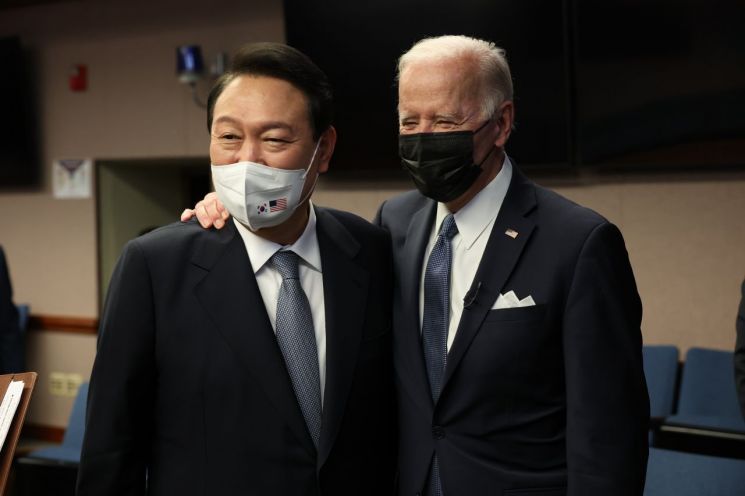
The state-run Global Times reported on the 23rd that the South Korean Yoon Suk-yeol administration would not be able to cause a stir over the Taiwan issue, in response to the inclusion of the Taiwan issue in the joint statement of the South Korea-U.S. summit.
The media analyzed that the joint statement mentioned the "importance of maintaining peace and stability in the Taiwan Strait," which means that South Korea is cooperating with the U.S. to intervene in the Taiwan issue.
Xin Chang, a professor at Fudan University, explained that "this is a signal that South Korea can provide stronger support to the U.S., including on the Taiwan issue," and that it is a provocation against China.
The Global Times also mentioned the Korean Peninsula (North Korea) issue in relation to the joint statement. It pointed out that if South Korea's stance on the Taiwan issue changes, the Korean Peninsula issue will become more complicated, which will have a negative impact on South Korea.
The media expected that South Korea's new government is likely to maintain the U.S. position but that this will end in rhetoric. It also claimed that if South Korea stirs up the Taiwan issue, it will pay the price, and China has many means to counter South Korea.
Chinese media also maintained a negative stance on the expansion of South Korea-U.S. joint military exercises.
Lu Chao, a researcher at the Liaoning Academy of Social Sciences, represented North Korea's position by saying, "North Korea regards the South Korea-U.S. military exercises as a barometer for judging the situation on the Korean Peninsula," and "the expansion of joint exercises will provoke North Korea and further complicate the Korean Peninsula issue."
Regarding President Biden's visit to South Korea, China's deployment of state media and government-affiliated scholars at the forefront seems to reflect the burden of deteriorating relations with South Korea. It can also be interpreted as leaving room for continued dialogue with the South Korean government.
On the other hand, on economic issues such as the Indo-Pacific Economic Framework (IPEF), Foreign Minister Wang Yi personally stepped forward. At a press conference following the China-Pakistan Foreign Ministers' meeting held the previous day, Wang said, "We must see through the hidden meaning behind IPEF," defining IPEF as a U.S. conspiracy to check China's economy, including supply chains, according to the People's Daily.
He stated, "A new economic system should promote free trade and benefit the global economy without causing geopolitical confrontation," and then criticized the U.S. side by saying, "The U.S. intends to use the new economic system as a tool to isolate China."
Wang added, "China is a super-large market with a population of 1.4 billion," and "If trade and other economic issues are approached ideologically, it will be them (the U.S. and its allies), not China, who will be isolated."
© The Asia Business Daily(www.asiae.co.kr). All rights reserved.

















