A Total of 367 Financial Incidents in 6 Years at 5 Major Banks
Increase in Incidents Including Financial Disorderly Conduct
Receiving Money from Customers and Private Financial Transactions Included
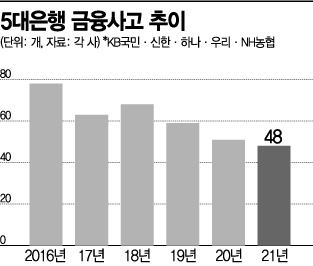
[Asia Economy Reporter Song Seung-seop] It has been found that more than 61 financial incidents occur annually on average due to banks' internal control failures. This figure includes not only ‘monetary incidents’ causing financial losses such as embezzlement but also ‘financial order disruption acts’ that do not cause financial losses but are problematic. Recent embezzlement cases in banks have also been criticized as resulting from poor internal controls.
According to the management disclosures of the five major banks (KB Kookmin, Shinhan, Hana, Woori, NH Nonghyup) on the 23rd, a total of 367 financial incidents occurred from 2016 to last year. This means an average of 61.1 financial incidents occurred annually. KB Kookmin Bank had the highest number with 87 cases, followed by Woori Bank with 76 cases. Shinhan Bank and Hana Bank each had 69 cases, and NH Nonghyup Bank had 66 cases.
Financial incidents at financial institutions are divided based on whether there is financial loss. If customers and companies suffer losses due to embezzlement, misappropriation, breach of trust, fraud, or theft, it is classified as a ‘monetary incident.’ Other cases such as bribery, illegal private lending mediation, violation of the Financial Real Name System, private monetary loans, and others are classified as ‘financial order disruption acts.’ Generally, statistics have focused on monetary incidents.
However, among all financial incidents, financial order disruption acts numbered 208, exceeding monetary incidents at 159. While monetary incidents decreased from 39 cases in 2016 to 19 last year, financial order disruption acts only decreased from 39 to 29 cases. Although there was no financial loss, this indicates that moral hazard damaging trust relationships with customers and the market was much more frequent among financial institution employees.
Receiving valuables from customers and engaging in private monetary transactions
Among disruption acts, violations of the Financial Real Name System due to improper management of customers’ personal information were the most frequent at 95 cases. The Financial Real Name System requires that financial transactions must be conducted under the name of the actual transaction party. Nevertheless, banks often disclosed customers’ personal information to third parties or used it for their own marketing. KB Kookmin Bank had the highest number of violations at 29 cases, followed by NH Nonghyup Bank with 24 cases. Then came Woori Bank (22 cases), Shinhan Bank (12 cases), and Hana Bank (8 cases).
There were also 52 cases of ‘private monetary loans’ detected, where money was lent privately. Due to the nature of handling money, banks must not lend money privately to customers, business partners, or internal employees. Providing guarantees is also prohibited. Excluding other cases (26 cases), there were 24 cases where bank employees received valuables and 11 cases of mediating illegal private loans.
During the same period, there were a total of 159 monetary incidents, with 72 cases of embezzlement. Hana Bank and NH Nonghyup Bank each had 18 cases, the highest number, followed by Shinhan Bank with 13 cases. Woori Bank and KB Kookmin Bank also experienced 12 and 11 embezzlement cases respectively. Misappropriation incidents totaled 13 cases. Combining all domestic banks, embezzlement and misappropriation incidents alone caused damage worth approximately 6.76 billion KRW last year. Serious fraud cases were also recorded at 46 cases. KB Kookmin Bank had the most with 16 cases, including 4 fraud cases last year. Woori Bank had 12 cases, Shinhan Bank 9, Hana Bank 7, and NH Nonghyup Bank 2.
Ultimately, there are criticisms that even large banks either do not have basic internal control systems in place or fail to operate them properly. It is difficult to dismiss the 61.4 billion KRW embezzlement case at Woori Bank as merely an individual deviation. Professor Kim Dae-jong of Sejong University’s Department of Business Administration emphasized, “(Financial incidents) involve multiple factors, and internal control is the most important core system among them.”
© The Asia Business Daily(www.asiae.co.kr). All rights reserved.
![Clutching a Stolen Dior Bag, Saying "I Hate Being Poor but Real"... The Grotesque Con of a "Human Knockoff" [Slate]](https://cwcontent.asiae.co.kr/asiaresize/183/2026021902243444107_1771435474.jpg)











