Below 10,000 for the First Time Since January 25 with 8,570 Cases
Fewer Severe Cases and Deaths Hospitalized Compared to Then
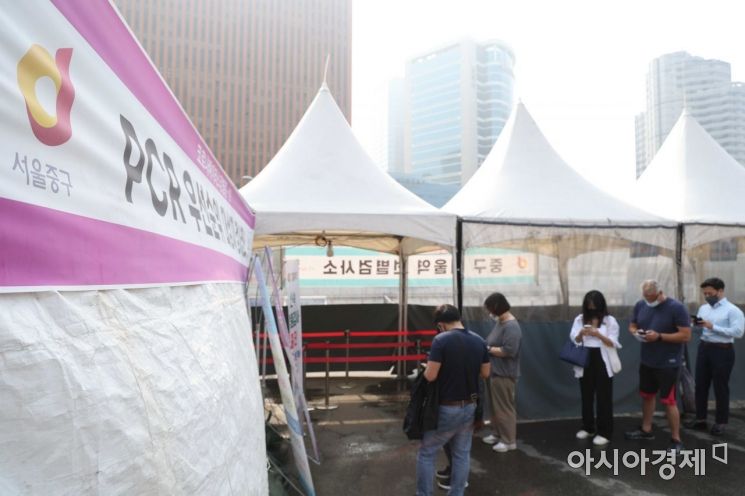 On the 23rd, when the decline in COVID-19 confirmed cases continued, the temporary screening clinic at Seoul Station was quiet. Photo by Mun Ho-nam munonam@
[Asia Economy Reporter Kim Young-won] The number of new COVID-19 cases in South Korea has fallen below 10,000 for the first time in 118 days, showing a continuous downward trend.
On the 23rd, the Central Disease Control Headquarters announced that as of midnight on the 23rd, 9,975 new COVID-19 cases were added, bringing the total cumulative cases to 17,967,672.
The daily new cases fell below 10,000 for the first time in 118 days since January 25, when 8,570 cases were reported. Considering that the Omicron variant accounted for 50.3% in the third week of January, this is the first time since the full-scale spread of Omicron that new cases have dropped below 10,000.
The number of critically ill patients and deaths has decreased compared to January 25. As of midnight on this day, there were 225 critically ill patients and 22 deaths, fewer than the 392 critically ill patients and 23 deaths reported at midnight on January 25. The total cumulative deaths stand at 23,987, with a fatality rate of 0.13%.
COVID-19 indicators, including confirmed cases, continue to show a steady decline. In the second week of this month, the weekly decrease in cases was about 5% compared to the previous week, showing the smallest decline since the peak of the outbreak, but in the third week, the decrease widened again to about 38.7% compared to the previous week.
The numbers of critically ill patients and deaths are also continuously decreasing. The average daily deaths over the week ending on the 22nd were 37, a decrease of about 35.1% compared to the previous week. The number of critically ill patients hospitalized due to COVID-19 also decreased by about 30.4% during the same period.
The continued isolation requirement for confirmed cases until the 20th of next month is also expected to contribute to the stable downward trend. According to a mathematical model by the Korea Disease Control and Prevention Agency, if isolation is maintained as it is, the daily new cases are estimated to be about 14,646 at the end of this month, decreasing to 8,309 by the end of next month, and slightly increasing to 9,014 by the end of July. On the other hand, if the isolation requirement is lifted, the number of confirmed cases is expected to be 1.7 to 4.5 times higher than if isolation is maintained.
However, the spread of COVID-19 variants remains a variable. In the United States, the number of cases has been increasing for seven consecutive weeks due to the spread of BA.2.12.1, a sub-lineage of Omicron. BA.2.12.1 is known to be 23-27% more transmissible than BA.2, which is known as stealth Omicron.
With daily new cases in the U.S. exceeding 100,000, rebounding to levels seen during the Delta wave, the U.S. Centers for Disease Control and Prevention (CDC) is considering expanding the fourth dose of vaccination to those under 50 years old. As of the 17th, a total of 19 cases of BA.2.12.1 have been confirmed in South Korea.
© The Asia Business Daily(www.asiae.co.kr). All rights reserved.
![Clutching a Stolen Dior Bag, Saying "I Hate Being Poor but Real"... The Grotesque Con of a "Human Knockoff" [Slate]](https://cwcontent.asiae.co.kr/asiaresize/183/2026021902243444107_1771435474.jpg)
















