First Biden-Kishida Face-to-Face Summit on the 23rd
Discussion on Advanced Technology Cooperation at the Quad Leaders' Meeting on the 24th
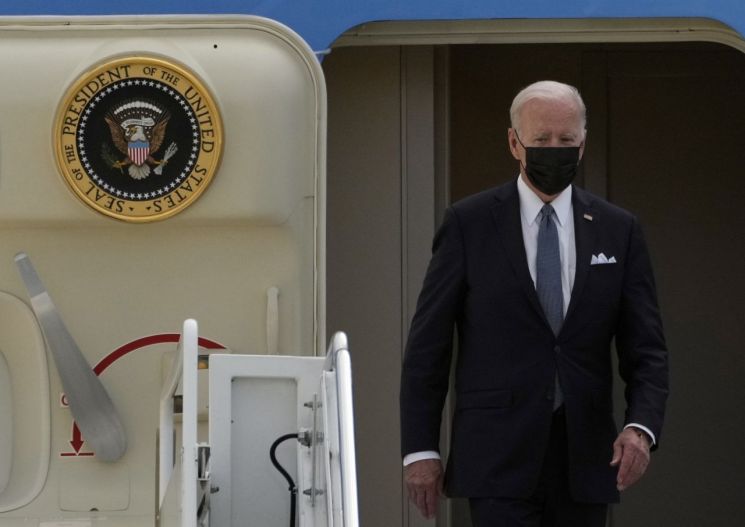 US President Joe Biden arrived in Tokyo, Japan on the 22nd and is seen disembarking from Air Force One, the presidential aircraft. [Image source=EPA Yonhap News]
[Asia Economy Reporter Jeong Hyunjin] Following his visit to South Korea, U.S. President Joe Biden, currently in Japan, is expected to focus on cooperation in advanced technology sectors to counter China. On the 23rd, President Biden plans to establish a new framework for export controls on advanced technologies during a summit with Japanese Prime Minister Fumio Kishida. At the Quad summit the following day, a consultative body aimed at countering China, discussions are expected to center on cooperation in advanced technology fields such as semiconductors, 5G, and biotechnology.
According to Japan's Nihon Keizai Shimbun and Yomiuri Shimbun, President Biden, visiting Japan for the first time since taking office, and Prime Minister Kishida, who assumed office in October last year, will hold their first face-to-face summit in Tokyo on this day. The two leaders are expected to confirm policies to strengthen deterrence and response capabilities between the two countries to enhance regional security with China in mind.
The U.S. and Japanese leaders plan to coordinate on including the creation of a new framework for export controls on advanced technologies in a joint statement, Nihon Keizai reported. If implemented, exports of key Japanese components embedded in Chinese electronic products could be halted, likely provoking China's opposition. Export controls refer to monitoring and restricting exports of products or technologies that may be used for military purposes or disrupt international order to certain countries. The U.S. and Japan have agreed that technologies potentially used for serious human rights abuses should also be included under export controls. This includes facial recognition and surveillance camera-related technologies.
China has been suspected of using surveillance cameras in its repression of the Uyghur minority in Xinjiang. Earlier this month, foreign media reported that China’s largest surveillance equipment manufacturer, Hikvision, supplied these cameras, and that the U.S. Treasury Department is considering sanctions. Although China possesses the technology to assemble final products, Nihon Keizai noted that electronic components embedded in these devices often come from advanced products made in Japan and other countries. Additionally, spyware that collects smartphone personal information and GPS technology that tracks location raise concerns about potential use in human rights violations. Following this joint statement, the two countries are expected to quickly select technologies subject to export controls and proceed with legal revisions.
The Biden administration established an initiative last December to ban exports of related technologies to authoritarian governments like China that use various surveillance equipment and technologies for human rights abuses. Japan has not yet joined this initiative. Regarding this, a Japanese government official told Nihon Keizai that "technical and practical cooperation with the U.S. is underway."
At the Quad summit on the 24th, involving the U.S., Japan, Australia, and India, President Biden is expected to agree on creating a public-private dialogue channel concerning 5G and biotechnology. The four countries also plan to establish joint principles to build supply chains independent of China in sectors such as semiconductors. On this day, Yomiuri reported that the draft joint statement to be adopted at the Quad summit includes plans to create public-private dialogues involving industry and governments related to 5G, 6G, and biotechnology. Yomiuri explained that this reflects concerns that private companies capable of countering Chinese firms like Huawei have not sufficiently developed within the four countries. The Quad summit is also expected to define openness and respect for human rights as fundamental principles for supply chains.
Meanwhile, during the summit, President Biden and Prime Minister Kishida are expected to discuss not only advanced technologies but also the Indo-Pacific Economic Framework (IPEF), measures to strengthen semiconductor supply chains, and energy security issues. They are also anticipated to hold talks on responses to North Korea’s nuclear and missile developments and on improving Japan-South Korea relations.
© The Asia Business Daily(www.asiae.co.kr). All rights reserved.
![From Bar Hostess to Organ Seller to High Society... The Grotesque Con of a "Human Counterfeit" [Slate]](https://cwcontent.asiae.co.kr/asiaresize/183/2026021902243444107_1771435474.jpg)
















