Taxis Unavailable Even Before Last Train... Citizens and Self-Employed "Hope for More Vehicles"
Taxi Driver Says Public Intervention Inevitable: "Taxi Business Has Received a Death Sentence"
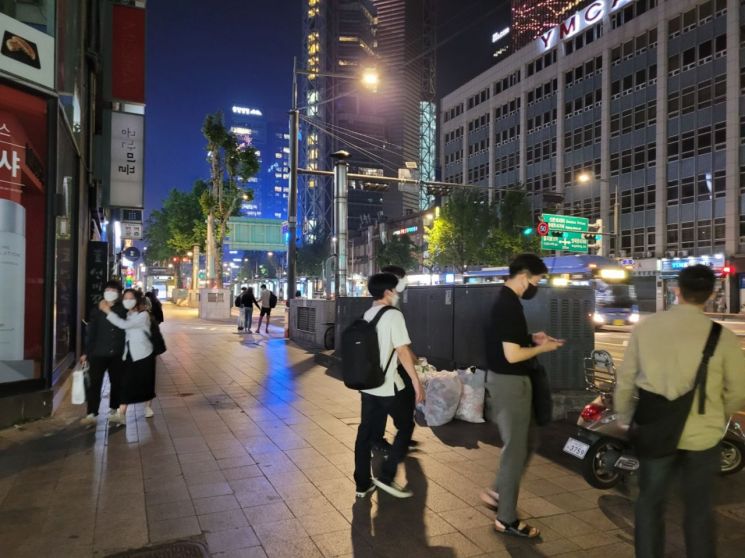 Around 11 p.m. on the 22nd, near Jonggak Station in Seoul, people kept trying to call taxis but ultimately failed. They moved to take the subway or late-night buses.
 Photo by Gong Byung-sun mydillon@
[Asia Economy Reporter Gong Byung-sun] On the 22nd, people drinking near Jonggak Station in Seoul hurriedly moved as the clock struck 11 p.m. Although the bar's operating hours had not yet ended, they were trying not to miss the last subway and bus rides. Some looked at their smartphones to catch a taxi but failed. Even when trying to hail passing taxis, all taxis displayed "Reserved" signs while driving on the road. One passenger waved to catch a taxi but heard it was only going to Gangdong-gu, Seoul, and weakly closed the taxi door. Then, they picked up their smartphone again to search for a taxi.
The taxi crisis is ongoing. Due to the recession caused by COVID-19, the number of taxi drivers has significantly decreased, but there are no countermeasures. According to the National Taxi Transport Business Association Federation, the number of taxi drivers decreased by 26,917 over two years since December 2019. Additionally, factors such as rising fuel prices have reduced the profitability of taxi operations, making it an undesirable industry. This situation has become more pronounced as COVID-19 quarantine restrictions have been lifted.
On this day near Jonggak Station in Seoul, taxis were not available even before the subway and buses stopped running. A reporter from this paper tried to call a taxi via smartphone from 11 p.m. but repeatedly failed. Citizens who wanted to comfortably go home by taxi stood on the street for more than 15 minutes, realized the taxi crisis, and turned to take the subway or bus.
 Around 11 p.m. on the 22nd, our reporter also tried to call a taxi but kept failing.
 Photo by KakaoT capture
Citizens suffering from the taxi crisis wanted relief from the inconvenience. Office worker Jo (29) said, "Last week, I waited until 3 a.m. trying to catch a taxi from Suwon to Yongin," adding, "These days, I try not to miss the last ride." Ryu (32) said, "Although COVID-19 quarantine measures have been lifted, it is burdensome to meet people late because there are no taxis," and added, "I hope more taxis are added so that people can travel comfortably even at dawn."
Self-employed people also secretly hope for an increase in taxis. This is because the number of customers during early morning hours does not increase as much as expected. Kang (62), who runs a pub in Jonggak, said, "Although quarantine measures have been lifted, unlike before COVID-19, customers leave as soon as it hits 11 p.m.," adding, "Sales this month have increased 1.8 times compared to last month, but it is disappointing that sales have not grown more."
As this situation repeats, Seoul mayoral candidates have presented related pledges. Song Young-gil, the Democratic Party candidate for Seoul mayor, proposed a monthly salary public taxi operated by Seoul City by acquiring corporate taxis. Oh Se-hoon, the People Power Party candidate for Seoul mayor, pledged to operate late-night exclusive taxis with accident-free corporate taxi drivers.
However, taxi drivers' reactions are lukewarm. They say the business viability of taxi operations has already been sentenced to death. Taxi driver Jeon (57), met at Gwanghwamun Square in Seoul on the day, said, "Taxi drivers bear gas costs of 700,000 won per month, and no one would choose this job bearing such costs," adding, "Corporations are also running at a loss, so I think there is no business viability for private operation anymore." He also said, "Since the private sector cannot endure, public intervention is necessary," but added, "It involves tax money, and I am not sure if citizens will actively agree to it."
© The Asia Business Daily(www.asiae.co.kr). All rights reserved.


















