Increase in Finished Vehicle Exports and Job Creation After Alabama Operation in 2005
Parts Suppliers' Exports to the US Rise and Companies Actively Expand Overseas
[Asia Economy Reporter Yoo Hyun-seok] As Hyundai Motor Group has decided on a new investment totaling $10.5 billion in the United States, there are expectations that the establishment of an electric vehicle (EV)-dedicated factory in Georgia will create a virtuous cycle effect for the domestic EV ecosystem. This is because, in the past, when Hyundai Motor Group operated its Alabama plant, a finished car factory in the U.S., not only did finished car exports increase, but the global expansion of the parts industry and job creation effects were also actively realized.
According to Hyundai Motor Group on the 23rd, Brian Kemp, Governor of Georgia, and Jang Jae-hoon, President of Hyundai Motor Company, held an investment agreement ceremony on the 20th (local time) at the new factory site near Savannah, Georgia, officially announcing the construction of an EV-dedicated factory. The factory aims to begin operations in the first half of 2025 and will be an EV production hub capable of producing 300,000 electric vehicles annually. Including the battery cell factory to be established nearby, the total investment amount reaches $5.54 billion (approximately 7 trillion KRW). This will be the first factory producing only pure electric vehicles in about 20 years since the first finished car factory in Alabama began operations in 2005.
The U.S. market is a representative place with high environmental awareness and strong demand for electric vehicles. It is especially expected to be able to flexibly respond to local government institutional and policy changes related to the automotive industry, including electric vehicles.
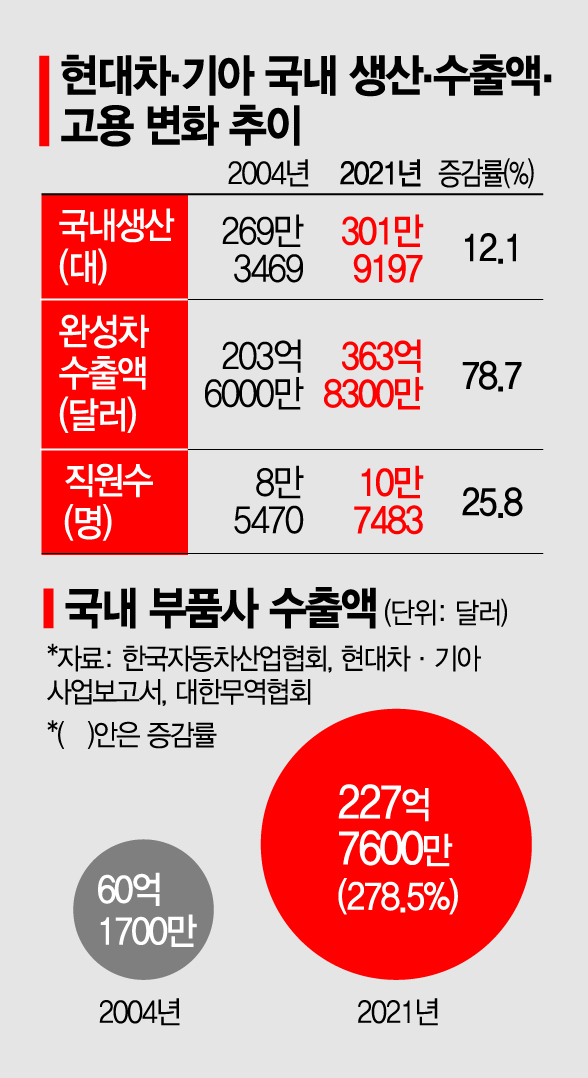
The automotive industry anticipates a "second Alabama effect." This is because the operation of Hyundai’s Alabama plant marked the beginning of increased finished car exports to the U.S. and the full-scale global expansion of the domestic parts industry. In fact, Hyundai Motor and Kia’s finished car exports to the U.S. increased by 52%, from $9.18 billion (approximately 11.65 trillion KRW) in 2004 to $14 billion (approximately 17.77 trillion KRW) last year. The establishment of the new factory is evaluated to have played a significant role in enhancing brand value in the U.S. and increasing local sales.
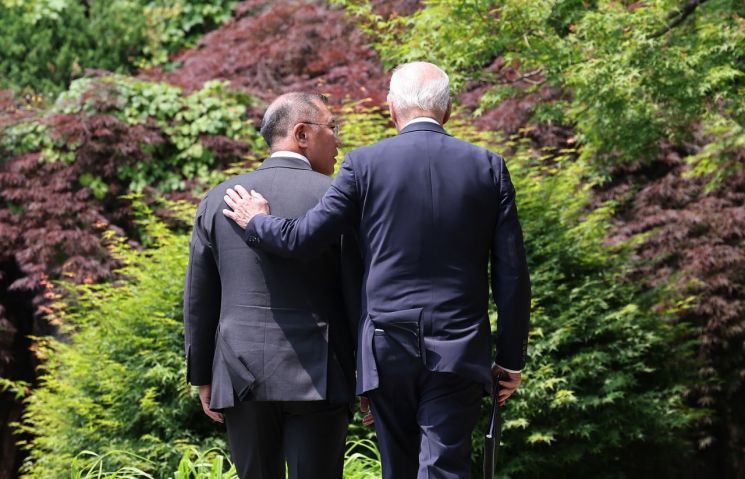 On the morning of the 22nd, U.S. President Joe Biden, after finishing his speech at a meeting with Chung Eui-sun, Chairman of Hyundai Motor Group, held at the Grand Hyatt Hotel in Yongsan-gu, Seoul, where he is staying during his visit to Korea, placed his hand on Chairman Chung's shoulder as he was leaving.
 Exports from domestic parts companies to the U.S. also increased. According to the Korea International Trade Association, the total exports of domestic parts companies to the U.S. rose more than sixfold, from $1.175 billion (approximately 1.4975 trillion KRW) in 2004 to $6.912 billion (approximately 8.8093 trillion KRW) last year.
Contrary to concerns that the establishment of overseas factories would reduce domestic jobs, positive effects are expected as Hyundai Motor and Kia increased domestic production, exports, and employment. In 2004, Hyundai Motor and Kia produced 2.69 million vehicles domestically, while last year production reached 3.02 million units. The export value increased even more significantly. Exports rose 79%, from $20.36 billion (approximately 25.9488 trillion KRW) in 2004 to $36.38 billion (approximately 46.3663 trillion KRW) last year. Domestic employment also gained momentum. According to Hyundai Motor and Kia’s business reports, the number of employees at both companies increased by 22,000 during the same period. From 85,470 employees in 2004, the number rose 26% to 107,483 last year.
Overseas expansion by domestic companies has also become more active. A total of 748 first- and second-tier suppliers have entered overseas markets alongside Hyundai Motor Group. As a result, the average sales of partner companies increased 3.3 times, from 97.9 billion KRW in 2004 to 319.6 billion KRW in 2020, and their asset size grew 3.7 times, from 70.2 billion KRW to 261.2 billion KRW.
A Hyundai Motor Group official stated, "Overseas finished car production has enhanced local brand value and increased demand, which in turn led to increased domestic production and exports and revitalization of the domestic parts industry, forming a virtuous growth cycle. We expect that the U.S. EV-dedicated factory will not only promote the growth of a wide range of related domestic industries but also create new added value."
© The Asia Business Daily(www.asiae.co.kr). All rights reserved.


















