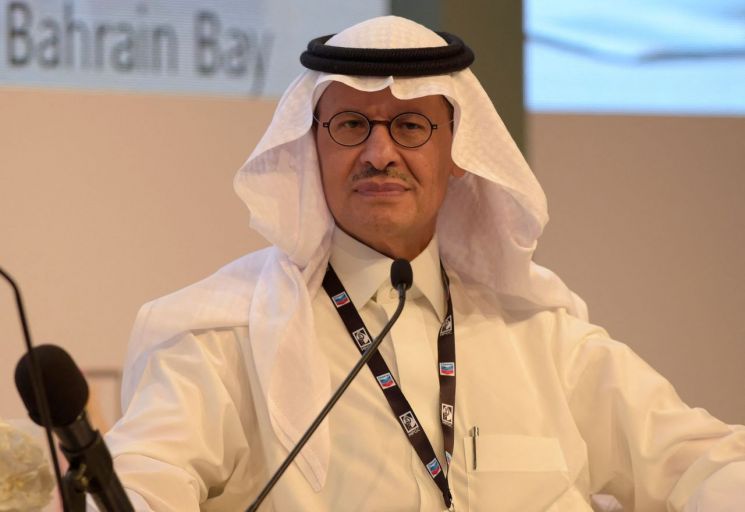
[Asia Economy Reporter Park Byung-hee] Saudi Arabia's Energy Minister Abdulaziz bin Salman has expressed his intention to continue consultations on oil production volumes with Russia within the framework of the Organization of the Petroleum Exporting Countries Plus (OPEC+) and maintain their cooperative relationship.
According to major foreign media on the 22nd (local time), Minister Abdulaziz said, "Saudi Arabia wants to continue consulting on oil production volumes with OPEC+, including Russia."
Minister Abdulaziz's remarks are interpreted as dismissing recent doubts about Russia's position within OPEC+. Since Russia's invasion of Ukraine, its oil production has reportedly decreased. This is because Western sanctions have made it difficult for Russia to secure the equipment and technology necessary for crude oil production. OilX, an oil market information company, estimated that Russia's average daily oil production dropped from 11 million barrels in March to 10 million barrels in April. The International Energy Agency (IEA) predicted that Russia's oil production could decrease by up to 3 million barrels due to Western sanctions.
As oil production declines and Russia finds it increasingly difficult to sell crude oil to the West, some analysts have suggested that Russia's position within OPEC+ could become ambiguous. However, Saudi Arabia, the world's largest crude oil exporter with strong influence within OPEC, has expressed its intention to continue working with Russia.
With the current OPEC+ oil production quota agreement, made in 2020, set to expire in three months, a new production agreement is needed, and Russia's position is expected to be reflected.
Minister Abdulaziz said it is too early to comment on a new production agreement due to high market uncertainty. He added that if there is demand, OPEC+ will increase production.
OPEC drastically cut daily oil production by 5.8 million barrels in March 2020 after the COVID-19 pandemic outbreak. Since then, it has gradually increased production by 430,000 barrels per month. After Russia's invasion of Ukraine caused international oil prices to soar, the West, including the United States, demanded Saudi Arabia increase production to lower prices, but Saudi Arabia ignored these requests.
Minister Abdulaziz pointed out that the rise in oil prices is due to lost refining capacity and taxes. He said, "What determines the market is crude oil refining capacity," adding, "At least over the past three years, the world has lost 4 million barrels of refining capacity, with 2.7 million barrels lost especially since the COVID-19 pandemic." Minister Abdulaziz emphasized that in the face of high uncertainties such as China's COVID-19 lockdown measures, slowing global economic growth, and supply chain disruptions, OPEC+ is necessary for orderly adjustments in the future.
Since 2016, Saudi Arabia has consulted with Russia on oil production volumes through OPEC+. After the outbreak of the Ukraine war, Saudi Arabia has maintained a neutral stance between the West and Russia. Crown Prince Mohammed bin Salman and King Salman bin Abdulaziz of Saudi Arabia also congratulated Russia on its Victory Day earlier this month.
© The Asia Business Daily(www.asiae.co.kr). All rights reserved.
![Clutching a Stolen Dior Bag, Saying "I Hate Being Poor but Real"... The Grotesque Con of a "Human Knockoff" [Slate]](https://cwcontent.asiae.co.kr/asiaresize/183/2026021902243444107_1771435474.jpg)











