Basic Science Support Research Institute Analyzes Results Using Fluorescence Imaging Technology
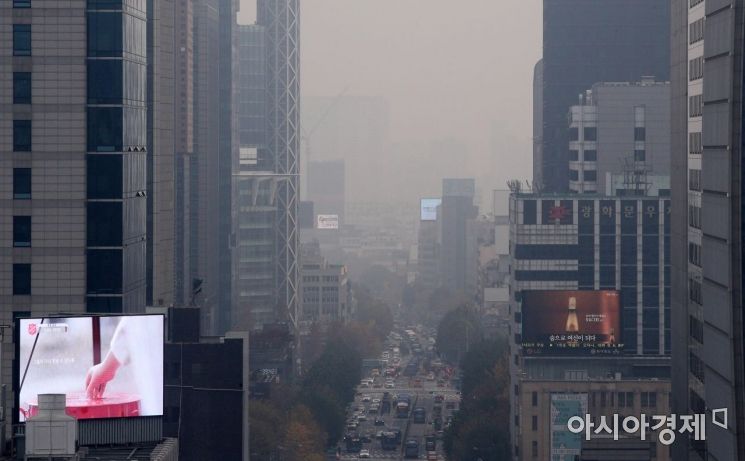 On the 19th, when fine dust concentrations reached 'bad' levels in various parts of the metropolitan area, the downtown area of Seoul appeared hazy. The Korea Meteorological Administration forecasted that fine dust concentrations would be 'bad' in the metropolitan area, Gangwon Yeongseo, Chungcheong region, Daegu, and Gyeongbuk, while other regions would experience 'moderate' levels. Photo by Kim Hyun-min kimhyun81@
[Asia Economy Reporter Kim Bong-su] A study has found that inhaled ultrafine dust particles penetrate deep into the lungs and can remain there for up to four weeks.
The Korea Basic Science Institute (KBSI) announced on the 23rd that the research team led by Dr. Hong Gwan-su and Dr. Park Hye-seon from the Bio Convergence Research Division confirmed this fact by producing model particles of ultrafine dust and nano fine dust and using fluorescence imaging technology to observe the biodistribution patterns of particles injected into the human body.
Particles smaller than 100 nm (0.1 μm) are called "nano fine dust," which are about 1/100th the size of fine dust particles and are predicted to penetrate deeper into the human body than ultrafine dust. However, research results clearly presenting the effects of these smaller particles on the human body have not yet been established domestically or internationally.
The research team produced fluorescent imaging-capable model substances of ultrafine dust and nano fine dust, injected them into living organisms, and compared and analyzed the migration routes by organ and the accumulation amounts of fine dust at the cellular level for up to one month. When nano fine dust particles were injected into the bronchi and the amount of particles remaining in the lungs was observed, it was confirmed that the nano fine dust decreased more rapidly compared to ultrafine particles. Some of these particles penetrated deeply into lung cells and were observed to move along blood vessels to other organs such as the liver and kidneys. The time taken for nano fine dust to spread to other organs was observed to be as short as within two days. Notably, immune cells present in the pulmonary organs retained nano fine dust particles inside the cells even after four weeks, with the number being eight times greater than that of ultrafine particles.
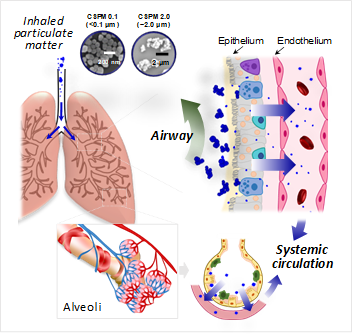
This study was conducted using relatively stable model particles that do not degrade within the body to observe and analyze the migration paths of fine dust particles over a long period in vivo. The research team explained that when hydrocarbon-type fine dust particles that degrade inside the body and cause toxicity are injected, the toxicity to various organs and the immune system, as well as the induction of diseases and disruption of the immune system, could be significant.
The model substances created this time were experimented with in a spherical shape but with different particle sizes. Since actual fine dust encountered in daily life cannot be specifically shaped and may have adsorbed toxic substances, which could have more harmful effects on the human body than ultrafine dust, the production and utilization of model substances reflecting various characteristics are expected to greatly contribute to accurately predicting the effects of fine dust on living organisms and developing reduction technologies in the future.
The results of this study were published on the 12th in the international academic journal “Journal of Nanobiotechnology.”
© The Asia Business Daily(www.asiae.co.kr). All rights reserved.


















