1.6 Trillion KRW Cut in 2nd Supplementary Budget This Year Under Spending Restructuring
Defense Minister Says "No Problem"
Experts: "Timing Adjustment Possible for DAPA Weapon Purchases"
National Assembly Expresses Concerns Over Exchange Rates and Project Deployment Timing
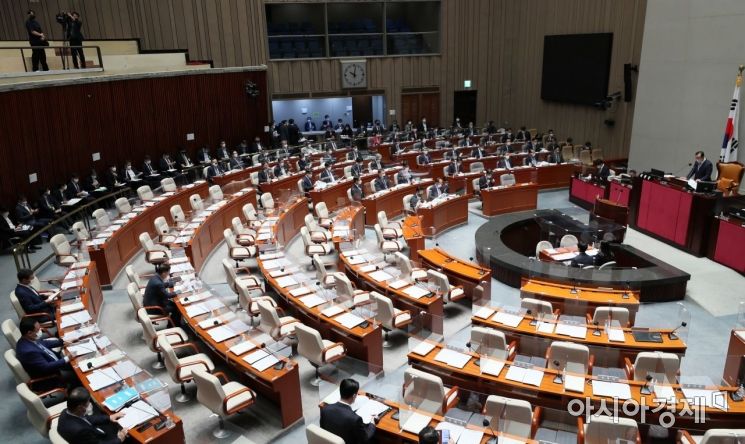 On the 20th, during the plenary meeting of the Budget and Accounts Committee held at the National Assembly amid the peak of local election campaigns, many lawmakers' seats were empty. Photo by Yoon Dong-joo doso7@
[Asia Economy Reporter Naju-seok] This year’s second supplementary budget review brought the issue of tax revenue projections to the forefront, but the reduction of defense spending became an equally contentious topic. The government’s supplementary budget funding plan included a cut of 1.6 trillion KRW in defense-related budgets out of a 7 trillion KRW expenditure restructuring proposal.
Regarding this budget cut, members of the National Defense Committee from the Democratic Party of Korea (DPK) refused to review the budget, claiming it threatened national security. Ki Dong-min, the DPK’s defense committee spokesperson, stated in a press release on the 18th, "The government reduced the defense budget by 1.5068 trillion KRW in this supplementary budget, including 951.8 billion KRW for operational expenses and 555 billion KRW for defense capability improvement. While pushing for a 7 trillion KRW expenditure restructuring to secure supplementary budget funds, about 23%, roughly one-quarter, was secured through cuts to the defense budget." He condemned the move, saying, "Not only are they borrowing taxes in advance under the guise of fiscal soundness, but they also slashed the defense budget in large chunks." Consequently, DPK defense committee members agreed that "further review of the supplementary budget is meaningless."
However, the Ministry of National Defense maintains that these budget cuts do not pose any problems for defense. On the 20th, during the plenary session of the National Assembly’s Budget and Accounts Special Committee, when DPK lawmaker Jeon Hye-sook questioned, "Is there no problem even with such cuts?" Defense Minister Lee Jong-seop replied, "No, there isn’t."
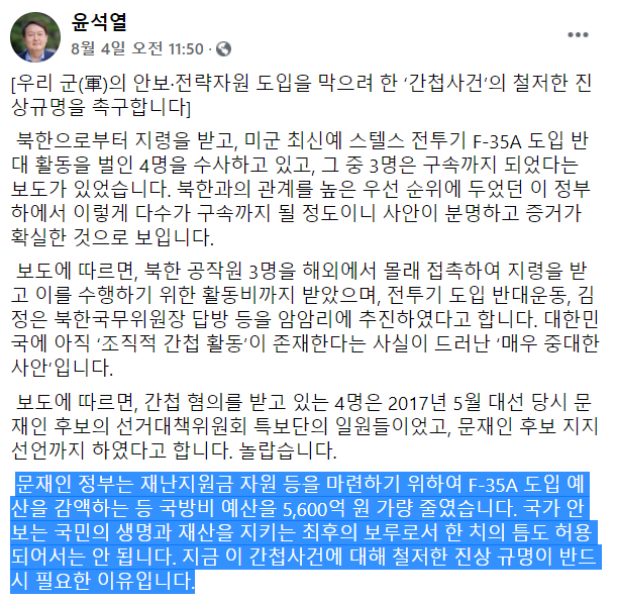
In fact, a similar incident occurred last year. During the second supplementary budget process, the Defense Acquisition Program Administration (DAPA) budget was cut, including 92 billion KRW for the F-35 procurement and a total of 562.9 billion KRW in defense spending. Then-presidential candidate Yoon Seok-yeol (People Power Party) stated on social media, "The Moon Jae-in administration cut about 560 billion KRW in defense spending, including reductions in the F-35A procurement budget, to secure resources for disaster relief funds," emphasizing, "National security is the last bastion protecting the lives and property of the people and must not allow any gaps."
However, President Yoon himself submitted a supplementary budget to the National Assembly shortly after taking office that included significant cuts to defense spending.
Is this defense budget cut really without problems?
Regarding this, analysis of opinions from related agencies and research institutes on the specific projects affected by the budget cuts reveals differing views.
Looking at the projects with reduced budgets, 1.06 trillion KRW was cut across 54 detailed projects in the operational expenses sector, and 550 billion KRW was reduced in 56 defense capability improvement projects.
The cuts span from uniforms to advanced weapons procurement projects. According to preliminary reports from the National Defense Committee, basic uniform projects such as combat uniforms, combat boots, and undergarments saw about 8.6 billion KRW cut during this second supplementary budget process. Additionally, 103.5 billion KRW was cut from housing and officer quarters budgets, and 55 billion KRW from barracks living quarters. Furthermore, 301.5 billion KRW was cut across 15 projects including mobility equipment, 135.9 billion KRW from the Maritime Patrol Aircraft-II project, 77.7 billion KRW from weapon system operability enhancement support, 57.5 billion KRW from Identification Friend or Foe (IFF) equipment performance upgrades, 52.6 billion KRW from maritime operation helicopters, and 40 billion KRW from the Submarine Rescue Ship-II project.
This issue also emerged as a key point in the supplementary budget review committee. DPK lawmaker Kim Byung-joo criticized it as "neglecting national security." The DPK-affiliated think tank, the Democratic Research Institute, also pointed out in a report that "The conservative government, which has emphasized national security, cutting 1.5 trillion KRW from the defense budget through expenditure restructuring is difficult to defend against criticism that it prioritizes other matters over security."
However, controversy continues regarding large-scale weapon system budgets. Lee Sang-min, senior research fellow at the Nara Salim Research Institute, explained in a report titled "Everything about the 2022 Second Supplementary Budget" that "When DAPA purchases weapons from the U.S., transactions are conducted through the Foreign Military Sales (FMS) account of the U.S. Department of Defense," adding, "It is possible to adjust timing based on the deposited funds in the FMS account and exchange gains after deposit." Previously, this researcher stated that when the F-35A procurement budget was cut in last year’s supplementary budget, "The DAPA budget cut has nothing to do with national security. It was a cut of exchange gains and bid savings," and "It was merely an advance recognition of unused funds that would be recognized at settlement anyway."
Of course, there are also voices of concern. The National Assembly Budget Office diagnosed, "Some defense capability improvement projects, such as the Submarine Rescue Ship-II project and the 4th GPS-guided bomb project, were cut due to reasons like delayed test evaluations and facility design delays, but it is necessary to thoroughly review whether these expenditure restructuring cuts might cause delays in weapon system acquisition and operationalization schedules." Although the budget was cut due to delayed test evaluations for the Submarine Rescue Ship-II project, the impact on future operationalization schedules needs to be examined. For the 4th GPS-guided bomb project, the budget cut was due to facility design delays, but efforts are needed to prevent delays in the overall project operationalization schedule. Budget cuts could potentially lead to project delays.
More fundamentally, the cuts under the name of expenditure restructuring may be only nominal expenditure restructuring. Expenditure restructuring implies cutting project budgets to reallocate funds elsewhere, but in the case of weapon procurement budgets, most of the cuts this year are shifted to next year or later budgets. It is like taking a stone from the bottom to prop up the top. The National Defense Committee noted in its preliminary supplementary budget review report that "Adjusting only the execution timing without reducing the total project cost means that from a mid-term perspective, the total amount the state must bear does not change, making it difficult to view this as genuine expenditure restructuring for resource procurement." Although it may be a shell game, considering exchange rates, the burden could increase.
Moreover, it was pointed out that if exchange rates rise sharply as recently, the burden could increase. According to the report, "In a situation where the won-dollar exchange rate is rising sharply, if the current upward trend continues next year, it is necessary to be aware that this could result in a greater fiscal burden."
© The Asia Business Daily(www.asiae.co.kr). All rights reserved.


















