Forecast: Block Deal Sale of Woori Financial Shares Also Has Negative Impact
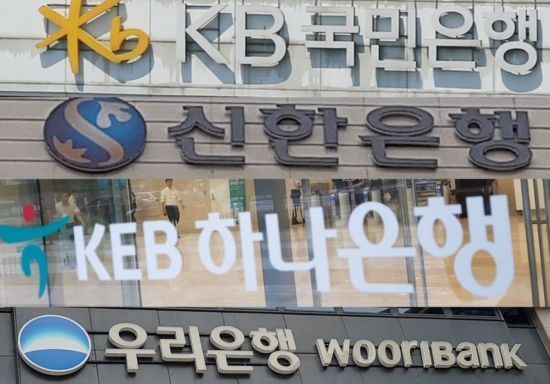
[Asia Economy Reporter Minwoo Lee] The stock prices of domestic banks continue to show sluggish performance. This is attributed to the increasing possibility of an economic recession, which offsets the effects of interest rate hikes and reduces expectations for further growth.
On the 22nd, Hana Financial Investment analyzed the stock prices of domestic banks in this manner. Last week, major bank stocks fell by an average of about 1.4%, significantly underperforming the KOSPI return of 1.3%. Jungwook Choi, a researcher at Hana Financial Investment, explained, "When major U.S. retailers such as Walmart and Target reported poor earnings due to cost burdens from rising prices, inflation fears spread and concerns about an economic recession were triggered," adding, "As a result of a preference for safe assets, investment demand flowed into U.S. Treasury bonds, leading to a continued decline in U.S. Treasury yields."
In fact, the U.S. 10-year Treasury yield fell by 14 basis points (bp; 1bp=0.01%) to 2.79% over the past week. It has dropped 35bp over the last two weeks. Meanwhile, the 2-year Treasury yield remained steady at 2.59% for two consecutive weeks, narrowing the yield spread between short- and long-term bonds to around 20bp.
Additionally, domestically, the Korea Deposit Insurance Corporation's block trade of a 2.33% stake in Woori Financial Group and Morgan Stanley Capital International (MSCI)'s withdrawal of its planned weighting increase also had a negative impact. Previously, MSCI had announced plans to raise Woori Financial's free float ratio but withdrew this on the 18th.
Researcher Choi stated, "The government plans to supply 20 trillion KRW of Safe Conversion Loans this year to ease the burden on borrowers with variable-rate mortgage loans and may supply up to an additional 20 trillion KRW next year, considering interest rates, market conditions, and budget," adding, "This could affect loan growth in the banking sector, but since the interest rate attractiveness is lower compared to the past, the actual effect remains to be seen."
© The Asia Business Daily(www.asiae.co.kr). All rights reserved.

















