Proposals for Startup Collaboration Expansion, Customized Entry by Urban and Rural Characteristics, and Segmented Consumer Market Targeting
[Asia Economy Reporter Park Sun-mi] Although China's economic growth has noticeably slowed, this is part of the transition from quantitative growth to qualitative growth, and there are claims that Korean companies need to reassess their strategies for entering the Chinese market.
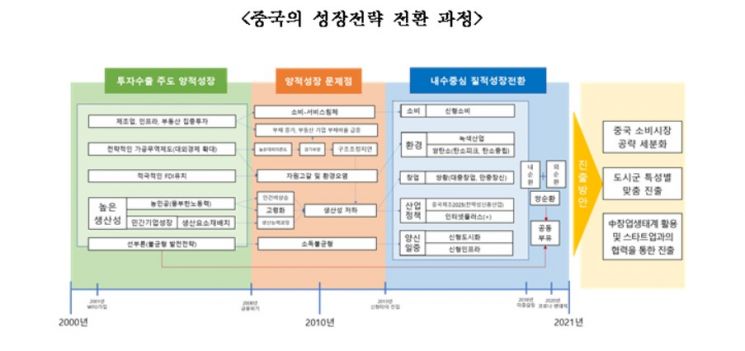
According to the "China's Growth Strategy Transition and Response Strategies for Our Companies" report released on the 23rd by the Korea International Trade Association's International Trade and Commerce Research Institute, China achieved rapid quantitative growth in the 2000s driven by investment and exports. However, facing various issues such as social imbalance, environmental pollution, and resource depletion, China shifted its policies toward qualitative growth from the 2010s. In this process, the slowdown in China's economic growth was inevitable, and recently, it has also encountered unexpected domestic and international adversities such as the pandemic, trade disputes with the United States, and the launch of the Indo-Pacific Economic Framework (IPEF).
The report analyzed, "China's transition to a qualitative growth economy is both a process of economic development and a survival strategy to avoid the middle-income trap," adding, "Rather, due to these domestic and international environmental changes, China feels an even more urgent need for qualitative growth and will continue to pursue related policies."
Since China is expected to continue its qualitative growth policies despite enduring economic growth slowdown, it advised that South Korea, which has a high trade dependence on China, needs a sustainable export strategy aligned with China's policy direction. It emphasized that Korean companies should focus on three key strategies for entering the Chinese market: ▲collaborative entry with startups, ▲customized entry based on characteristics of urban clusters, and ▲segmentation of consumer market targeting.
The proportion of university student startups in China is 9.4%, indicating a very active startup ecosystem. Especially as the Chinese government is increasing support for startups and small and medium enterprises under the common prosperity (wealth redistribution) policy, the report advised that entry through cooperation with Chinese innovative companies would be promising.
Additionally, due to China's rapid urbanization, entry into fields such as agricultural technology improvement, resource development, and energy efficiency, which can address environmental pollution and resource shortages, is expected to be promising.
An Byeong-seon, senior researcher at the Korea International Trade Association, emphasized, "The slowdown in China's economic growth has been ongoing for a long time due to the shift in growth strategy," and added, "China's transition to qualitative growth is a key task for sustainable growth, and our companies also need to reassess their entry strategies."
© The Asia Business Daily(www.asiae.co.kr). All rights reserved.

















