
[Asia Economy Reporter Park Byung-hee] With the Australian Labor Party, which introduced a strong carbon tax policy 10 years ago, regaining power after 9 years, significant changes are expected in Australia's environmental policy.
According to the vote count results reported by AP News on the 22nd, citing Australian ABC Broadcasting, with 67% of the votes counted, the Labor Party secured 71 seats. The ruling Liberal-National Coalition managed to secure only 52 seats. The number of seats for the Liberal-National Coalition significantly decreased from 76 seats in the 2019 general election. Although the Labor Party's seats, which were 68 in the 2019 general election, did not increase significantly, the number of seats held by independents and minor parties increased substantially. Minor parties and independent candidates secured a total of 15 seats, including the Greens with 3 seats.
The Labor Party succeeded in regaining power after 9 years, having lost the government in the 2013 general election. Attention is focused on whether the carbon tax policy, abolished by the Liberal-National Coalition government, will be reinstated.
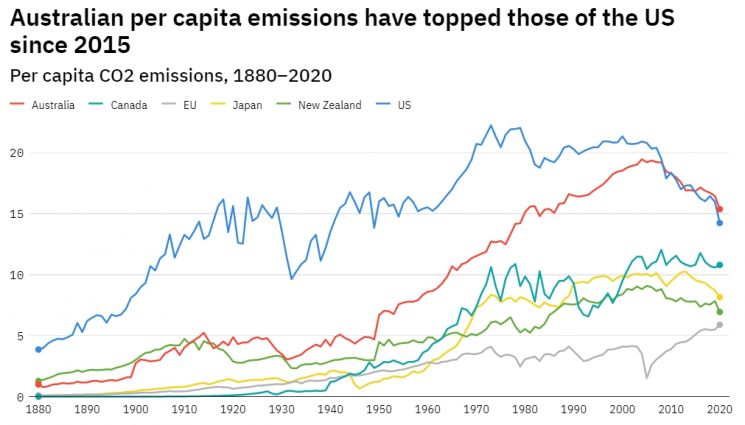
Australia is a country with high per capita carbon dioxide emissions. According to Our World in Data, the per capita carbon dioxide emissions in 2020 were 15.97 tons, higher than the United States (14.24 tons). It was double that of China (7.41 tons) and triple that of the European Union (EU, 5.71 tons).
Australia generates 60% of its electricity through coal power. The mining industry accounts for 7% of the gross domestic product (GDP) and half of the exports.
The Labor Party introduced a fixed-price carbon tax in July 2012 during its previous administration. At that time, the plan was for the top 500 carbon-emitting companies to pay 23 Australian dollars per ton in the first year, with the price increasing by 2.5% annually over the next three years. However, the introduction of the carbon tax became a boomerang that hindered the Labor government.
The Labor Party revealed the final plan in July 2011, one year before the carbon tax implementation, setting the standard at 23 Australian dollars per ton.
The European Union (EU), which has the world's largest carbon emissions trading market, had a carbon permit price of 15 euros per ton in early 2011, similar to 23 Australian dollars. However, the EU carbon permit price fell below 10 euros per ton immediately after the Australian government announced the final carbon tax plan. When the carbon tax policy was actually implemented, Australian companies paid much higher carbon taxes than European companies, sparking controversy.
At that time, the Australian opposition party attacked the government, arguing that the carbon tax increased the economic burden on citizens and households, and succeeded in regaining power in the September 2013 general election. The Liberal-National Coalition abolished the carbon tax in July 2014, the year after taking office.
The carbon tax remained a subject of political conflict even after its abolition. The famous anecdote of former Prime Minister Scott Morrison bringing a lump of coal to parliament in 2017 is well known. Morrison, who was then the Treasurer, said, "This is coal. Do not fear or be afraid. Coal does not harm you. This coal was mined where opposition party supporters live."
Anthony Albanese, leader of the Labor Party, who succeeded in regaining power and announced that he plans to take the prime ministerial oath on the 23rd, pledged a carbon emissions trading system.
Albanese stated that emissions from large greenhouse gas emitters would be capped. Companies exceeding the limit would be forced to purchase carbon permits. Conversely, companies emitting within the limit would be able to earn money through permits. He said the annual emission cap would be gradually lowered.
Albanese also plans to raise the 2030 greenhouse gas reduction target.
The Liberal-National Coalition faced international criticism for setting a lower 2030 greenhouse gas reduction target compared to other countries. The coalition announced that greenhouse gas emissions would be reduced by 26-28% from 2005 levels by 2030. This target is much lower than the UK’s 68%, the EU’s 55%, and the US’s 50-52%.
Albanese pledged to reduce emissions by 43% from 2005 levels by 2030. The Greens set a target of 60% reduction.
In recent years, as natural disasters have increased in Australia, climate change has emerged as a key factor influencing the general election results. Victoria and New South Wales suffered significant damage from large wildfires at the end of 2019 and early 2020. More than 2,000 homes were damaged by the fires, and at least 34 people died. Earlier this year, the entire eastern states, including Queensland and New South Wales, suffered severe damage from the worst floods on record.
© The Asia Business Daily(www.asiae.co.kr). All rights reserved.


















