-The South Korea-US leaders repeatedly emphasize the ‘economic security’ alliance… united voices on ‘supply chain recovery and expansion’
-Joint confirmation of denuclearization goals, South Korea-US alliance evolves into economic security
-President Yoon: "Deterrence against North Korea is important… timely deployment of strategic assets also discussed"
-President Biden: "The South Korea-US alliance is stronger than ever… strengthening supply chains to gain competitive advantage"
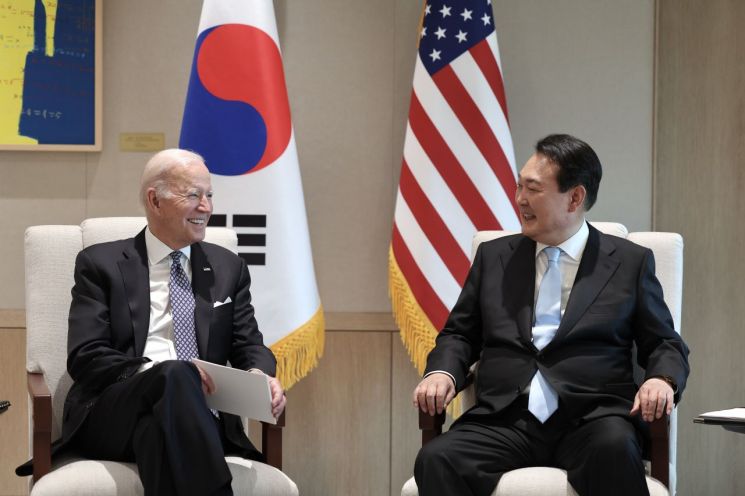
[Asia Economy Reporter Bae Kyunghwan] U.S. President Joe Biden concluded his three-day, two-night visit to South Korea on the 22nd and departed for Japan. Around 2:25 p.m. that day, President Biden finished his visit to the Korea Aerospace Operations Center (KAOC) located at Osan Air Base in Gyeonggi Province. President Yoon Seok-yeol accompanied him during the KAOC visit, emphasizing the strong South Korea-US alliance and encouraging South Korean and US troops. The Blue House stated, "When President Biden’s vehicle departed, the two leaders gave each other a thumbs-up greeting." On his way to Japan after completing his visit to South Korea, President Biden was seen off by Foreign Minister Park Jin.
Throughout the three-day visit, Presidents Yoon and Biden emphasized strengthening the South Korea-US alliance. Biden’s visit came just ten days after President Yoon’s inauguration, marking the fastest visit by a U.S. president following a South Korean president’s inauguration, which was highly significant. Choosing South Korea as his first Asian tour destination, President Biden held summit talks focusing on three main agendas: joint South Korea-US responses to North Korean provocations, economic security cooperation, and South Korea’s contributions to international issues.
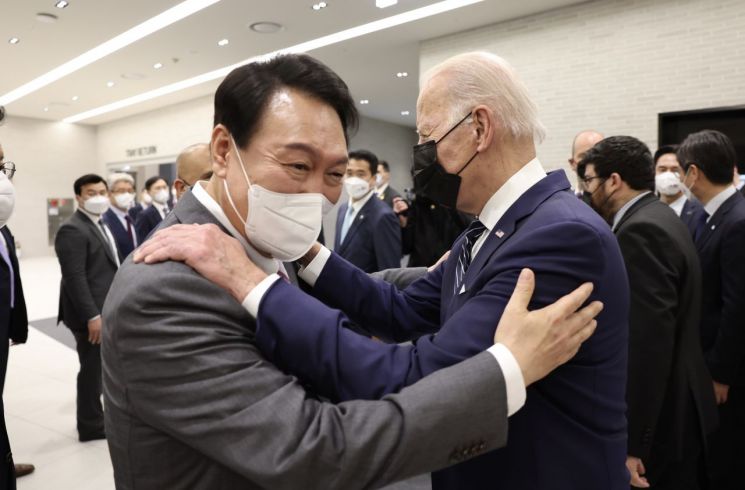
◆South Korea-US alliance begins at semiconductor factory= President Biden arrived in South Korea on the afternoon of the 20th at around 5:30 p.m. via Osan Air Base in Gyeonggi Province, where he was welcomed by Foreign Minister Park Jin before moving to Samsung Electronics’ Pyeongtaek plant. President Yoon, departing from his office in Yongsan, Seoul, arrived at the Pyeongtaek plant first at about 5:54 p.m., where Samsung Electronics Vice Chairman Lee Jae-yong greeted him.
President Biden toured the 22 production lines with Vice Chairman Lee, guided by President Yoon. Biden praised, "I saw the site producing the world’s best semiconductor chips," and President Yoon stated, "Semiconductors are national security assets that will secure our future," adding, "We plan to provide bold incentives and necessary support without hesitation."
In a joint speech, President Yoon expressed hope that "the South Korea-US relationship will be reborn as an economic security alliance based on advanced technology and supply chain cooperation." He evaluated President Biden’s visit to the Pyeongtaek campus as a valuable opportunity to reflect not only on economic and security significance but also on the meaning of a global comprehensive strategic alliance.
President Yoon repeatedly emphasized the importance of the semiconductor industry in the South Korea-US relationship. He explained, "Semiconductors are essential components for all advanced industries such as autonomous vehicles, AI (artificial intelligence), and robotics, and are key elements determining future technological competitiveness," adding, "South Korea supplies 70% of the world’s memory semiconductors and plays a pivotal role in the global semiconductor supply chain."
President Biden introduced, "The U.S. offers a highly skilled workforce and entrepreneurial spirit of innovation," and "In the U.S., many companies expect protection for their ideas and investments." He continued, "We must accelerate efforts to solve supply chain resilience issues together with allied countries that share values like South Korea," emphasizing, "Cross-border cooperation among multiple countries is important, and strengthening long-term resilience and competitiveness through such relationships will be possible."
He also highly evaluated South Korea’s status in the semiconductor industry. President Biden said, "South Korea has the world’s most advanced semiconductor production complex and holds many advantages in design and production," adding, "Semiconductors are a vital driver of our economy, playing significant roles especially in smartphones and medical diagnostic devices."
Mention of supply chain expansion, a core agenda of the summit, was not omitted. President Biden analyzed that the Ukraine war has disrupted global supply chains and stressed the importance of cross-border cooperation among multiple countries to restore supply chains.
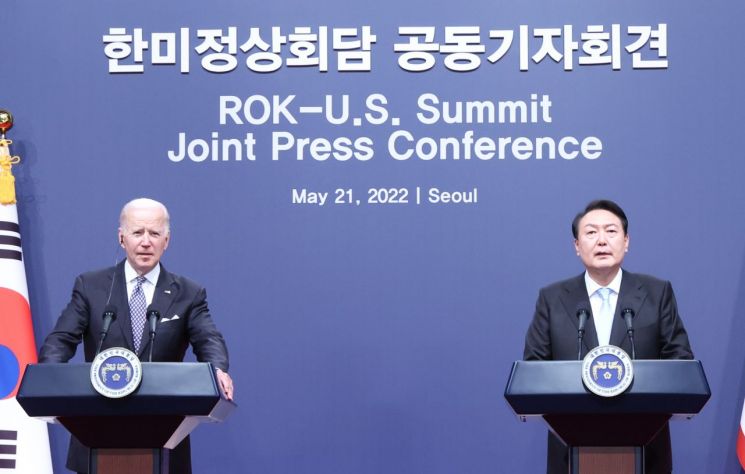
◆South Korea-US alliance as an active alliance… Summit focuses on ‘North Korea and economic security’= The talks, which began on the afternoon of the 22nd at the 5th-floor office of the government building, proceeded in the order of a small-group meeting, informal talks, and expanded talks. The core agendas included strengthening the South Korea-US security alliance, responding to North Korea’s nuclear threats, economic security, and regional cooperation.
The two countries announced summit outcomes centered on strengthening practical extended deterrence against North Korea, economic security cooperation based on the South Korea-US alliance, and establishing regional order through the Indo-Pacific Economic Framework (IPEF). The two leaders agreed to build a new South Korea-US alliance relationship focused on economic security and to jointly respond to market shocks caused by changes in the international order. To this end, they decided to establish an economic security dialogue between their presidential offices to communicate and cooperate frequently in economic security fields such as supply chains and advanced science and technology.
President Yoon particularly emphasized, "We shared the goal of developing the South Korea-US alliance into a global comprehensive strategic alliance." He stated, "We now face new challenges such as the long-standing task of North Korea’s denuclearization, the pandemic crisis, changes in trade order and supply chain restructuring, climate change, and the crisis of democracy," adding, "As a comprehensive strategic alliance, we will respond to these challenges together."
During the talks, the two leaders reaffirmed their commitment to extended deterrence against North Korean provocations and agreed to reactivate the high-level Extended Deterrence Strategy and Consultation Group (EDSCG). President Yoon called this "the first step, participation in the Indo-Pacific Economic Framework (IPEF)," to which President Biden responded, "Now is the time when the South Korea-US alliance is stronger and more vibrant than ever."
President Biden mentioned his visit to Samsung’s semiconductor plant in Pyeongtaek with President Yoon the previous day, highlighting the importance of supply chain cooperation between the two countries. He explained, "The world’s best semiconductors are being developed through innovation in South Korea and the U.S.," adding, "Companies like Samsung in South Korea are currently investing billions of dollars in the U.S." He continued, "Through this, we will become closer and cooperate more closely," and "We will strengthen our supply chains and prepare for shocks to maintain our competitive edge."
To this end, South Korea and the U.S. agreed to newly launch an ‘economic security dialogue’ between their presidential offices to communicate and cooperate frequently in economic security fields such as supply chains and advanced science and technology. Additionally, the two countries’ nuclear power industries will jointly work to develop and promote exports of new reactors and small modular reactors (SMRs). They also initiated consultations on the ‘Defense Mutual Procurement Agreement,’ which can be considered a free trade agreement (FTA) in the emerging defense industry sector.
They planned to expand space exploration cooperation and resume the ‘South Korea-US Civil Space Dialogue’ to develop cooperation beyond space technology into the space industry. The U.S. also confirmed its willingness to support the development of the ‘Korean Positioning System (KPS)’ during the talks. President Yoon explained, "By regularizing the South Korea-US Civil Space Dialogue, we expect to discover various cooperation agendas such as technology exchange in the space sector."
The two leaders agreed, "The South Korea-US Free Trade Agreement (FTA), which marks its 10th anniversary this year, remains the foundation of the economic relationship between the two countries," and "Based on shared values of fair and market-based competition, we will jointly respond to market distortion practices."

◆President Yoon and President Biden emphasize the South Korea-US alliance at Osan US military base= On the 22nd, the last day of his visit, President Biden emphasized the importance of strengthening the South Korea-US alliance during his visit to the Korea Aerospace Operations Center (KAOC) at Osan US Air Force Base in Gyeonggi Province. In his encouragement speech, President Biden expressed gratitude for the hard work of the troops who uphold the long-standing South Korea-US alliance.
He said, "(You all) are those who carry out such precious missions on the front lines, and I am very pleased that the two countries innovate and coordinate here to accomplish important tasks," adding, "As you know, the alliance between the two countries was forged through sacrifices in a long-ago war, and even after 70 years, thanks to the service of excellent troops like you, the South Korea-US alliance remains strong." He continued, "Coordination and integration between the two countries are very important goals not only in the past but also now. I believe that maintaining stability on the Korean Peninsula and in the region is important not only for the Korean Peninsula but also for world peace."
President Yoon also said, "(The South Korean Special Operations Forces troops and the U.S. 7th Air Force Command troops) are all friends. Since U.S. troops serve far from their beloved families and friends in a foreign country, our troops should treat them even more closely," urging, "Your friendship and camaraderie are the strength of the South Korea-US alliance."
President Yoon emphasized the historical and geographical importance of Osan US Air Base. He explained, "Osan Base is where the Communist forces invaded on June 25, 1950, and five days later, President Truman ordered the deployment of U.S. troops. The Swiss unit came here first and engaged the Communists," adding, "This area near Osan is where the U.S. troops first shed blood for the freedom of the Republic of Korea, and after the war, the U.S. Air Force operated the base."
President Yoon and President Biden concluded their KAOC visit around 2:25 p.m. that day and exchanged farewells. The Blue House spokesperson’s office stated, "When President Biden’s vehicle departed, the two leaders gave each other a thumbs-up greeting." After completing his three-day, two-night visit to South Korea, President Biden encouraged the U.S. troops stationed at Osan Air Base and departed for Japan, accompanied by Foreign Minister Park Jin.
© The Asia Business Daily(www.asiae.co.kr). All rights reserved.
!["The Woman Who Threw Herself into the Water Clutching a Stolen Dior Bag"...A Grotesque Success Story That Shakes the Korean Psyche [Slate]](https://cwcontent.asiae.co.kr/asiaresize/183/2026021902243444107_1771435474.jpg)


















