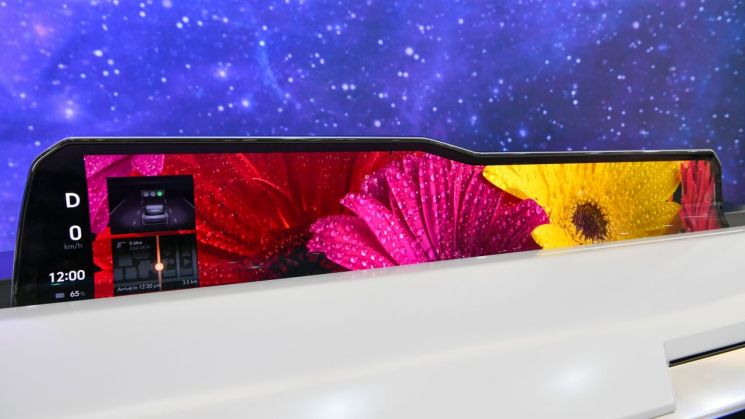
[Asia Economy Reporter Choi Dae-yeol] Hyundai Mobis announced on the 22nd that it has developed variable display technology applicable to next-generation integrated cockpit systems. The equipment can implement various driving information as well as 3D stereoscopic navigation and infotainment functions, and the company expects to secure a competitive edge in the fiercely competitive future vehicle display market.
The variable display developed by the company is optimized for autonomous vehicles and features a curved screen that moves. The screen moves up and down, also called a swivel display. It is a 34-inch ultra-large screen equipped with a 6K-class OLED panel with ultra-high resolution. The 34-inch size is currently the largest screen among vehicle displays, which have stringent quality requirements such as durability and reliability.
Additionally, the ultra-large screen is developed as a curved screen that bends in three stages from top to bottom. The company explained, "It enhances visibility and adds aesthetic effects."
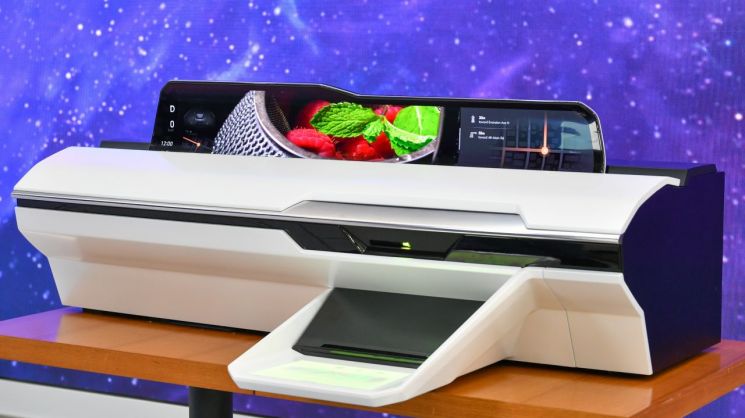
The display extends widely from the driver's seat to the passenger seat, enabling the implementation of various content. If necessary, it can be rotated inward to be used as a small screen displaying only the minimum information needed for driving, securing a sense of openness. It can be operated via touchscreen and motion recognition.
During the development of this new technology, the company filed 10 domestic and international patents. Patents were applied for in areas such as technology for aligning the swivel display, position control, and integrated cockpit design. Jung Soo-kyung, Vice President and Head of the Electronics BU at Hyundai Mobis, said, "We will continuously introduce converged new technologies optimized for future mobility by combining advanced technologies with our existing core component technology capabilities."
Previously, the company unveiled the M.Vision X, a future urban shared mobility concept, showcasing technology that utilizes the entire 360-degree glass of the vehicle as a display. It also secured augmented reality head-up display (AR HUD) technology that projects driving information in real-time onto the front windshield by matching it with the forward road.
© The Asia Business Daily(www.asiae.co.kr). All rights reserved.


















