[Asia Economy Reporter Yoo In-ho] In the joint Seoul statement, the South Korea-US leaders sent a strong warning message to North Korea through measures such as ‘expansion of ROK-US combined exercises’ and ‘reconfirmation of deployment of US strategic assets.’
The two countries presented a more solid and concrete plan to jointly deter and respond to North Korea’s heightened nuclear and missile threats.
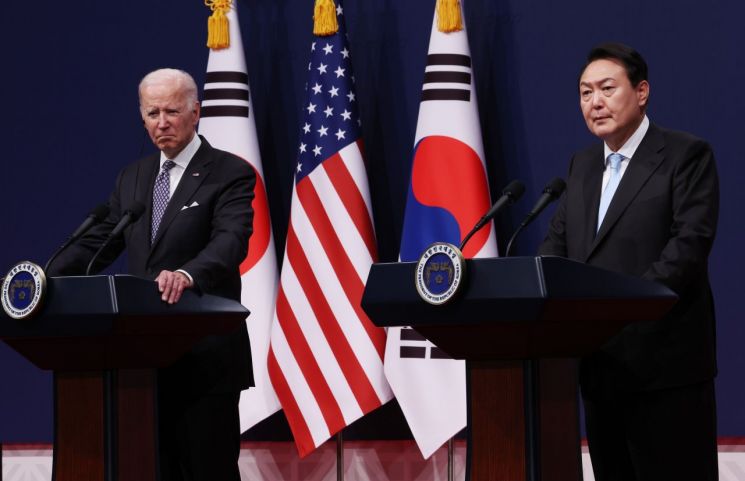
This appears to reflect the recognition of both leaders that the ROK-US alliance needs to respond preemptively in the situation where North Korea threatens a preemptive strike with tactical nuclear weapons.
On the 21st, regarding North Korea policy, the South Korea-US leaders agreed to start consultations to expand combined exercises and training to strengthen the combined defense posture, to reactivate the Extended Deterrence Strategy and Consultation Group (EDSCG), and to reconfirm the deployment of US strategic assets. Earlier, President Yoon Suk-yeol and President Joe Biden stated this in the ‘ROK-US Leaders Joint Statement’ released after their summit at the Yongsan Presidential Office in Seoul.
What draws attention here is the discussion on the necessity of combined exercises to respond to the North Korean nuclear threat. President Yoon said at the press conference held after the summit, “There was also discussion on whether combined exercises between the two countries to prepare for a nuclear attack are necessary in various ways.”
Accordingly, the defense authorities of South Korea and the US are expected to soon begin discussions on plans for combined exercises to respond to a North Korean nuclear attack.
The combined exercises to prepare for a nuclear attack are expected to be subdivided into areas such as surveillance of North Korea’s nuclear facilities and bases, detection of signs of nuclear use, and destruction in case of actual use, with exercise and training plans prepared accordingly.
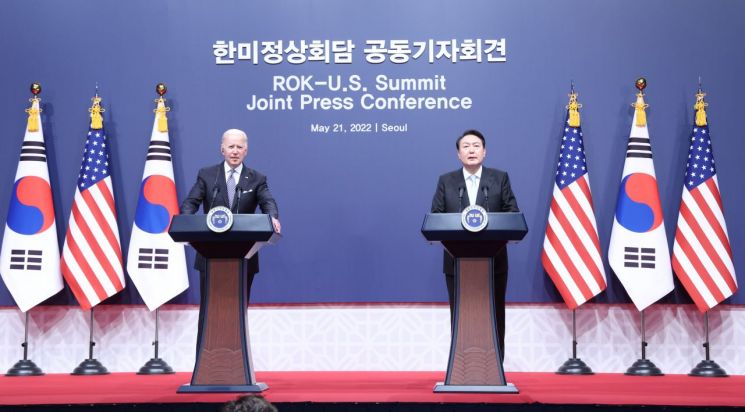
It is also noteworthy that discussions have been agreed to start on expanding the scope and scale of combined exercises and training. The joint statement of the two leaders specifies the scope as ‘on the Korean Peninsula and its surroundings.’ This means that combined exercises will be frequently conducted in the East Sea, West Sea, and South Sea international waters as well. The Presidential Office described the ROK-US combined exercises as ‘normalization of ROK-US combined exercises.’
Another achievement of this summit is that the extended deterrence capabilities provided by the US to South Korea in case of emergency were specifically stated as ‘nuclear, conventional, and missile defense.’ In the situation where North Korea mentions the possibility of preemptive use of tactical nuclear weapons, this is interpreted as a clear message to North Korea that ‘nuclear will be met with nuclear.’
Furthermore, the two leaders agreed to reactivate the Extended Deterrence Strategy and Consultation Group (EDSCG), which was suspended during the Moon Jae-in administration, at an early date. The EDSCG, established in December 2016 for strategic and policy consultations on extended deterrence against North Korea, has not convened since its second meeting in January 2018.
Experts explain that if the EDSCG is reactivated, it will be possible to timely discuss the deployment of US strategic assets during heightened crises on the Korean Peninsula, thereby enhancing the effectiveness of extended deterrence.
Also, through coordination between the two countries, the leaders reconfirmed the timely deployment of US strategic assets and agreed to identify additional deterrence measures against North Korea through follow-up consultations such as the EDSCG. The strategic weapons to be deployed on the Korean Peninsula include the US’s three major long-range bombers: B-52H, B-1B, and B-2. Immediate deployment is expected if North Korea conducts major provocations such as nuclear tests or intercontinental ballistic missile (ICBM) launches.
US media also reported in detail on the results of the ROK-US summit on the 21st (local time), noting a clear difference in tone compared to previous administrations’ North Korea policies.
In particular, contrasting former President Donald Trump and President Biden, they evaluated that since the ROK-US leaders agreed on the complete denuclearization of the Korean Peninsula and principled responses to North Korean provocations, the door for diplomatic solutions may become narrower.
However, attention was also drawn to whether the issue of vaccine support to North Korea, highlighted amid the recent spread of COVID-19 in North Korea, could provide a breakthrough to the stalled dialogue.
The Washington Post (WP) introduced, “The two leaders agreed to expand ROK-US combined exercises, which North Korea has shown resistance to,” and “President Biden meeting President Yoon, who had been in office just over a week, first shows the importance the US places on its relationship with South Korea.”
WP reported, “The two leaders agreed to expand cooperation in other areas such as cyberattacks as well as military exercises to deter North Korea,” and “Since North Korea’s collapse of North Korea-US talks in 2019, North Korea has strongly opposed US-led sanctions and ROK-US combined exercises, labeling them hostile acts.”
© The Asia Business Daily(www.asiae.co.kr). All rights reserved.


















