Expecting a Second Alabama Effect
Revitalizing Domestic Parts Industry through Overseas Complete Vehicle Production
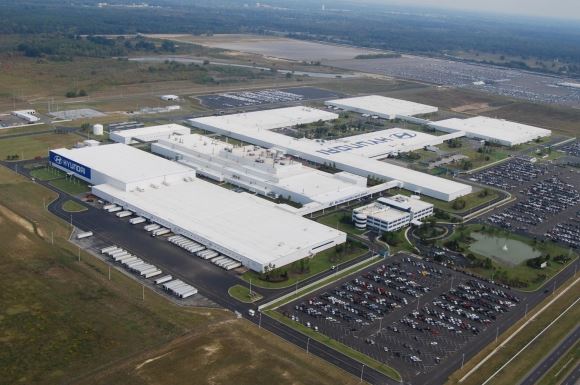
[Asia Economy Reporter Yoo Hyun-seok] Hyundai Motor Group is building a new electric vehicle (EV) production plant in the state of Georgia, USA. Hyundai Motor Group expects that the dedicated EV plant in the U.S. will not only boost the extensive related industries in Korea but also create new added value.
On the 21st, Hyundai Motor Group announced that it will invest 6.3 trillion KRW to establish an EV-dedicated plant and a battery cell plant in Georgia, USA. The plan is to build a factory capable of producing 300,000 EVs annually in Georgia, aiming to start operations in the first half of 2025.
◆ Response to the Buy American Policy = Hyundai Motor Group's investment in the U.S. is a strategic decision to respond to the U.S. government's stringent 'Buy American' policy. It is also aimed at growing as a top-tier player in the global EV market, particularly in the U.S., a key market.
Hyundai Motor Group also expects that the dedicated EV plant in the U.S. will foster the growth of Korea's extensive related industries and create new added value. Local EV production in the U.S. is anticipated to generate positive public opinion, quickly reflect customer needs, enhance brand trust, and promote sales growth. Additionally, it is expected to increase exports of EVs from domestic plants supplying products to the U.S. market alongside the local factory.
Hyundai Motor Group explains that overseas production of finished vehicles enhances local brand value and increases demand, leading to a virtuous cycle of growth that includes increased domestic production and exports, as well as revitalization of the domestic parts industry. In fact, compared to 2004, the year before Hyundai and Kia's global management began in earnest in 2005, domestic finished vehicle production by the two companies increased by 12% in 2021, finished vehicle export value rose by 79%, and domestic employment grew by 26%. During the same period, domestic automotive parts exports surged by 279%.
The U.S. dedicated EV plant is expected by the automotive industry to replicate the 'Second Alabama Effect.' Since the start of operations at Hyundai's first U.S. finished vehicle plant in Alabama in 2005, exports of finished vehicles to the U.S. have increased significantly, and the global expansion of the domestic parts industry has been activated.
Hyundai Motor Group's first U.S. production base, the Alabama plant, played a major role in increasing local sales by effectively removing tangible and intangible barriers such as tariffs and enhancing brand value in the U.S. market. It also positively impacted sales of high value-added vehicles exported from Korea, increasing domestic finished vehicle export value. Premium SUVs such as the Palisade and Genesis brand products produced domestically performed well in the U.S. market. As a result, Hyundai and Kia's U.S. finished vehicle export value rose 52% from $9.18 billion (approximately 11.65 trillion KRW) in 2004 to $14 billion (approximately 17.77 trillion KRW) last year.
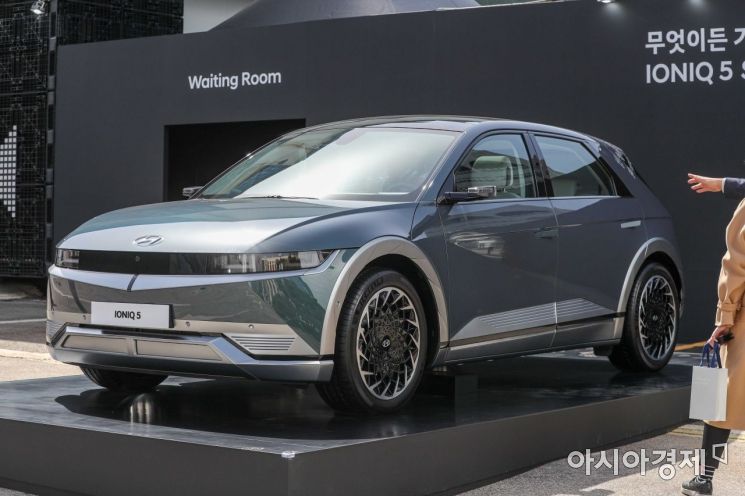 On the 17th, the 'Ioniq 5' was unveiled at Hyundai Motor Company's Wonhyo-ro building in Yongsan-gu, Seoul. Photo by Jinhyung Kang aymsdream@
◆ U.S. Dedicated EV Plant Presents Opportunities for Domestic Parts Suppliers = Hyundai Motor Group expects that the U.S. dedicated EV production base will also provide new opportunities for domestic parts suppliers struggling to respond to the electrification transition in the global automotive industry. It can serve as a foothold to expand domestic production of EV parts and exports to the U.S. while securing stable entry into the U.S. EV market.
In the past, the construction of the Alabama plant opened the door for small and medium-sized parts suppliers, who had difficulty entering overseas markets and remained domestic, to enter the U.S. market. Currently, 40 companies operate factories in the U.S., supplying parts not only to Hyundai and Kia but also to local global automakers.
The construction of the U.S. dedicated EV plant also positively impacts sales growth for domestic equipment manufacturers. Hyundai Motor Group sources a significant portion of the production equipment, the backbone of the plant, from Korea. Specifically, major equipment related to body presses, conveyors, welding robots, body assembly and transportation, as well as body molds mounted on presses, are procured domestically.
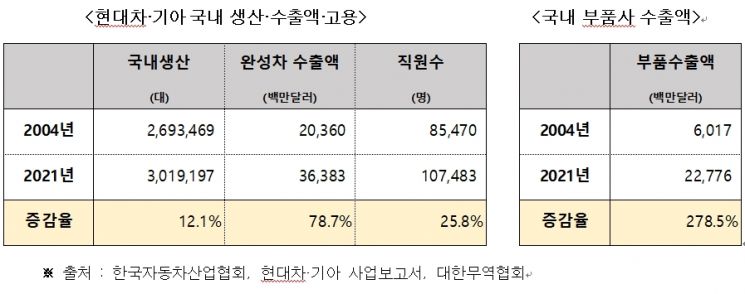
Furthermore, Hyundai Motor Group emphasizes that contrary to concerns that overseas production would reduce domestic jobs, it has actually increased Hyundai and Kia's domestic production, export value, and employment. In 2004, the year before overseas production bases began to be established in earnest in 2005, Hyundai and Kia produced 2.69 million vehicles domestically. However, last year, domestic production reached 3.02 million vehicles, a 12.1% increase despite COVID-19. The increase in export value was even greater. Hyundai and Kia's export value was $20.36 billion (approximately 25.8 trillion KRW) in 2004 and expanded by 79% to $36.38 billion (approximately 46.2 trillion KRW) last year.
Domestic employment also gained momentum. According to Hyundai and Kia's business reports, the number of employees at both companies increased by 22,000 during the same period, rising 26% from 85,470 in 2004 to 107,483 last year. Strengthening of domestic research and development (R&D) functions led to a 97.9% increase in Hyundai Motor's domestic research staff from 5,931 in 2007 to 11,739 in 2020.
Domestic automotive parts export value was $6.017 billion (approximately 7.6 trillion KRW) in 2004 but increased about fourfold to $22.776 billion (approximately 28.9 trillion KRW) last year. Additionally, 748 first- and second-tier suppliers have entered overseas markets alongside Hyundai Motor Group. As a result, the average sales of partner companies increased 3.3 times from 97.9 billion KRW in 2004 to 319.6 billion KRW in 2020, and asset size grew 3.7 times from 70.2 billion KRW to 261.2 billion KRW.
© The Asia Business Daily(www.asiae.co.kr). All rights reserved.
![Clutching a Stolen Dior Bag, Saying "I Hate Being Poor but Real"... The Grotesque Con of a "Human Knockoff" [Slate]](https://cwcontent.asiae.co.kr/asiaresize/183/2026021902243444107_1771435474.jpg)


















