Yoon "Reflect on the Meaning of Comprehensive Strategic Alliance"... Biden "Global Supply Chain Disruptions Require Allied Cooperation"
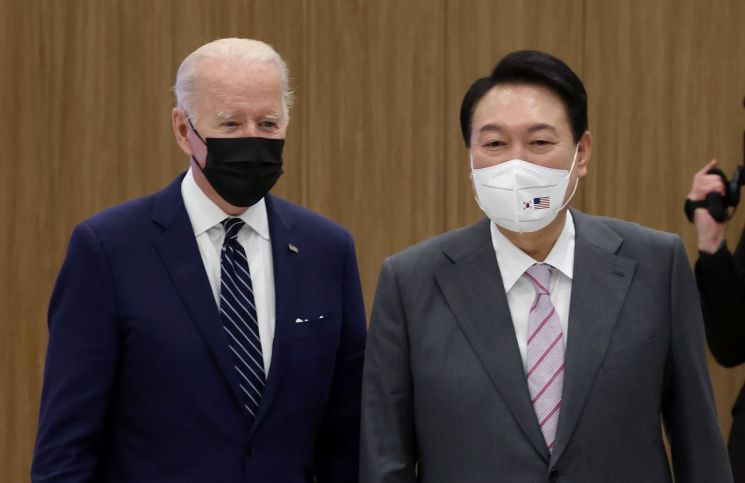
[Asia Economy Reporter Baek Kyunghwan] The summit schedule between President Yoon Suk-yeol and U.S. President Joe Biden has officially begun. On the afternoon of the 20th, President Biden arrived at the U.S. military base in Osan, Gyeonggi Province, and started his three-day visit to Korea by visiting Samsung Electronics' Pyeongtaek plant together with President Yoon. President Biden's visit to Korea comes just ten days after President Yoon's inauguration. It is also significant as the fastest visit by a U.S. president following the inauguration of a Korean president in history. Choosing Korea as his first stop on his inaugural Asia tour, President Biden will focus on three main agenda items during the summit: the South Korea-U.S. joint response strategy to North Korean provocations, economic security cooperation measures, and Korea's contributions to international issues.
President Biden arrived in Korea around 5:30 p.m. on the 20th via Osan Air Base in Gyeonggi Province, where he was welcomed by Foreign Minister Park Jin before moving to Samsung Electronics' Pyeongtaek plant. President Yoon, who departed from his office in Yongsan, Seoul, arrived at the Pyeongtaek plant first at around 5:54 p.m., where Samsung Electronics Vice Chairman Lee Jae-yong greeted him. President Yoon shook hands with Vice Chairman Lee and remarked, "You should have come earlier."
President Biden toured the production facilities for 22 minutes with President Yoon, guided by Vice Chairman Lee. President Biden praised the site, saying, "I saw the production site of the world's best semiconductor chips," and President Yoon stated, "Semiconductors are national security assets that will be responsible for our future," adding, "We plan to provide bold incentives and necessary support without hesitation."
◆ President Yoon: "Hope South Korea-U.S. Relations Become an Economic Security Alliance" = In a joint speech, President Yoon expressed to President Joe Biden his hope that "South Korea-U.S. relations will be reborn as an economic security alliance based on advanced technology and supply chain cooperation." President Yoon evaluated President Biden's visit to the Pyeongtaek campus as a good opportunity to reflect not only on its economic and security significance but also on the meaning of a global comprehensive strategic alliance.
President Yoon repeatedly emphasized the importance of the semiconductor industry in South Korea-U.S. relations. He explained, "Semiconductors are essential components for all advanced industries such as autonomous vehicles, AI (artificial intelligence), and robotics, and they are key factors determining future technological competitiveness. South Korea supplies 70% of the world's memory semiconductors and plays a pivotal role in the global semiconductor supply chain."
He continued, "We consider semiconductors as national security assets responsible for our future and plan to provide bold incentives and necessary support without hesitation. I also ask President Biden to take great interest not only in providing various incentives for our semiconductor companies' investments in the U.S. but also in encouraging investments by U.S. advanced materials, equipment, and design companies in Korea."
President Yoon also mentioned President Biden's achievements. According to President Yoon, President Biden has emphasized the importance of semiconductors as a core of the global supply chain since his inauguration. "I understand that he is making great efforts to pass the Chips Act in Congress. He personally chairs supply chain meetings and leads international cooperation to stabilize global supply chains," he evaluated.
President Yoon also referred to examples of semiconductor cooperation between the two countries, such as the establishment of Korea Semiconductor in 1974 as a South Korea-U.S. joint venture and Samsung Electronics' plan to build a foundry (semiconductor contract manufacturing) plant in Taylor City, U.S. He said, "Just as the South Korea-U.S. alliance has a long history, the history of South Korea-U.S. semiconductor cooperation is also very deep," adding, "American semiconductor materials and equipment companies such as Lam Research and DuPont are strengthening collaboration with Korean semiconductor companies through investments in Korea. At the same time, semiconductor cooperation between the South Korean and U.S. governments is actively progressing."
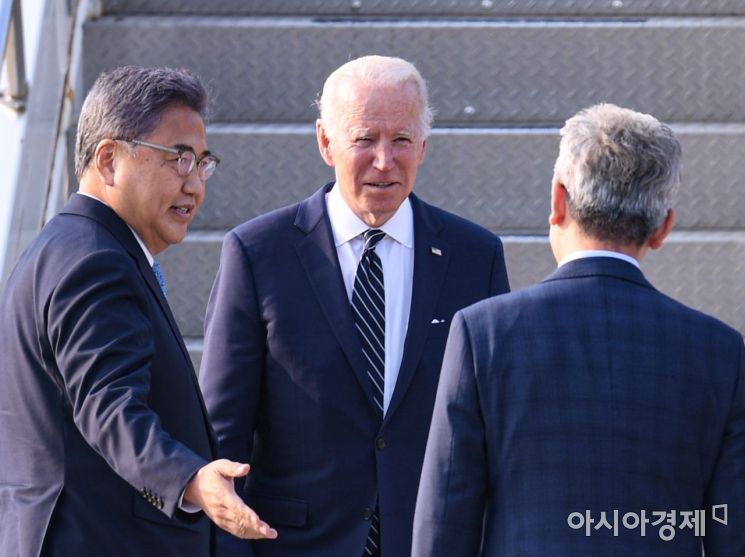 U.S. President Joe Biden arrived at Osan Air Base in Gyeonggi Province on the 20th aboard his official aircraft, Air Force One, and was greeted by Foreign Minister Park Jin (left). President Biden will visit South Korea from the 20th to the 22nd and Japan from the 22nd to the 24th. / Osan - Photo by Joint Press Corps
◆ President Biden: "We Must Work with Allies to Restore Supply Chains" = President Biden emphasized to President Yoon that "we must accelerate efforts to address supply chain resilience issues together with allies who share values, like South Korea."
On this day, President Biden introduced, "The U.S. has a highly skilled workforce and provides an entrepreneurial spirit of innovation," adding, "In the U.S., you can expect protection for many companies' ideas and investments." He continued, "We must accelerate efforts to solve supply chain resilience issues together with allies who share values like South Korea. It is important for multiple countries to cooperate across borders, and strengthening long-term resilience and recovery and enhancing each country's competitiveness can be achieved through such strengthened relationships."
He also highly evaluated South Korea's status in the semiconductor industry. President Biden said, "South Korea has the world's most advanced semiconductor production complex and holds many advantages in design and production," adding, "Semiconductors are an important driving force for our economy, playing a significant role especially in smartphones and medical diagnostic devices."
President Biden also mentioned Samsung's investment in the U.S. He introduced, "Samsung announced a 20 trillion won investment in May to build its second foundry in the U.S.," and expressed, "We are very grateful for this." He assessed that this will create 3,000 new high-tech jobs and increase the current 20,000 jobs Samsung maintains in the U.S.
He did not omit mentioning the expansion of supply chains, a key agenda of this summit. President Biden analyzed that the global supply chain has been disrupted due to the Ukraine war and emphasized the importance of multiple countries cooperating across borders to restore supply chains.
He added, "With a company like Samsung in Korea, technological innovation will be actively developed in the future, and when the two countries cooperate through a technological alliance for economic security, more progress is expected," and said, "Strengthening the alliance between the two countries is very important for stability, peace, and prosperity in the Asia-Pacific region and the world."
On the second day of his visit on the 21st, President Biden will first visit the National Seoul National Cemetery in Dongjak-dong to pay respects. He will then hold the first South Korea-U.S. summit with President Yoon at the Yongsan Presidential Office building and attend a welcome dinner hosted by President Yoon at the nearby National Museum of Korea after the summit. On the 22nd, he is scheduled to meet Chung Eui-sun, Chairman of Hyundai Motor Group. He will visit the Air Force Operations Command Aerospace Operations Headquarters (KAOC), which commands air operations across the Korean Peninsula, with President Yoon. Afterwards, he will encourage staff at the U.S. Embassy in Korea at Yongsan U.S. military base before departing from Osan U.S. military base to Japan, the second stop of his tour.
© The Asia Business Daily(www.asiae.co.kr). All rights reserved.


















