6·1 Local Election with 7 Ballots, Each a Different Color in a 'Colorful' Election
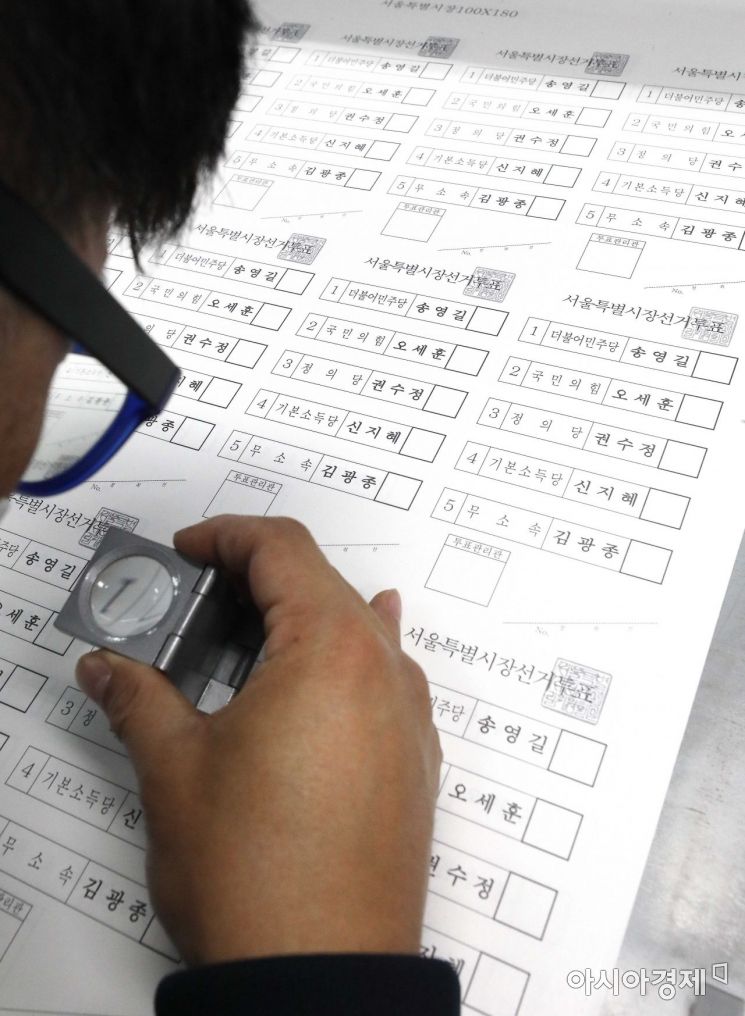 On the 18th, two weeks before the 8th nationwide local elections, an official at a printing company in Paju, Gyeonggi Province, is checking the condition of the ballot papers for the Seoul mayoral election. Photo by Moon Honam munonam@
[Asia Economy Reporter Kim Jong-hwa] The official campaign for the June 1 local elections began on the 19th. Depending on the region, voters receive between 4 and 8 ballots, resulting in more ballots than in the last presidential election.
Ballots symbolize the domestic paper manufacturing technology and represent the culmination of paper technology. Ballots must be free from static electricity and ink smudging. During vote counting, if ballots stick together due to static or if the ink from the stamp smudges, the vote can be declared invalid.
Since even a tiny dot can cause reading errors, advanced technology is required during production to ensure no microscopic contaminants are included. The durability and strength of the paper itself are also important. The paper must have good resilience to unfold smoothly after being folded, which helps prevent paper jams in automatic counting machines.
In the last presidential election, the ballot length was 27.0 cm with a record second-highest 14 candidates registered. In the 2017 19th presidential election, the longest ballot length of 28.5 cm was recorded with a record-high 15 candidates. Longer ballots increase the likelihood of jams in automatic counting machines, which the paper industry does not welcome.
This local election is expected to be colorful. Voters receive a total of 7 ballots in different colors: Superintendent of Education (light green), Mayor/Provincial Governor (white), District/City/County Chairperson (egg yellow), Local Assembly Member (light pink), Proportional Representation Local Assembly Member (sky blue), District/City/County Assembly Member (sky gray), and Proportional Representation District/City/County Assembly Member (light beige). In the 7 districts holding by-elections for National Assembly members, voters receive an additional ballot, totaling 8.
The seven colors?white, light green, egg yellow, blue-gray, sky blue, light beige, and light pink?must have a basis weight of 100g/㎡ and be eco-certified to be supplied to the National Election Commission. Only two types of ballots meet these stringent quality standards: Murim’s ‘Neo Ballot Paper’ and Hansol Paper’s ‘HANSOL Ballot Paper’.
Murim, which began supplying ballots since the 2002 local elections when the electronic counting system was first introduced, has maintained a 60% market share after obtaining a patent for ballot manufacturing technology in 2007. The remaining market share is held by Hansol Paper.
A paper industry official said, "We understand that the total amount of ballots supplied for this local election is about 710 tons," adding, "Supplying ballots is symbolic of recognition for paper quality, but it does not significantly contribute to profits."
© The Asia Business Daily(www.asiae.co.kr). All rights reserved.

















