[Asia Economy Yang Nak-gyu, Military Specialist Reporter] The South Korean and U.S. military authorities are maintaining the highest level of readiness on the 20th in response to U.S. President Joe Biden's visit to Korea.
On this day, a military official said, "Until this morning, there were no signs of imminent provocations at North Korea's major nuclear and missile facilities," but added, "However, we are closely monitoring the situation as the possibility of provocations by North Korea remains high."
The E-4B "Nightwatch," which also serves as the U.S. Secretary of Defense's dedicated aircraft, flew near Tokyo, Japan, on this day. Equipped with the capability to directly command all military forces from the sky and conduct nuclear war operations, it is also known as the "Doomsday Plane."
Last December, U.S. Secretary of Defense Lloyd Austin used this aircraft during his visit to Korea to attend the 53rd Security Consultative Meeting (SCM) between South Korea and the U.S. The exposure of the E-4B's flight path ahead of summit meetings with South Korea and Japan is interpreted as a move targeting North Korea, which is preparing nuclear tests and intercontinental ballistic missile (ICBM) provocations.
U.S. Air Force reconnaissance aircraft have been conducting surveillance activities over the East Sea. The RC-135S "Cobra Ball" reconnaissance aircraft took off from Kadena Air Base, located in Okinawa Prefecture, Japan. Ahead of President Biden's Korea-Japan tour (Korea from the 20th to the 22nd, Japan from the 22nd to the 24th), the U.S. military has been dispatching one "Cobra Ball" and one aerial refueling aircraft almost daily to the East Sea to carry out long-duration missions.
Additionally, at night, another U.S. Air Force reconnaissance aircraft, the RC-135V "Rivet Joint," has been flying sorties over the Korean Peninsula, conducting surveillance activities by flying back and forth in an east-west direction over the West Sea near the Military Demarcation Line (MDL) adjacent to the Seoul metropolitan area, northern Gangwon Province, and the East Sea airspace.
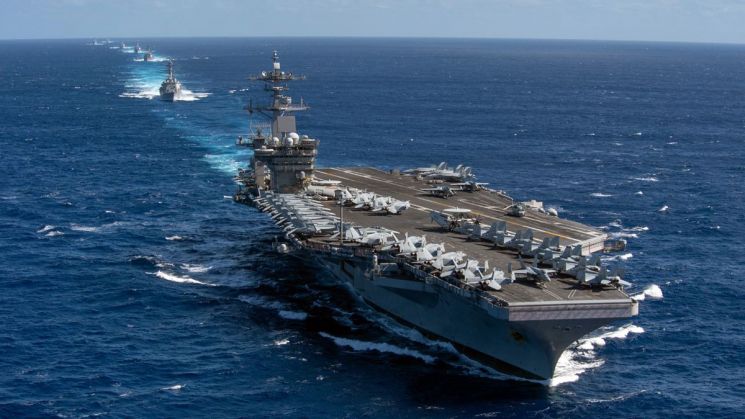
Currently, in the Western Pacific region, the U.S. Navy's nuclear-powered aircraft carriers "Ronald Reagan" and "Abraham Lincoln," as well as the amphibious assault ship "Tripoli," are deployed. Additionally, the amphibious assault ship "America" is on standby at the U.S. Navy base in Sasebo, Japan.
The "Ronald Reagan" carrier, part of the U.S. Navy's 7th Fleet based at Yokosuka Naval Base in Japan, departed Yokosuka with the assistance of a tugboat yesterday morning. The Nimitz-class nuclear-powered carrier "Ronald Reagan" entered Yokosuka Base in October last year and underwent winter maintenance from January to April this year. The "Ronald Reagan" carrier strike group previously deployed to the East Sea in November 2017, coinciding with then-U.S. President Donald Trump's first visit to Korea, conducting joint exercises alongside two other carrier strike groups, "Theodore Roosevelt" and "Nimitz," as part of maximum pressure on North Korea.
F/A-18 "Super Hornet" aircraft and other carrier-based planes from the U.S. Marine Corps stationed at Iwakuni Air Base in Japan are reportedly conducting Field Carrier Landing Practice (FCLP) on Iwo Jima (Iojima) in preparation for full mission deployment.
Some speculate that if North Korea provokes during the summit period, a show of force in response could be conducted. During the ICBM launch on March 24, the military conducted a live-fire demonstration over the East Sea. The live-fire included one Hyunmoo-2 surface-to-surface ballistic missile operated by the Army Missile Command, one ATACMS tactical ballistic missile, one Haeseong-II ship-to-surface missile operated by the Navy, and two JDAM GPS-guided bombs operated by the Air Force.
U.S. strategic assets may also be deployed. Kim Tae-hyo, First Deputy Director of the National Security Office, stated, "If a serious provocation occurs, there are assets that can be immediately mobilized and others that take weeks; both are being discussed and considered simultaneously." The "immediately mobilizable" assets likely refer to Air Force strategic bombers.
There is also speculation that the U.S. strategic weapons could raise the level of response through threat flights as a warning. The strategic weapons expected to be deployed include the U.S.'s three major long-range bombers: the B-52H (Stratofortress), B-1B (Lancer), and B-2 (Spirit).
In September 2017, immediately after North Korea's sixth nuclear test, two B-1B strategic bombers, known as the "Death Swans," and F-15C fighters flew into international airspace over the East Sea north of the Northern Limit Line (NLL). At that time, U.S. bombers and fighters flew farther north than ever before, crossing over the Demilitarized Zone (DMZ).
© The Asia Business Daily(www.asiae.co.kr). All rights reserved.

















