People's Bank of China Freezes 1-Year Loan Rate, Cuts 5-Year Loan Rate as a 'Last Resort'
China Likely to Boost Economy Through Fiscal Policy
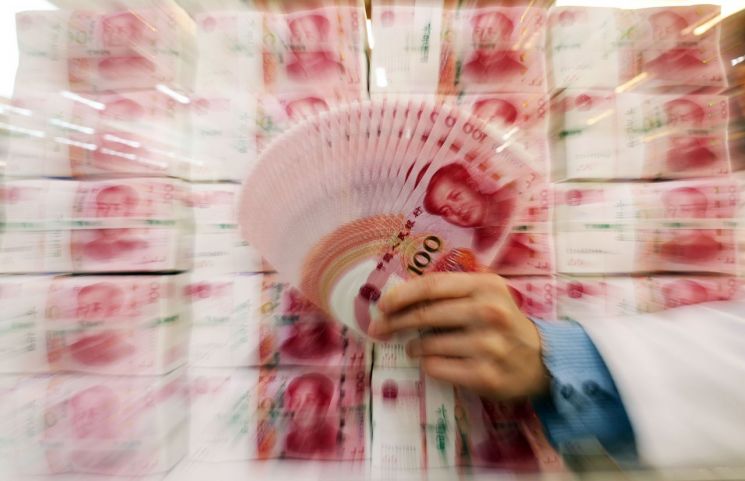
[Asia Economy Beijing=Special Correspondent Jo Young-shin] Despite a significant economic downturn, China's monetary authorities have kept the 1-year Loan Prime Rate (LPR), which effectively serves as the benchmark interest rate, unchanged. However, they lowered the 5-year medium- to long-term loan rate.
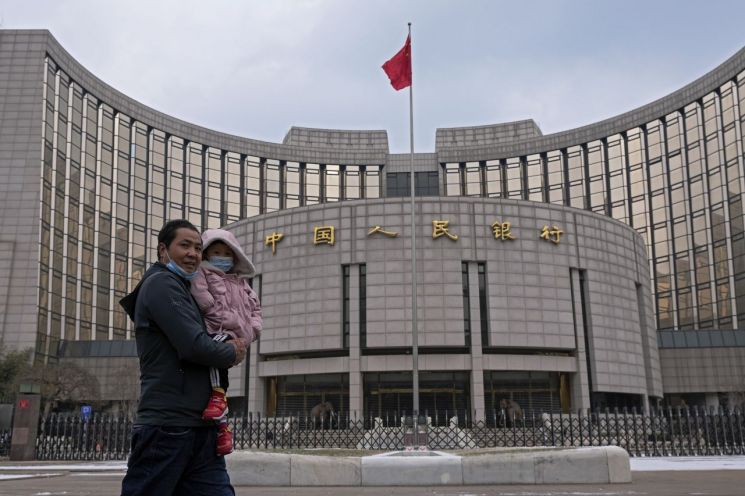
China's central bank, the People's Bank of China, announced on the 20th that the 1-year LPR remained at 3.7%, the same as the previous month. This marks the fourth consecutive month of no change following a 0.1 percentage point cut in January. Meanwhile, the 5-year LPR was reduced by 0.15 percentage points from 4.6% to 4.45%. In other words, short-term loan rates were held steady, while medium- to long-term loan rates were cut.
Limited Chinese Monetary Policy Hampered by Lockdowns
Given the sharp deterioration in key economic indicators due to the resurgence of COVID-19, the prevailing expectation was that the People's Bank of China would lower interest rates.
However, there was an unexpected obstacle: inflation. Additionally, China's leadership's 'Zero COVID' policy was seen as a potential barrier to the use of aggressive monetary policy. Even if interest rates were cut, the entities that would spend money are restricted by lockdowns. Ultimately, lowering rates might only fuel inflation without delivering the expected economic stimulus. For this reason, many experts anticipated a rate freeze.
After careful consideration, the People's Bank of China appears to have taken a dual approach by freezing the 1-year short-term rate while cutting the 5-year medium- to long-term rate, reflecting the complexity of the situation.
The cut in the 5-year loan rate can also be interpreted as a monetary policy aimed at the real estate market. It sends a message that some real estate regulations will be eased while maintaining the stance that housing is for living, not speculation.
In fact, Chinese financial authorities such as the China Banking and Insurance Regulatory Commission recently stated the need for differentiated policies to meet the reasonable housing demand of homebuyers (end users).
China's economic media outlet Caijing reported on the same day that mortgage rates in 20 major cities including Guangzhou, Shenzhen, Tianjin, Qingdao, and Zhengzhou have fallen.
Signals from Chinese Economic Indicators
Last month, China's retail sales amounted to 2.9483 trillion yuan, plunging by a staggering 11.1% year-on-year. Retail sales of consumer goods excluding automobiles, which require large expenditures, fell by 8.4% year-on-year to 2.6916 trillion yuan. Domestic consumption, which accounts for over 60% of China's GDP, is essentially collapsing.
Industrial production also turned negative last month. In April, China's industrial production decreased by 2.9% year-on-year.
Inflation is also concerning. Last month, China's Producer Price Index (PPI) rose by 8.0% year-on-year. Although the PPI, which surged to 13.5% last October due to power shortages caused by coal shortages, has been declining monthly, it remains high.
The Consumer Price Index (CPI) also stood at 2.1%. After rising to 2.3% in November last year, the CPI had been on a downward trend but has been rising sharply since March. The transmission of PPI to CPI and panic buying due to the COVID-19 resurgence have driven CPI up. The increase in international grain and raw material prices following Russia's invasion of Ukraine is another significant factor.
Chinese state media have published optimistic articles asserting that the fundamentals of the Chinese economy remain solid and that the economy will recover in the second half of the year, but it is difficult to accept these claims at face value.
Some in Beijing predict that achieving the original GDP growth target of 'within 5.5%' in the second half of the year will be challenging. There are even concerns that maintaining the 4.8% growth rate recorded in the first quarter may be difficult.
Focus on Fiscal Policy Over Monetary Policy in China
Some voices in China cautiously suggest that revisions to the key economic indicators announced at the Two Sessions (National People's Congress and Chinese People's Political Consultative Conference) may be inevitable.
A representative indicator is the national fiscal deficit ratio. This year's target for China's fiscal deficit ratio is 2.8%, down 0.4 percentage points from last year's target of around 3.2%. This is significantly lower than the 3.6% during the height of the COVID-19 pandemic in 2020.
Within China, there are opinions that the government should raise the fiscal deficit ratio target from 2.8% to over 3%. Raising the fiscal deficit target implies the need for a more proactive fiscal policy. Although fiscal policy increases national debt, it has the advantage of minimizing inflationary pressures compared to monetary policy measures such as interest rate cuts.
A more proactive fiscal policy would also help address employment issues. Last month, the urban unemployment rate in China rose by 0.3 percentage points from the previous month to 6.1%, the highest since March 2020, the early stage of the COVID-19 pandemic. This exceeds the leadership's annual unemployment target of 5.5%.
A bigger problem is that the unemployment rate for those under 24 years old is much higher than in Europe and the United States. According to Chinese economic media Caixin, as of the end of April, the unemployment rate for those under 24 in China was 18.2%, compared to 13.9% in Europe and 8.6% in the United States.
Caixin cited experts saying that youth unemployment in China has surged since October 2021 and that China should use all possible monetary and fiscal policy tools.
© The Asia Business Daily(www.asiae.co.kr). All rights reserved.
!["The Woman Who Threw Herself into the Water Clutching a Stolen Dior Bag"...A Grotesque Success Story That Shakes the Korean Psyche [Slate]](https://cwcontent.asiae.co.kr/asiaresize/183/2026021902243444107_1771435474.jpg)

















