Government Emphasizing National Debt Repayment
Democrats Clash Saying "Supplementary Budget Spending Needed"
[Asia Economy Reporter Oh Ju-yeon] Although the ruling and opposition parties have expressed a unified stance on passing the second supplementary budget (추경) within May, the negotiation process is expected to be challenging. The Democratic Party of Korea is demanding an increase and revision of the government’s 59.4 trillion won supplementary budget proposal by 10.8 trillion won and is proposing to use the national bond repayment amount as the supplementary budget expenditure source, making this a key issue in the current supplementary budget. Additionally, regarding the Ministry of Economy and Finance’s 53 trillion won excess tax revenue error, the Democratic Party criticizes it as an ‘intentional act rather than a simple mistake or error,’ indicating that the process of passing President Yoon Suk-yeol’s first supplementary budget may not be smooth.
On the morning of the 20th, the second day of the National Assembly Budget and Accounts Committee’s comprehensive policy questioning, Democratic Party lawmaker Shin Jeong-hoon pointed out again the 53 trillion won excess tax revenue error, stating, "The 53 trillion won excess tax revenue corresponds to 15% of the main budget size."
Shin said, "Last year, the Democratic Party actively demanded expansionary fiscal policy emphasizing the need for supplementary budgets to overcome the COVID-19 crisis, but the Ministry of Economy and Finance repeatedly stressed ‘guarding the treasury.’ Now, by announcing a 53 trillion won excess tax revenue, it is playing the role of savior for the Yoon Suk-yeol administration," he criticized. He added, "Can the public trust fiscal management if it is unpredictably increased and decreased? If the government recklessly estimates and tax revenue does not materialize in the second half, making national bond issuance inevitable, will they take responsibility?"
In response, Deputy Prime Minister and Minister of Economy and Finance Choo Kyung-ho said, "It was difficult to present only rosy forecasts, so we made conservative estimates," and added, "We will manage the national finances with more accurate tax revenue estimates in the future."
Not only regarding the tax revenue estimation error, but the government and the Democratic Party are also in conflict over the size of the supplementary budget and whether to include the 9 trillion won national bond repayment amount as supplementary budget expenditure.
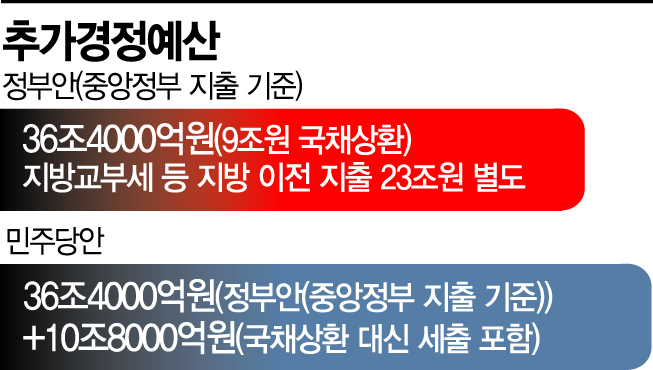
Previously, the government submitted a supplementary budget proposal totaling 59.4 trillion won to the National Assembly. Excluding 23 trillion won allocated for local government transfers, the central government expenditure amounts to 36.4 trillion won. The Democratic Party is proposing a supplementary budget increased by 10.8 trillion won on top of this. They also advocate using the 9 trillion won allocated for national bond repayment to increase the supplementary budget expenditure. At the policy coordination meeting the day before, Floor Leader Park Hong-geun emphasized expanding the supplementary budget, saying, "We will fully and promptly compensate small business owners and self-employed individuals for their sacrifices, and we will definitely pursue retroactive application of loss compensation." However, the government and the People Power Party insist on using the funds for national bond repayment, emphasizing fiscal soundness, leading to a tense standoff.
Meanwhile, the Ministry of Economy and Finance estimates that this year’s excess tax revenue will reach 53.3 trillion won. Of this, 44.3 trillion won will be used as supplementary budget funds, and 9 trillion won will be used to repay national bonds.
© The Asia Business Daily(www.asiae.co.kr). All rights reserved.