Industry "Expansion of Fuel Cost Linkage Adjustment Range"
Government Keeps Door Open for Price Increase
Concerns Deepen Over Rapid Inflation Surge
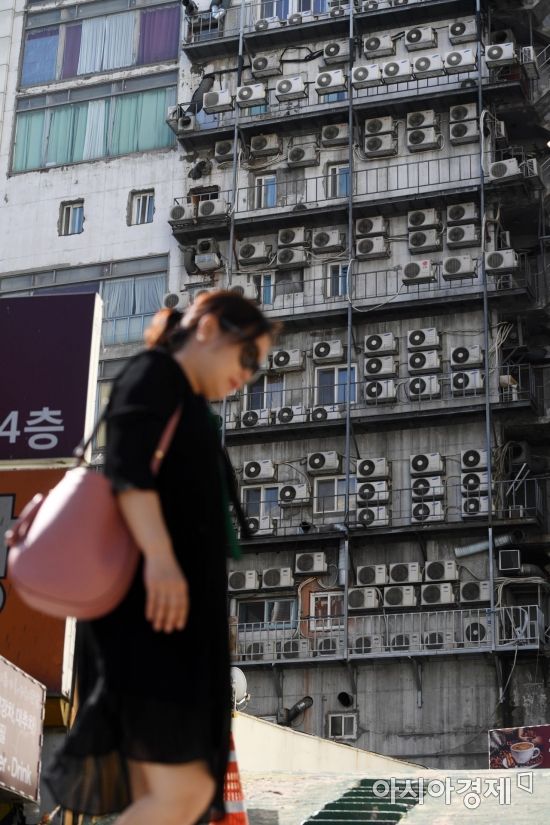 On the 31st, as power demand increases due to the heatwave, air conditioner outdoor units are densely installed on the exterior wall of a building in Jung-gu, Seoul. Photo by Moon Honam munonam@
Attention is also focused on the electricity rate adjustment plan, which is a fundamental solution for the management normalization of Korea Electric Power Corporation (KEPCO).
According to the related industry on the 20th, KEPCO will announce whether to raise electricity rates for the third quarter on the 20th of next month. Electricity rates consist of basic charges, electricity consumption charges (standard fuel cost), climate environment charges, and fuel cost adjustment charges. The third quarter electricity rates are determined based on the average fuel cost from March to May. Due to the high oil prices caused by Russia's invasion of Ukraine, KEPCO has incurred massive deficits, increasing pressure to raise electricity rates in the second half of the year.
According to the Korea Power Exchange, the System Marginal Price (SMP), which is the wholesale electricity price KEPCO pays to power producers, reached a record high of 202.11 KRW per kWh last month since the opening of the electricity wholesale market. In particular, the unit fuel cost of bituminous coal this month was 101.38 KRW per kWh, nearly double compared to the same period last year (53.07 KRW). KEPCO raised electricity rates by 6.9 KRW per kWh starting last month and plans to increase the standard fuel cost by an additional 4.9 KRW in October.
However, the problem is that the international community, including the United States, has stopped importing Russian coal and natural gas, which may cause fuel costs to rise more sharply in the future. Accordingly, there are claims within the power industry that the adjustment range of the fuel cost linkage system should be expanded to a maximum of 5.0 KRW per quarter. The industry sees that a fuel cost increase of 33 KRW per kWh is necessary for KEPCO's operational normalization. Limiting the quarterly adjustment range to a maximum of 3.0 KRW, as is currently done, is criticized for not reflecting the reality of rising international energy prices.
The Yoon Suk-yeol administration recently stated that it would follow the cost-based principle regarding electricity rates, leaving open the possibility of a rate increase. However, considering the public burden in a situation where price stability is the top priority, raising electricity rates is not an easy choice. Professor Yoo Seung-hoon of the Department of Future Energy Convergence at Seoul National University of Science and Technology said, "To resolve KEPCO's management deficit, an increase in electricity rates is primarily necessary," adding, "Within the scope where the fuel cost linkage system operates, raising rates to the maximum possible extent should provide relief to KEPCO's financial difficulties."
© The Asia Business Daily(www.asiae.co.kr). All rights reserved.
![Clutching a Stolen Dior Bag, Saying "I Hate Being Poor but Real"... The Grotesque Con of a "Human Knockoff" [Slate]](https://cwcontent.asiae.co.kr/asiaresize/183/2026021902243444107_1771435474.jpg)















