Rapid Growth Due to COVID-19 but
Online Penetration Rate of Food and Beverages
Lower Compared to 45% in Non-Food Products
Growth Potential Remains Despite Endemic
Market Size Expected to Reach 70 Trillion Won by 2025
'War' Over Core Competitiveness in Delivery
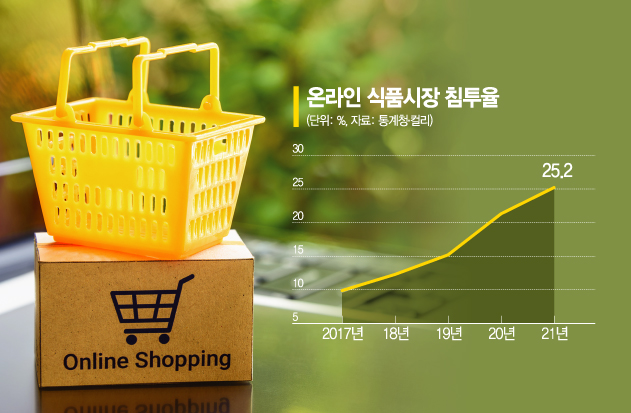
Although 'online grocery shopping' has significantly increased due to COVID-19, the share of online transactions in the food market still accounts for only about one-quarter. Online and offline retailers see continued growth potential in the online grocery market and are focusing on expanding delivery capabilities, one of the core competitive strengths of this market, even in the endemic (periodic infectious disease outbreak) situation.
According to Statistics Korea and Kurly on the 20th, the online penetration rate of food and beverages (the proportion of online transactions in the total consumer market) was 25.2% last year. Fresh foods such as fruits, vegetables, and eggs, which require careful management, had an online penetration rate of only 15.2% in the food market until 2019, just before COVID-19, due to the perception that they must be seen and selected in person.
However, the non-face-to-face online grocery market rapidly grew through the COVID period, surpassing a 20% penetration rate in 2020 (21.3%) and expanding to 25.2% last year. Consumers in their 50s and 60s, who had been reluctant to purchase food online during the pandemic, also moved massively into this market. According to Kurly, the number of new customers aged 50-60 who joined Market Kurly last year was 2.3 times higher than the previous year.
Nevertheless, the online penetration rate in the food market remains lower compared to non-food sectors. Last year, the online penetration rate in the non-food market was around 45%. Compared to electronics (58.1%), books (54.8%), furniture (48.8%), as well as cosmetics (39.4%) and fashion (31.7%), where trying on or testing products is important, the online penetration rate for food and beverages was significantly lower.
For this reason, most online and offline grocery channels are actively competing in delivery services through online platforms this year as well. Although the economy has entered a reopening phase, there is still room for additional growth in this market. In response to dawn delivery services by Market Kurly, SSG.com, and Oasis, Lotte Mart and Homeplus are countering with same-day delivery services such as 'Baro Delivery,' which delivers within 1-2 hours after ordering. Recently, GS Retail joined the competition by launching 'Yomart,' an instant grocery shopping service in partnership with Yogiyo that delivers within one hour.
The online food market size grew from 10.4 trillion won in 2017 to 13.4 trillion won in 2018, 17.1 trillion won in 2019, 25.9 trillion won in 2020, and 32.8 trillion won last year, with an average annual growth rate of 34%. It is expected to grow to around 70 trillion won by 2025. A retail industry official said, "There are concerns that the rapid growth of the online grocery market may slow down as we enter the endemic phase, but the industry does not expect consumers who have already shifted to this market to easily change their shopping patterns," adding, "Competition related to 'fast and convenient delivery,' the core competitive strength of online grocery shopping including fresh foods, will continue."
© The Asia Business Daily(www.asiae.co.kr). All rights reserved.

















