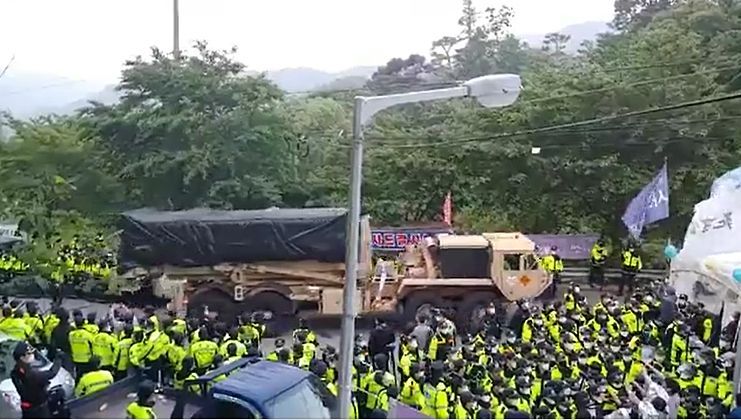
[Asia Economy Yang Nak-gyu, Military Specialist Reporter] Discussions on normalizing the deployment of the Terminal High Altitude Area Defense (THAAD) system stationed in Seongju, Gyeongbuk, are expected to take place at the upcoming South Korea-U.S. summit on the 21st. The plan is to use the already allocated defense cost-sharing funds to improve the conditions of the Seongju base facilities.
On the 20th, a government official stated, "We understand that both South Korea and the U.S. have generally agreed on the principle of normalizing the Seongju THAAD base."
The THAAD system deployed in Seongju has not yet been officially stationed because the environmental impact assessment has not been completed. An environmental impact assessment of the base and its surroundings must be conducted before deployment, but it has not been carried out so far.
Initially, during the Park Geun-hye administration in April 2017, the Ministry of National Defense announced it would conduct a "small-scale environmental impact assessment" on the THAAD base, to be completed within six months. However, one month after the Moon Jae-in administration took office, in July 2017, the Ministry shifted its policy to conduct a "general environmental impact assessment." The general environmental impact assessment takes more than twice as long as the small-scale assessment. Even this evaluation has seen no progress for five years.
Given this situation, the living conditions for South Korean and U.S. soldiers at the THAAD base are inadequate. It is known that the U.S. side has continuously raised complaints about the conditions of the THAAD base to the South Korean side at occasions such as the Security Consultative Meeting (SCM).
Currently, remodeling work on the living quarters for South Korean and U.S. soldiers at the THAAD base is underway, but the pace has slowed due to opposition from residents and groups near the THAAD base.
President Yoon Suk-yeol pledged during his presidential campaign to complete the general environmental impact assessment for the Seongju base and normalize the base to ensure the operational conditions of the U.S. Forces Korea. In January, while announcing his foreign and security pledges, he said, "Look at the THAAD base in Seongju. How can we call it an alliance if the government neglects this?"
The Ministry of National Defense reportedly reported to the Presidential Transition Committee in March that it plans to promptly proceed with the general environmental impact assessment, which has been delayed due to local opposition.
Meanwhile, Kim Tae-hyo, First Deputy Director of the National Security Office, said at a briefing at the Yongsan office, "Wang Yoon-jong, Economic Security Secretary, and Tarun Chhabra, Senior Director for Technology and National Security at the White House, have agreed to hold a call," adding, "This will serve as a regular communication channel for economic security between the White House and the Presidential Office."
He also added that four real-time communication channels are currently operating: between Kim Sung-han, Director of the National Security Office, and Jake Sullivan, U.S. National Security Advisor; Kim Tae-hyo, Deputy Director, and Jonathan Finer, U.S. Deputy National Security Advisor, and Kurt Campbell, White House National Security Council (NSC) Coordinator for Indo-Pacific Affairs; and between Lee Moon-hee, Foreign Affairs Secretary, and Ed Kagan, Senior Director for East Asia and Oceania at the NSC.
© The Asia Business Daily(www.asiae.co.kr). All rights reserved.
![Clutching a Stolen Dior Bag, Saying "I Hate Being Poor but Real"... The Grotesque Con of a "Human Knockoff" [Slate]](https://cwcontent.asiae.co.kr/asiaresize/183/2026021902243444107_1771435474.jpg)











