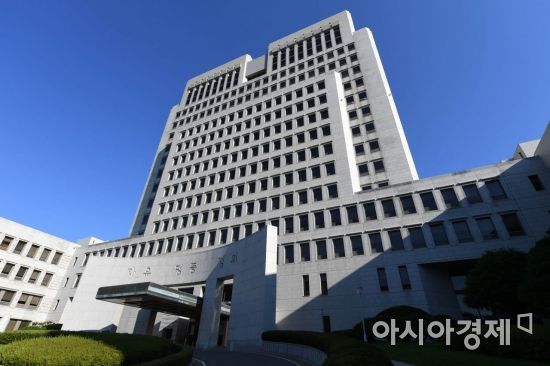
[Asia Economy Reporter Choi Seok-jin, Legal Affairs Specialist] The Supreme Court has ruled that nationality acquisition through sham marriage and passports issued based on such nationality are invalid.
The Supreme Court's First Division (Presiding Justice Kim Seon-su) announced on the 19th that it upheld the original sentence of 10 months imprisonment with a 2-year probation for ethnic Korean Chinese woman A, who was indicted on charges including falsification of official electronic records, use of falsified official electronic records, use of falsified passports, and violation of the Immigration Control Act.
A, born in Ying'an City, Heilongjiang Province, China, married ethnic Korean Chinese B in 1981 and had twin daughters, but later decided to wash her identity by changing her name, date of birth, and marital status after entering Korea through a sham marriage with a Korean in order to work in South Korea.
In 1995, she created a fake household registration (Hogu-bu, the former Korean family registry, now the Family Relations Registration System) under the name C through an unidentified 'broker' in Heilongjiang Province, China, and even obtained a passport.
Then, on October 9, 1995, she entered into a sham marriage with Korean D and entered South Korea at the end of December that year, acquiring South Korean nationality the following year, and thereafter lived under the pretense of being Korean named C.
In the meantime, on January 17, 2011, A visited the Passport Division of the Ministry of Foreign Affairs and Trade and submitted a passport application containing false information such as the fake name and date of birth used for identity washing, and was issued a South Korean passport.
On December 12, 2012, she went to Gangbuk District Office in Gangbuk-gu, Seoul, to register her marriage with her Chinese husband B, submitting a marriage application with the fake name and date of birth registered in the Chinese household registry.
She also listed unrelated individuals in the section for parents' names, intending to invite them to Korea under the guise of kinship. However, unaware of the circumstances, the district office staff entered the information submitted by A into the official electronic record system of family relations registration as is. The prosecution indicted A on charges of falsification of official electronic records and use of falsified official electronic records for these actions.
Furthermore, on December 10, 2013, at Incheon International Airport's departure inspection, A presented a South Korean passport issued under a fake name obtained through identity washing without a valid passport issued by the Chinese government to the immigration officer and departed without authorization. She illegally departed 12 times until October 16, 2017, and illegally entered South Korea 12 times with the fake-name South Korean passport from December 24, 2013, to October 18, 2017. The prosecution applied charges of use of falsified passports and violation of the Immigration Control Act.
The first trial court found all of A's charges guilty and sentenced her to 10 months imprisonment with a 2-year probation.
The court stated, "Although it appears that the defendant has lived without major issues for over 20 years after acquiring false nationality in South Korea, crimes related directly or indirectly to false nationality acquisition, including this case, can be linked to other crimes domestically and internationally and can disrupt domestic legal order, so everyone should understand that these crimes must be strictly punished from a preventive perspective."
It added, "Moreover, although not included in the charges of this case, the defendant allowed unverified Chinese individuals who were not relatives to enter the country under the pretense of invitation after acquiring false nationality."
The court further explained, "Regardless of the circumstances, the defendant has lived as a South Korean citizen for over 20 years and hopes for leniency such as a suspended sentence to continue living in South Korea, but considering that the defendant lived in China for over 40 years as a teacher and recently received a pension from the Chinese government under her real Chinese name A, and that her spouse currently holds Chinese nationality and their two children, also Chinese nationals, live in Japan after marriage, it is difficult to see that the defendant who acquired false nationality can solely base her life in South Korea," explaining the sentencing rationale.
A appealed the first trial verdict, claiming in the second trial that she had no intent to commit the crime and that her actions were justified and thus lacked illegality.
She argued that since she was recognized as a national by the South Korean government under the name C and issued a resident registration card, she believed that using the identity C had legal approval under the South Korean legal system, so she had no intent regarding the falsity of her identity, and that obtaining and using a passport based on the resident registration card issued by the South Korean government was a socially acceptable and lawful act.
However, the appellate court rejected A's claims and found no problem with the first trial's judgment.
The Supreme Court, which reviewed the case upon A's appeal, first clarified the relationship between nationality acquisition through sham marriage, the crime of using a falsified passport, and violation of the Immigration Control Act as follows.
The court stated, "Article 3, Paragraph 1 of the former Nationality Act stipulates that one of the legal grounds for acquiring South Korean nationality is 'a person who has become the spouse of a South Korean national'," and added, "To qualify, there must be a marital agreement between the parties, that is, a mutual intention to create a mental and physical union recognized socially as a married couple."
It continued, "Even if a foreign woman enters South Korea and registers a marriage with a South Korean man as a means to work or for other purposes, if there is no such marital agreement, she does not qualify as 'a person who has become the spouse of a South Korean national' under Article 3, Paragraph 1 of the former Nationality Act, and thus cannot be said to have acquired South Korean nationality."
The court further explained, "If a person who has not acquired South Korean nationality records personal information as if they had acquired nationality and obtains a South Korean passport, then presents it to immigration officers during border inspections, it is considered both the use of a passport containing false information and unauthorized entry or exit without a valid foreign passport," and thus dismissed the appeal.
© The Asia Business Daily(www.asiae.co.kr). All rights reserved.

















