Knee Injuries Common During Lower Body Exercises Like Squats and Lunges
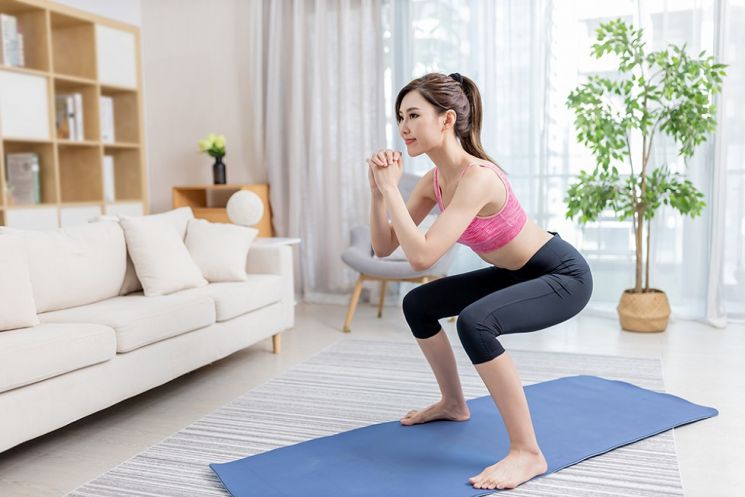 With the rise of the 'Sea Profile' trend centered around the MZ generation, bodyweight exercises such as squats and lunges are becoming popular. [Image source=Clipart Korea]
[Asia Economy Yeongnam Reporting Headquarters Reporter Dongguk Lee] Recently, among the MZ generation, the trend of taking photos of their healthy bodies, called ‘Bada Profile,’ has surged, leading to a rapid increase in people enjoying exercises aimed at building beautiful muscles along with dieting.
With easy access to exercise methods through videos provided on YouTube or IPTV, many people now follow along by watching videos at home or in gyms without professional help.
For beginners, bodyweight exercises are mainly performed, with squats and lunges being essential bodyweight workouts.
‘Squat’ is an exercise that involves repeatedly sitting down and standing up until the thighs are parallel to the knees, serving as the most basic lower body exercise. It effectively develops lower body muscles by training the lower back, glutes, thighs, and calves.
‘Lunge’ involves repeatedly sitting down and standing up with the legs spread about 1 meter apart front and back. It is an essential movement for hip-up exercises, which are highly valued nowadays, and a representative lower body workout.
The problem is that performing these exercises with incorrect posture for a long time can cause damage to the knee joints.
When doing squats or lunges, the knees naturally bend, but if the knees move forward beyond the toes or bend inward, excessive weight is placed on the knees, causing damage.
Knee injuries from exercise vary widely, from mild injuries such as tendinitis caused by inflammation of the tendons or pain caused by friction between the patella and femur when moving the knee, to more severe injuries like cruciate ligament damage, meniscus tears, and collateral ligament injuries. Therefore, special care should be taken to avoid joint cartilage damage during squat or lunge movements.
The joint cartilage, a smooth white tissue about 3?4 mm thick covering the areas where the femur and tibia form the knee joint, plays a role in distributing the force applied to the joint covered by the cartilage and minimizing friction.
This cartilage can be damaged due to various complex causes such as disease, trauma, or aging, but most damage occurs from repetitive overload or sudden impact.
Since cartilage lacks nerve or blood vessel tissue, there is no pain or inflammation initially, but if the lesion progresses to surrounding tissues, swelling and pain due to inflammation can be felt. Cartilage damage can be diagnosed through symptoms and imaging tests such as X-rays and MRI scans.
If knee joint damage or inflammation is mild, non-surgical treatments such as medication, physical therapy, and activity restriction are applied, and depending on symptoms, surgery using arthroscopy may be considered.
Dr. Jinhyuk Seo, head of the Joint Center at Daedong Hospital (Orthopedic Specialist), said, “Many people think knee pain naturally occurs with age, but in fact, knee pain is the most common symptom seen in orthopedics, and recently, many young people visit due to the development of leisure activities. If symptoms such as knee pain, swelling, or movement restriction appear after exercise, it is important to rest sufficiently. Many people apply patches or seek folk remedies if the pain persists, but it is more important to visit an orthopedic clinic for an accurate diagnosis and treatment,” he advised.
To prevent knee injuries during exercise, beginners should learn the correct posture and exercise methods from experts until they become familiar with the movements rather than following videos on their own. Also, since correct posture is crucial during squats and lunges, it is recommended to perform them in front of a mirror to observe one’s form.
Perform exercises after recognizing which area is being stimulated, and if stimulation is felt in other areas, check whether the posture is incorrect.
In particular, be careful not to let the knees go beyond the toes, and for lunges, extra caution is needed as weight is placed on one leg.
If lower body strength is insufficient, forcing the movements can have adverse effects, so it is also a good method to build lower body strength with other exercises before performing these movements.
© The Asia Business Daily(www.asiae.co.kr). All rights reserved.

















