Health Challenges, etc... Deposit Money and Earn 30% Profit if Successful
Critic: "An Action to Alleviate Anxiety"

[Asia Economy Intern Reporter Seohee Lee] Min-kyu Oh (33), who has been working at a publishing company for three years, is using a ‘habit formation app’ to regain his rapidly declining stamina caused by a sedentary work environment. After depositing 50,000 won, he participated in the ‘Plank every day for 4 weeks’ challenge and successfully achieved 100% of the goal, receiving 65,500 won back. This includes his original deposit of 50,000 won plus a ‘success bonus’ from the deposits of other participants who failed to meet the goal, resulting in about a 30% return. Oh said, “When I did home training alone, I never lasted more than a week, but after using the app, I completed a full month for the first time,” adding, “If you participate diligently, you can take care of your health and earn money, so it feels like killing two birds with one stone.”
Jin-hee Yoo (26), a senior at a university in Seoul, is currently participating in four challenges through the ‘habit formation app.’ She is verifying her execution of ‘Eating salad instead of rice at least three times a week,’ ‘Applying a face pack in the evening,’ ‘Walking with her pet,’ and ‘Transcribing foreign language articles’ on the app. Her average participation rate so far is 85%. Yoo said, “I intentionally deposit a large amount when joining so that I get up even if I feel reluctant because I don’t want to waste the money,” and added, “I plan to diet during summer vacation, and I think I will use the app for that as well.”
The popularity of habit formation apps among the MZ generation (Millennials + Generation Z) continues unabated. This is due to an increasing number of young people who want to share goals with others and gain a sense of accountability through that. Challenges range from trivial daily habits such as taking supplements, eating fruit, and watering plants to self-development activities like reading for an hour, transcribing columns, and listening to English radio. Users select their desired challenge and pay a deposit ranging from 30,000 to 200,000 won. If their participation rate during the challenge period is below 85%, they receive a partial refund; if 85% or above, a full refund; and if 100%, they receive the full refund plus a success bonus.
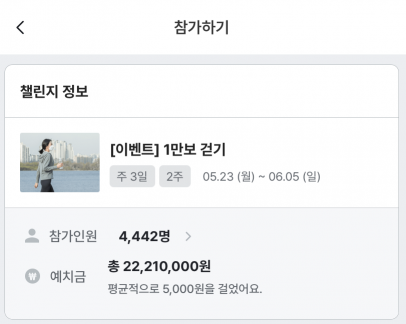 Number of participants in the 'Walk 10,000 Steps Daily' and accumulated deposits (Photo by Screen Capture)
As of the 19th, the ‘Walk 10,000 steps’ challenge, which had the highest number of participants, accumulated deposits totaling 22,145,000 won. The number of participants exceeded 4,400. The MZ generation not only verifies their participation on the app but also posts their challenge activities on personal SNS, continuing communication with others. When the reporter searched for ‘Miracle Morning’ (waking up 2-3 hours before the official start of the day to engage in self-development) on a social networking service that day, there were 1.1 million posts. Posts searched under ‘Habit Challenge’ and ‘Challengers’ totaled about 46,000.
Cultural critic Deok-hyun Jung diagnosed this as a ‘culture unique to the MZ generation trying to overcome anxiety.’ Jung said, “In the past, self-development was limited to career and professional paths, but now it includes very everyday things,” adding, “In an era of great uncertainty, the only thing one can control is oneself. Therefore, they try to offset anxiety in this way.” Professor Geum-ju Park of Seoul National University’s Department of Psychology explained the popularity of habit formation apps by saying, “Adults sometimes seek the discipline or sanctions they experienced in school for motivation,” and added, “By publicly declaring goals and paying a fee, they psychologically strengthen their motivation toward the goal.”
More companies are partnering with habit formation apps to promote their own brand products. The representative habit formation app ‘Challengers’ achieved remarkable growth in 2021 by forming new partnerships with 88 leading domestic companies such as Samsung Electronics, Naver, and Dongseo Food. The cumulative number of participants in corporate partnership challenges also increased more than tenfold compared to 2020, reaching 110,000, and the average number of participants per challenge was 638, about 2.5 times higher.
© The Asia Business Daily(www.asiae.co.kr). All rights reserved.


















