Samgyeopsal Prices Up 20% from a Month Ago
Feed Costs Rise Due to Prolonged Russia-Ukraine War
KDI Forecasts 4.2% Annual Consumer Price Increase
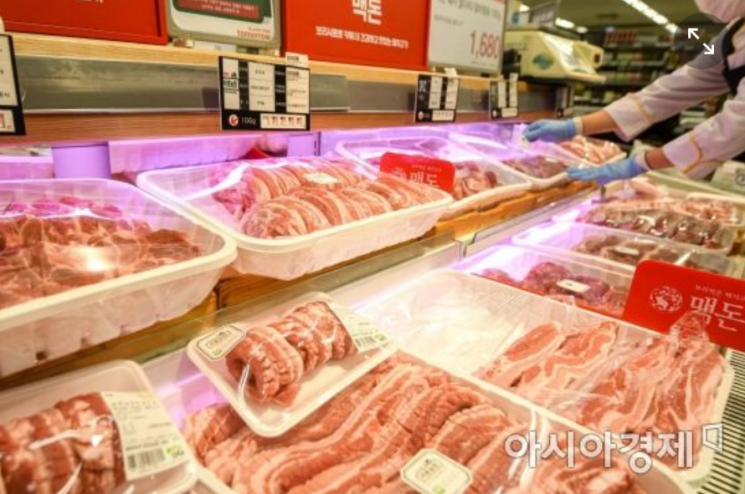 Pork is displayed at the meat section sales counter of a large supermarket in Seoul. Photo by Asia Economy DB.
[Asia Economy Reporter Heo Midam] # Kim (26), an office worker living in Yangcheon-gu, Seoul, started keeping a household ledger last month. This was because it became difficult to cope with rising prices, from food expenses to rent. Kim said, "These days, eating out feels almost scary. Since food expenses are the only thing I can cut back on, I try to buy cheap side dishes or cook at home. But the rising cost of ingredients is just as burdensome." He added, "Not long ago, I went to the mart to buy meat and was shocked to see that three strips of Samgyeopsal cost about 25,000 won," and confessed, "My salary stays the same, but prices keep rising, so life feels increasingly tough."
Recently, as meat prices have soared, consumers' sighs have deepened. Samgyeopsal, a representative dish for the working class, has risen in price so much that it is called "Gold (Geum) Samgyeopsal," and the price of leafy vegetables used as wraps with Samgyeopsal has also increased, adding to the burden on dining tables. This is because the Russian invasion of Ukraine caused international grain prices to surge, and the increase in grain prices led to higher feed costs, which in turn pushed up meat prices.
According to the Livestock Products Quality Evaluation Service on the 19th, the consumer price of U.S. ribs (100g) was 4,403 won as of the previous day, a 77% increase compared to 2,476 won a year ago. Australian ribs also rose 81% to 4,385 won from 2,422 won a year ago on the same date.
As the relatively cheap imported meat prices surged, more consumers are seeking domestic meat. However, domestic meat prices have also risen, increasing the burden on consumers. The consumer price of domestic refrigerated Samgyeopsal is 2,829 won per 100g, about 20% higher than a month ago (2,347 won).
The price of one serving of Samgyeopsal (based on 200g) sold in restaurants already reaches 20,000 won. Some meat restaurants are reducing the portion size of one serving of Samgyeopsal to lessen consumers' resistance to price hikes.
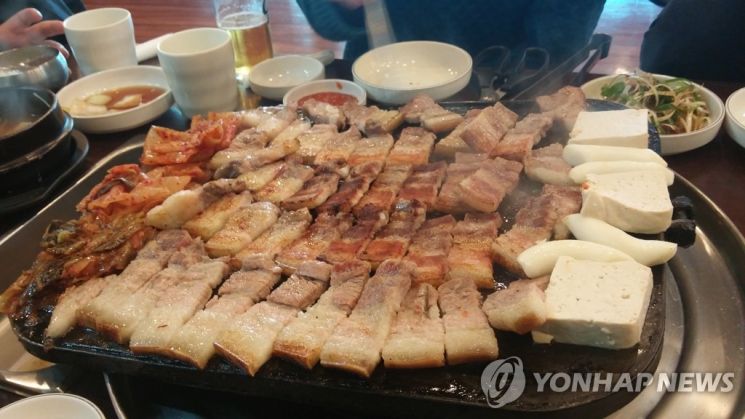
The rise in meat prices is related to Russia's invasion of Ukraine. The two countries are major producers of wheat, corn, and other grains, often called the "world's granary." However, as the war prolongs, farming has become impossible, causing grain prices to soar. Consequently, feed grain prices have also skyrocketed, leading to higher prices for pork and other meats.
Meanwhile, the price of leafy vegetables eaten with Samgyeopsal has also surged, further increasing consumer burdens. According to the Farm Air and Hankyung Agricultural Product Price Index (KAPI), the average wholesale price of perilla leaves this month was 7,664 won per kilogram, up 48.4% compared to the same month last year (5,163 won). Compared to the average May price (4,289 won), it surged 78.7%.
The problem is that meat prices may rise further. Samgyeopsal prices are typically highest in the summer months (July to August), when camping demand increases.

On online communities and elsewhere, opinions expressing the burden of rising Samgyeopsal prices continue. One netizen said, "Samgyeopsal prices are really expensive these days. When I went to the mart, it was about 3,300 to 3,600 won per 100g," adding, "I think it used to be around 2,200 to 2,500 won..." Another netizen said, "I knew prices had gone up, but I was shocked when I saw the Samgyeopsal price at the mart. It will probably rise more in summer. It seems everything except my salary is going up."
The rise in meat prices inevitably leads to increased burdens on dining table prices. According to a report titled "Changes and Prospects of Meat Consumption Structure" published last year by the Korea Rural Economic Institute, the annual per capita meat consumption in Korea increased about 71% over the past 20 years, from 31.9 kg to 54.3 kg. This is about 94% of the annual per capita rice consumption (57.7 kg), meaning Koreans eat as much meat as rice, their staple food.
Meanwhile, the Korea Development Institute (KDI) forecasted that the annual consumer price inflation rate will reach a high level of 4.2% this year. In its "2022 First Half Economic Outlook" published on the 18th, KDI stated about consumer prices, "In 2022, due to economic recovery and a sharp rise in international oil prices, the inflation rate will record a high 4.2%, but in 2023, as international oil prices stabilize, the inflation rate will fall to 2.2%."
© The Asia Business Daily(www.asiae.co.kr). All rights reserved.
![Clutching a Stolen Dior Bag, Saying "I Hate Being Poor but Real"... The Grotesque Con of a "Human Knockoff" [Slate]](https://cwcontent.asiae.co.kr/asiaresize/183/2026021902243444107_1771435474.jpg)












