Biden to Attend Quad Summit and Launch Indo-Pacific Economic Framework During Tour
China Calls Biden's Tour 'Blatant Provocation', Japan Urges 'Cautious Action'
[Asia Economy Beijing=Special Correspondent Jo Young-shin] As U.S. President Joe Biden prepares to visit South Korea and Japan, the United States and China are once again sharply confronting each other.
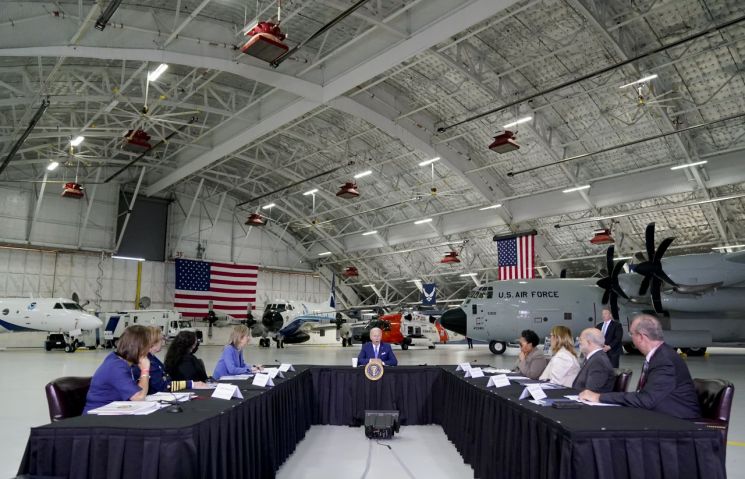
The White House officially confirmed that the Quad summit, a consultative body aimed at countering China, will be held during President Biden's East Asia tour. It also announced the official launch of the Indo-Pacific Economic Framework (IPEF) to curb China's expanding economic influence. In response, China labeled Biden's East Asia tour as an overt provocation targeting China and warned that it will take resolute measures to protect its sovereignty, security, and core interests (Taiwan).
Jake Sullivan, White House National Security Advisor, said at a press briefing on the 18th (local time) ahead of Biden's trip, "During this tour, President Biden will fully demonstrate his Indo-Pacific strategy," adding, "He will present effective and principled U.S. leadership in this region that will define much of the 21st century's future."
Sullivan emphasized that this tour comes after the U.S. rallied the West following Russia's invasion of Ukraine and marks the first visit to another critical region, the Indo-Pacific, at a very important moment. He noted that it will be an opportunity to reaffirm and strengthen security alliances with South Korea and Japan, deepen economic partnerships, and express gratitude for their cooperation in responding to the Ukraine war.
He further stated that Biden's tour carries a message about what the world could look like if democratic countries around the globe unite, openly conveying the intent to check and pressure China and other anti-democratic forces.
He specifically warned that there is a possibility of provocations from North Korea during Biden's visit and that any provocation will be met with a corresponding response.
China is strongly opposing Biden's visit, labeling it a provocative trip.
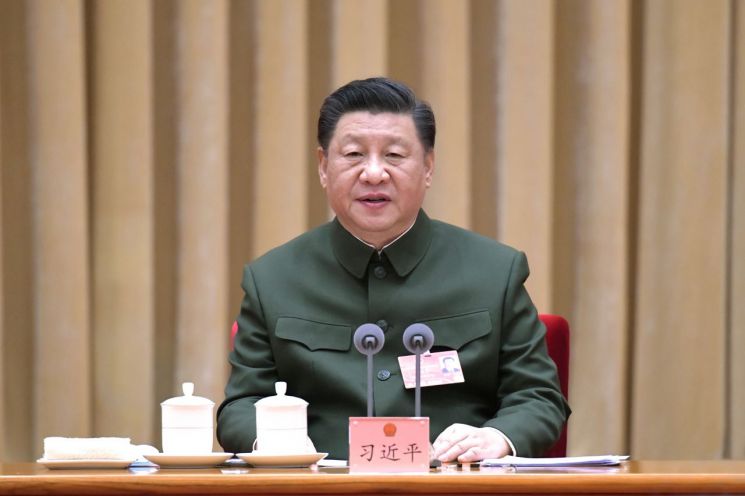
According to Chinese state media such as Xinhua News Agency, Yang Jiechi, a member of the Political Bureau of the Communist Party of China responsible for foreign affairs, said in a phone call with Sullivan the previous day that "the U.S. attempt to form factions (alliances) and incite division and confrontation will not succeed."
Yang reiterated a warning regarding the Taiwan issue. He stated, "If the U.S. uses Taiwan to contain China, China will take resolute measures to safeguard its sovereignty, security, and core interests," adding, "We (China) will do as we say."
Foreign Minister Wang Yi pressured Japan with very strong language. In a video call with Japanese Foreign Minister Hayashi Yoshimasa the previous day, Wang warned, "Japan should not follow the wrong path of its neighbor (the U.S.)," and urged, "Learn from history and act cautiously going forward." This is interpreted as a statement reflecting China's sentiment toward Japan and an intentionally insulting warning.
The state-run Global Times harshly criticized the Japanese political sphere, stating that Japan is acting as a guide for the U.S. in the Asia-Pacific region. The outlet analyzed that Japan's linking of the Ukraine issue with Taiwan to stir public opinion is a strategic move with the Diaoyutai (Senkaku Islands) in mind.
Meanwhile, some in Beijing speculate that Yang Jiechi and Sullivan may have exchanged broad views on economic issues such as tariffs, in addition to international and regional matters like Russia-Ukraine and North Korea. Economically, the U.S. is facing inflation problems, while China is exposed to recession risks due to the resurgence of COVID-19.
© The Asia Business Daily(www.asiae.co.kr). All rights reserved.


















