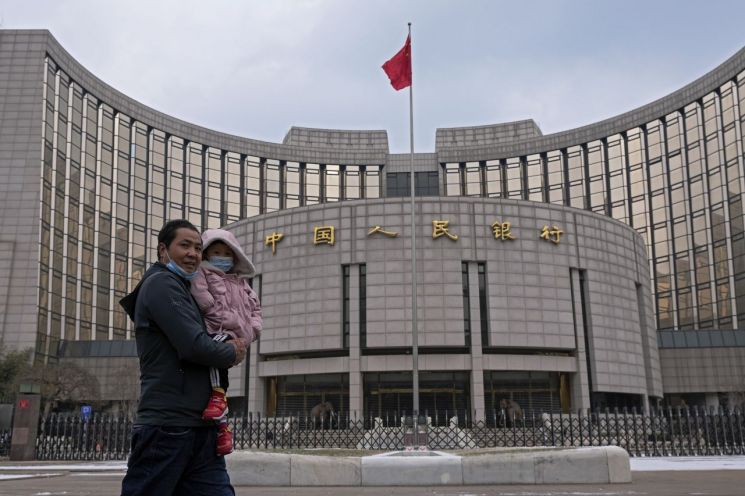
[Asia Economy Reporter Kim Hyunjung] The Wall Street Journal (WSJ) reported on the 18th (local time) that the Chinese government is investigating a central bank official on suspicion of leaking official economic statistics in advance. The official is known to be a hawk (favoring monetary tightening) who opposed China’s aggressive monetary easing.
According to WSJ, the Central Commission for Discipline Inspection (CCDI) announced on the same day that it is investigating Sun Guofeng, Director of the Monetary Policy Department at the People’s Bank of China (PBOC), for violations of discipline and law. The specific charges have not been disclosed.
However, sources familiar with the matter said the authorities are investigating whether Director Sun shared macroeconomic indicators such as inflation with certain bond traders at financial institutions before their official release since the late 1990s.
Sun, 49, who is under investigation, is known to have worked in the PBOC’s monetary policy department for over 20 years. He earned a Ph.D. in economics from a Chinese university and conducted research at Stanford University in the early 2000s. At that time, he published academic papers and English-language books on China’s financial reforms, which received favorable reviews, WSJ reported.
Those close to Director Sun described him as mild and diligent, and said that since his promotion to head of the monetary policy department in 2018, his workload has increased sharply, causing him noticeable stress, including his hair turning white.
Sun has maintained a hawkish stance opposing aggressive monetary easing, but the leadership reportedly demanded stronger monetary measures to support the economy, WSJ explained. Those close to him said he believed monetary easing could worsen speculative bubbles and cause excessive capital outflows during periods of slowing growth.
Economists diagnose that the Chinese central bank is currently in a complex situation where it must support growth amid increasing pressure on the Chinese currency and capital outflows. Eswar Prasad, an economics professor at Cornell University and former head of China division at the International Monetary Fund (IMF), analyzed, “As concerns about the vicious cycle of currency depreciation and capital outflows rise, the People’s Bank of China’s room to maneuver is becoming increasingly limited.”
© The Asia Business Daily(www.asiae.co.kr). All rights reserved.
![Clutching a Stolen Dior Bag, Saying "I Hate Being Poor but Real"... The Grotesque Con of a "Human Knockoff" [Slate]](https://cwcontent.asiae.co.kr/asiaresize/183/2026021902243444107_1771435474.jpg)
















