Yoon Administration Officially Joins IPEF... Discussed at Korea-US Summit
US-Led Indo-Pacific Economic Cooperation Focuses on New Trade Agendas
Strong Counterpart to RCEP... China-Led World's Largest FTA
IPEF Without 'Market Opening' Aims to Strengthen Regional Supply Chains
 President Yoon Suk-yeol answering questions
 (Seoul=Yonhap News) Ahn Jung-won reporter = On the morning of the 19th, one day before the vote on the confirmation of Prime Minister nominee Han Duck-soo, President Yoon Suk-yeol is answering questions from reporters as he arrives at the Yongsan Presidential Office building in Seoul. 2022.5.19
jeong@yna.co.kr
(End)
<Copyright(c) Yonhap News Agency, unauthorized reproduction and redistribution prohibited>
[Asia Economy Sejong=Reporter Lee Jun-hyung] As the government officially confirms joining the US-led Indo-Pacific Economic Framework (IPEF), South Korea's trade diplomacy calculations are becoming more complex. This is because the core of IPEF lies in countering the Regional Comprehensive Economic Partnership (RCEP), which Korea had joined earlier. At the same time, the government is also pushing for accession to the Comprehensive and Progressive Agreement for Trans-Pacific Partnership (CPTPP), drawing attention to the direction of economic alliances surrounding Korea.
According to related ministries on the 19th, President Yoon Suk-yeol will attend the IPEF launch summit in Japan on the 24th via video conference. Additionally, President Yoon plans to discuss supply chain cooperation centered on IPEF with President Joe Biden during the Korea-US summit on the 21st. A government official stated, “We plan to make a final announcement of Korea's intention to participate in IPEF at the Korea-US summit,” adding, “Participating in cooperation frameworks like IPEF is judged to be greatly beneficial to national interests.”
IPEF is an economic cooperation body in the Indo-Pacific region led by the United States. The Biden administration first unveiled the concept of IPEF at the East Asia Summit (EAS) in October last year. Currently, six countries including South Korea, Japan, Australia, New Zealand, Singapore, and the Philippines have confirmed participation. Some ASEAN countries such as Vietnam and Malaysia are reportedly still considering whether to join as founding members of IPEF.
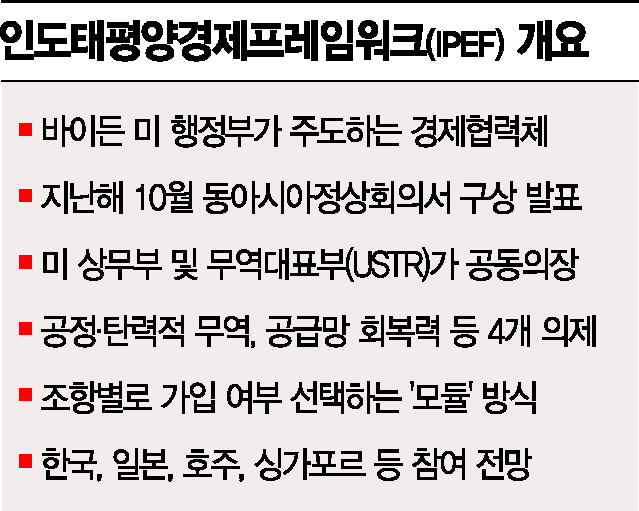
Some countries have not yet confirmed early participation in IPEF because it strongly serves to counter the China-led RCEP. RCEP, which came into effect earlier this year, is the world's largest free trade agreement (FTA) with 15 member countries including South Korea, Japan, and Australia. Trade volume among RCEP member countries accounts for about 32% of global trade, and it is characterized by unified rules of origin within the region. Since products produced among RCEP member countries are recognized as having the same origin, companies can significantly reduce costs associated with existing exports and imports. The Korean government joined RCEP with the intention of sequentially removing barriers necessary for exports and imports to enhance export competitiveness, which is a 'growth engine.'
This is similar to the CPTPP, another economic alliance that the Korean government is pursuing membership in. Launched in 2018, CPTPP is a mega FTA formed by 11 Asia-Pacific countries including Japan, Australia, and Mexico, with an average tariff elimination rate among member countries reaching about 96%, indicating a high level of market openness. China, as well as the United Kingdom, Taiwan, and Ecuador, applied for membership last year. Our government also officially expressed its intention to participate last year. China aims to dominate the Asia-Pacific economic leadership centered on RCEP and CPTPP.
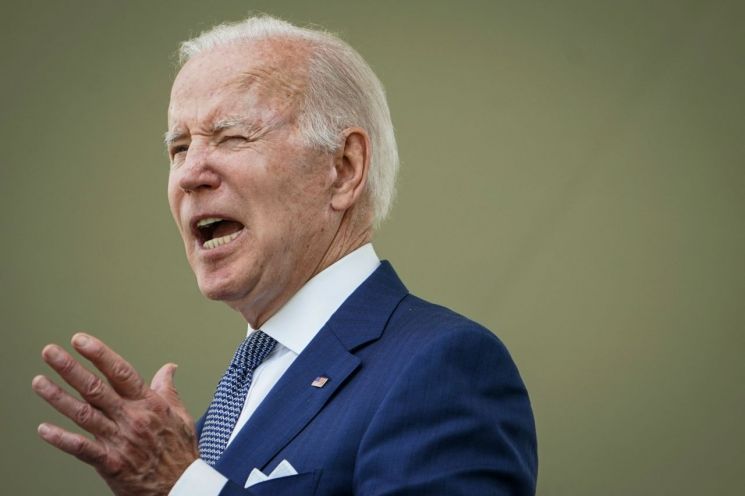 Biden Speaking at Memorial Ceremony for Fallen Police Officers
 (Washington AFP=Yonhap News) U.S. President Joe Biden delivered a speech on the 15th (local time) at the '2021 Law Enforcement Officers Fallen Memorial Ceremony' held at the U.S. Capitol in Washington DC. Referring to the mass shooting incident in Buffalo, New York, he said, "We must all work together to address hate crimes that remain a stain on the soul of America." May 16, 2022
jsmoon@yna.co.kr
(End)
? Yonhap News Agency, Unauthorized reproduction and redistribution prohibited
However, IPEF differs in nature from multilateral FTAs like RCEP and CPTPP. Unlike general trade agreements, IPEF does not include provisions related to 'market opening.' This means it differs from traditional FTAs, which aim to eliminate tariffs, from the outset. The US defines IPEF as an 'administrative agreement' rather than a treaty like an FTA. This is also why there has been debate about the effectiveness of IPEF.
Instead, IPEF focuses on new trade agendas such as global supply chains and decarbonization. Furthermore, IPEF is structured in a 'modular' way, allowing participants to choose whether to participate in each agenda and the degree of binding force of the agreement, offering a high degree of flexibility. The government expects that IPEF will strengthen regional supply chains in key industries such as semiconductors and secondary batteries.
© The Asia Business Daily(www.asiae.co.kr). All rights reserved.



















