[Asia Economy New York=Special Correspondent Seulgina Jo] "It is nothing less than a prelude to an upcoming recession." "It is worse than during the 2000 dot-com bubble."
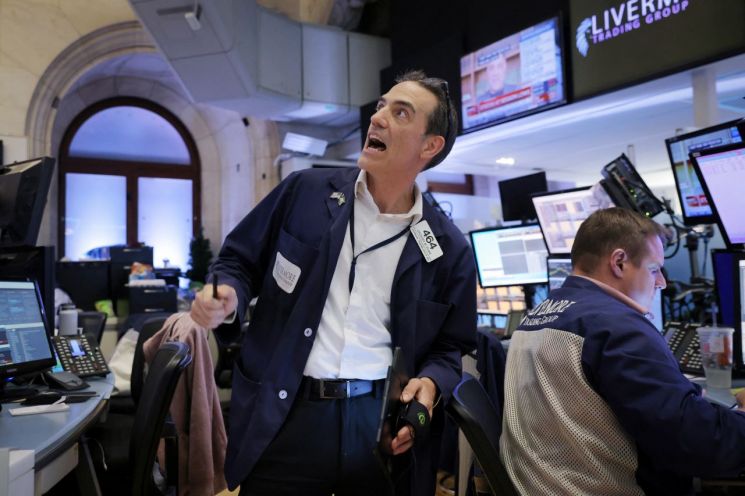
On the 18th (local time), although the U.S. New York stock market recorded its largest drop in two years, pessimism is spreading in the market that "the bottom is still far away." High inflation has begun to hamper corporate earnings, intensifying recession warning signals.
Jeremy Grantham, a famous Wall Street hedge fund manager, appeared on the economic media CNBC that day and predicted, "Stock prices could plunge to less than half of the current level." He diagnosed that the current situation, where bubbles exist not only in stocks as during the dot-com bubble but also in real estate, bonds, and commodities, is much worse. Grantham also compared this to the massive asset bubble in Japan in the 1980s.
Grantham, considered a representative pessimist, said, "If we are unlucky, there is a possibility of a drop to one-third," and expressed concern that "like during the 2000 dot-com bubble, it will take 2 to 3 years for the stock market to recover from the bear market." Based on the intraday low on the 12th of this month, the S&P 500 index has fallen about 19.9% from the beginning of the year, and the Nasdaq index has dropped about 27%.
Art Cashin, a UBS director known as a Wall Street legend, also said, "The bottom has not come yet," and "a real bear market is coming." He predicted that the moment the S&P 500 index breaks below the previous low of 3,930 points (closing basis) and records a new low could be a signal of 'free fall.' This is essentially a warning that the bear market will begin from now on.
Mike Bailey of FBB Capital Partners likened the New York stock market's 3-4% drop that day to a prelude to a recession. He argued that, as seen in cases like Walmart and Target, high inflation will directly hit corporate earnings and the real economy in earnest. LPL Financial analyzed, "Inflation and the 'hawkish' Federal Reserve are nothing new, but (in the market that day) concerns about the impact of inflation on corporate earnings were newly added," and said, "A larger bear market is also possible."
Investors have already significantly reduced their stock holdings and started to accumulate cash. According to Bank of America (BoA), in the May fund manager survey, investors' cash holdings were at the highest level since September 2001.
Mohamed El-Erian, Senior Advisor at Allianz, mentioned the rise in prices of safe assets such as government bonds and the dollar that day, diagnosing it as "a new phase different from before." He evaluated, "At first, it was a sell-off due to interest rate fears and tightening, but now there is also fear about growth." El-Erian has repeatedly criticized the Fed's delayed response to inflation and warned several times about the possibility of stagflation.
Voices expressing concern about a recession continue to pour out. David Solomon, CEO of Goldman Sachs, said in response to a question about the economic outlook 18 months ahead, "I see a 30% probability of a recession within 12 to 24 months," adding, "There is a reasonable possibility of a recession, and if not, we will see very, very slow growth."
Meanwhile, on the same day at the New York Stock Exchange (NYSE), the Dow Jones Industrial Average, composed of blue-chip stocks, closed at 31,490.07, down 1,164.52 points (3.57%) from the previous session. This is the largest drop since June 2020. The large-cap-focused S&P 500 index closed at 3,923.68, down 165.17 points (4.04%), and the tech-heavy Nasdaq index ended the day at 11,418.15, down 566.37 points (4.73%).
© The Asia Business Daily(www.asiae.co.kr). All rights reserved.
![User Who Sold Erroneously Deposited Bitcoins to Repay Debt and Fund Entertainment... What Did the Supreme Court Decide in 2021? [Legal Issue Check]](https://cwcontent.asiae.co.kr/asiaresize/183/2026020910431234020_1770601391.png)
















