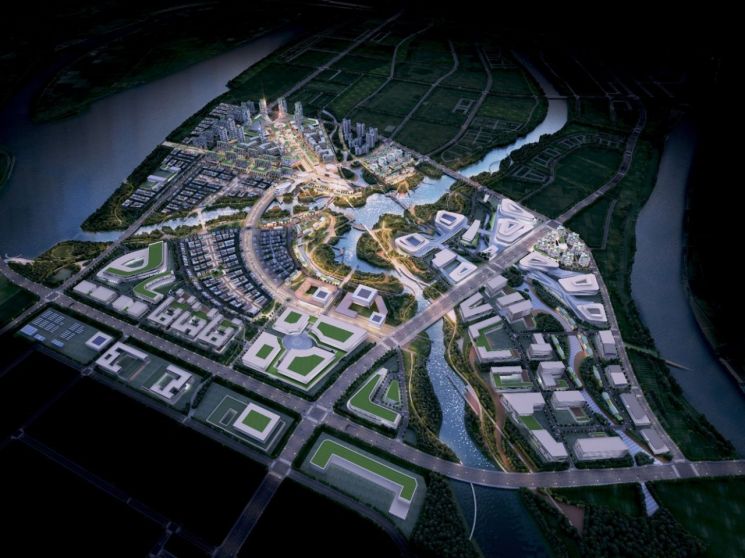
[Asia Economy Reporter Minyoung Kim] SK Ecoplant is participating in the Busan Eco Delta Smart City project to establish Korea's first 100% renewable energy self-sufficient city.
On the 19th, SK Ecoplant announced that the 'The In (人) Consortium,' which includes SK Ecoplant, was selected as the preferred negotiator in the 'Busan Eco Delta Smart City National Pilot City' construction and operation project commissioned by the Ministry of Land, Infrastructure and Transport and the Korea Water Resources Corporation.
SK Ecoplant will participate as an investor in the energy sector for this project. Based on its top-tier eco-friendly energy innovation technology capabilities and experience in Korea, it plans to provide renewable energy convergence solutions.
First, aiming to achieve 100% renewable energy self-sufficiency within the smart city, it will build and operate renewable energy supply infrastructure totaling 60MW, including fuel cells (SOFC, 59.4MW), rooftop solar power (602kW), thermoelectric generation using fuel cell waste heat (21kW), and geothermal (192RT). Through this, 100% of the energy required in the smart city will be produced and supplied by eco-friendly energy, establishing an energy self-sufficient city. This will result in an annual carbon reduction effect of approximately 74,000 tons, equivalent to planting 520,000 30-year-old pine trees.
Additionally, by introducing an AI and big data-based intelligent energy platform, it will strengthen integrated control and predictive management of distributed power sources, and support economic and stable energy supply through optimized energy platform operation. Together with SK C&C, it plans to build and operate electric vehicle charging stations using ultra-fast chargers linked to the renewable energy platform. Furthermore, a 59.4MW fuel cell will be installed in the smart city.
SK Ecoplant expressed its ambition to become a supplier of eco-friendly distributed energy solutions to realize The Zero City through this project. The strategy is to solidify its position as a leading national carbon reduction company by successfully carrying out this project.
This project involves an investment of approximately 5.4 trillion KRW to develop a 2.8㎢ (about 840,000 pyeong) smart city in Gangseo-gu, Busan. It will integrate major urban functions applying various advanced IT new technologies in residential, commercial, business, energy, culture, R&D, and healthcare sectors, with about 3,380 households planned.
The 'The In (人) Consortium,' selected as the preferred negotiator, consists of 12 companies including LG CNS (Smart Services division) as the lead representative, SK Ecoplant (energy sector), Shinhan Bank (finance sector), and Hyundai Construction (construction sector). A special purpose corporation (SPC) will be established in 2023 to commence full-scale operations. The project period is a total of 15 years, including 5 years of construction and 10 years of operation.
Wangjae Lee, Head of Eco Energy BU at SK Ecoplant, said, "As a result of securing sufficient competitiveness by building a broad value chain in renewable energy fields such as fuel cells, solar power, offshore wind power, and hydrogen, we were able to participate in this project. We will successfully carry out this project to accelerate the realization of The Zero City, a circular economy model where waste zero and carbon zero are actualized by integrating carbon neutrality, energy self-sufficiency, and smart city solutions."
© The Asia Business Daily(www.asiae.co.kr). All rights reserved.

















