Seoul, Daegu, Sejong Halved in One Year
Regulations and Rising Interest Rates Block Funding
New Real Estate Policy Expectations Lead to Wait-and-See Sentiment
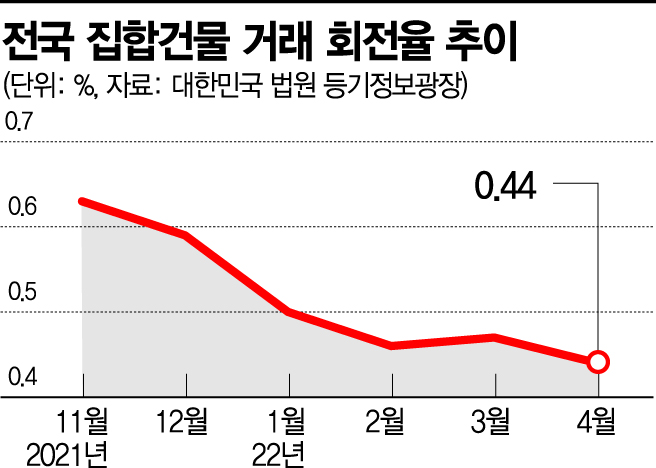
[Asia Economy Reporter Hwang Seoyul] The transaction turnover rate, which indicates the activity level of the real estate sales market, has once again hit rock bottom. It is the lowest in nine years. In addition to the tightening of funds for actual buyers due to loan regulations and interest rate hikes, the real estate market is struggling to gain momentum as buyers remain cautious even after the presidential election.
According to the Korea Court Registry Information Plaza on the 19th, the nationwide transaction turnover rate for collective buildings (apartments, multi-family/row houses, officetels, etc.) last month was recorded at 0.44%. This is the lowest figure in 9 years and 3 months since January 2013, when it was 0.32%. The turnover rate is calculated by dividing the number of real estate ownership transfer sale applications by the total number of properties and multiplying by 100, allowing comparison of the real estate market's activity level. A turnover rate of 0.44% means that out of every 10,000 collective buildings, 44 were sold.
The downward trend in sales transactions began in March last year. The turnover rate was 0.83% in March last year and has steadily declined since. Especially after November last year (0.63%), it sharply dropped, reaching 0.46% in February this year. It slightly rose to 0.47% in March but fell again to 0.44% last month. Compared to 0.78% in April last year, this is a decrease of 0.34 percentage points.
The transaction drought is severe across regions as well. Among the 17 cities, provinces, and metropolitan cities, except for six regions (Incheon, Gangwon, Chungbuk, Chungnam, Jeonbuk, Gyeongnam), the turnover rate last month was below 0.5%. The lowest was Daegu (0.26%), followed by Seoul and Sejong (0.32%). Considering that in April last year, Seoul's turnover rate was 0.64%, Daegu's was 0.63%, and Sejong's was 0.76%, the turnover rate has halved in just one year.
The market views buyers' cautious stance as the biggest factor. The head of A Real Estate Agency in Hongje-dong, Seodaemun-gu, said, "There are inquiries from buyers, but they only look for urgent sales," adding, "Since the new government has not yet implemented any pledges, buyers remain cautious." He continued, "Some buyers hope for loan easing, but others hesitate due to interest rates." According to the Korea Real Estate Board's weekly sales supply-demand trend, the nationwide sales supply-demand index has remained below 100 since the last week of November last year, when it was 100.1. Last week, the sales supply-demand index was 93.8. The index ranges from 0 to 200, with 100 as the baseline; below 100 indicates more supply, and above 100 indicates more demand.
© The Asia Business Daily(www.asiae.co.kr). All rights reserved.

















