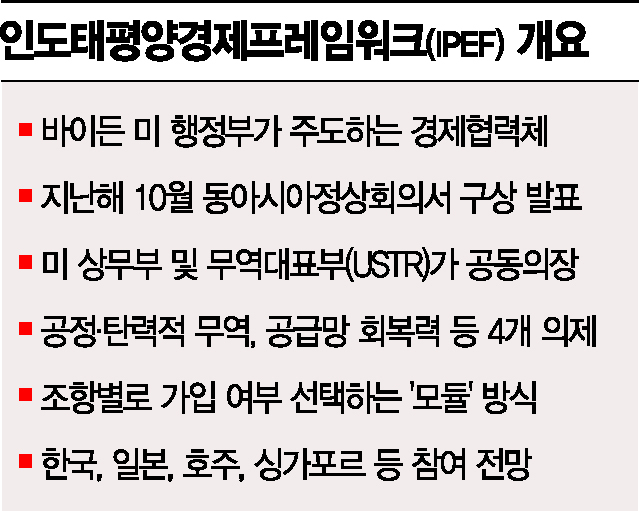
[Asia Economy Reporter Yoo In-ho, Sejong=Reporter Lee Jun-hyung] President Yoon Suk-yeol will officially declare South Korea's participation in the United States' economic cooperation initiative, the "Indo-Pacific Economic Framework" (IPEF), at the Korea-US summit on the 21st.
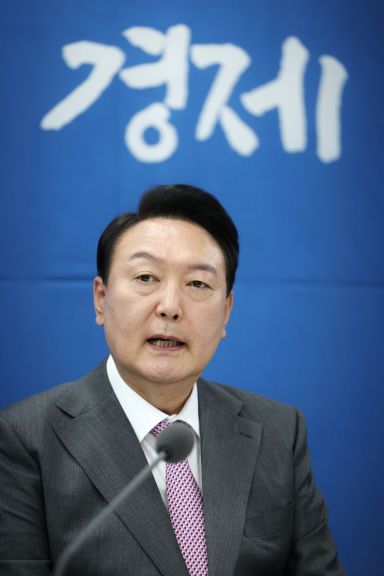
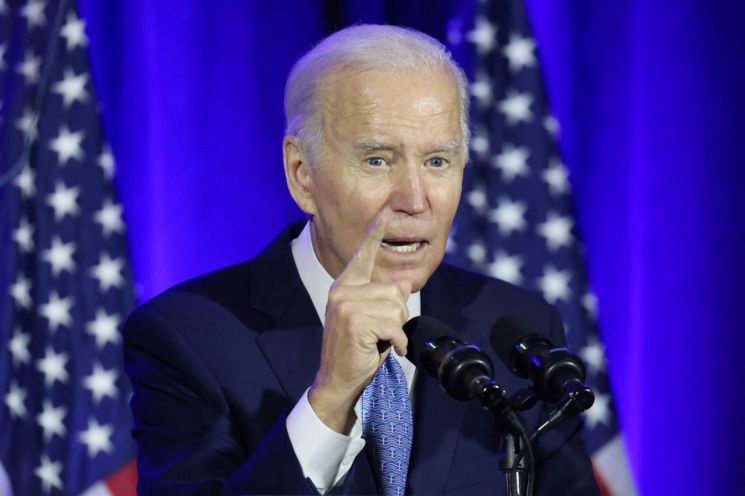
President Yoon will discuss participation in IPEF with US President Joe Biden during their bilateral meeting, and then expand economic security efforts by attending the IPEF launch summit held in Japan on the 24th via video conference.
Following his recent mention of joining IPEF in the National Assembly policy speech, President Yoon is expected to create a favorable economic security environment by formalizing South Korea's participation in the US-led IPEF through this summit.
Through this, President Yoon aims to strengthen a robust security system against North Korea's nuclear and missile threats, reinforce a joint response front in the Indo-Pacific region, and elevate economic cooperation to a higher level in response to global supply chain disruptions.
In diplomatic circles, there is analysis that President Yoon's official declaration of IPEF participation less than ten days after taking office reflects a judgment that it is desirable to join at the launch stage, given concerns that South Korea could be marginalized if it hesitates to join the new US-led trade norms being established.
In the past, the South Korean government missed the timing to join major agreements, which negatively affected national interests. The Comprehensive and Progressive Agreement for Trans-Pacific Partnership (CPTPP) is a representative example.
Originally, South Korea had opportunities to join the CPTPP's predecessor, the Trans-Pacific Partnership (TPP), since discussions began in 2010, but repeatedly declined membership, and ultimately the government only confirmed joining CPTPP last year.
The issue is that South Korea's participation in IPEF is expected to cause subtle changes in relations with China. IPEF is essentially a US-led regional economic cooperation community with a strong character of countering China.
Centered on four themes?trade, supply chains, decarbonization and infrastructure, and tax and anti-corruption?participating countries such as Japan, India, Australia, New Zealand, Singapore, and the Philippines seek economic cooperation measures, with a key focus on building regional supply chains excluding China in critical sectors like semiconductors and batteries.
In response, China, which has been wary of the Yoon administration's efforts to strengthen the Korea-US alliance, is expected to oppose South Korea's participation in IPEF during the Korea-US summit.
China has already expressed a negative stance on South Korea's IPEF participation. Wang Yi, China's State Councilor and Foreign Minister, recently told Foreign Minister Park Jin during a phone call, "We oppose the negative trend of decoupling." This is interpreted as an attempt to prevent South Korea from joining US-led pressure on China starting with IPEF membership.
The Presidential Office and the Ministry of Trade, Industry and Energy, the main government agency in charge, have distanced themselves from claims that IPEF is aimed at containing China.
An official from the Ministry of Trade said, "Our government believes that IPEF should be an inclusive and open economic cooperation body," adding, "South Korea is actively participating in various economic blocs to lead the new trade order in the Indo-Pacific region and expand economic cooperation." He further stated, "We will also strengthen economic cooperation with China and other regional countries through various cooperation channels."
Experts predict that the Korea-US summit will be the first diplomatic test for the Yoon administration following the formalization of IPEF membership.
Professor Park Won-gon of Ewha Womans University’s Department of North Korean Studies said, "Even if China protests, South Korea is not the only country joining, so there is no justification for retaliation targeting only South Korea," adding, "Any decision will inevitably incur costs and potential losses. It is necessary to balance between losses and gains."
© The Asia Business Daily(www.asiae.co.kr). All rights reserved.



















