'Regulatory Relaxation → Investment → Employment → Growth' Virtuous Cycle Promotion
Legislation Needed to Ensure Effectiveness of Cause-Three-Out 'Regulatory Cost Reduction System'
[Asia Economy Sejong=Reporter Kwon Haeyoung] The Yoon Seok-yeol administration's decision to introduce the 'Regulatory Cost Reduction System' is interpreted as a determination not just to remove the sandbags (regulations) that are holding back companies, but to thoroughly uproot the regulations so that the demand-side companies can feel the impact. Through a regulatory diet involving microscopic inspection from the establishment, operation, to abolition of regulations, the goal is to build a virtuous cycle structure of 'investment → employment → growth.'
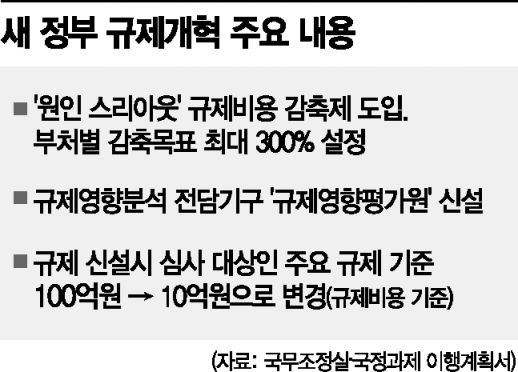
According to the government's national agenda implementation plan and related ministries on the 18th, the government plans to promote a regulatory innovation policy package including the Regulatory Cost Reduction System, which sets reduction targets for each ministry, expansion of regulatory review targets, and the establishment of the Regulatory Impact Assessment Institute.
First, the scope of major regulations that must undergo review by the Presidential Regulatory Reform Committee will be expanded from the current annual regulatory cost of 10 billion KRW or more to 1 billion KRW or more. Regulatory cost refers to the costs that citizens or companies must bear to comply with regulations. Currently, if the regulatory cost is 10 billion KRW or more or the regulation targets more than 1 million people, the Regulatory Reform Committee's main committee reviews its appropriateness. Going forward, to prevent unreasonable regulations in the economic and employment sectors, regulations with economic and social ripple effects and regulatory costs of 1 billion KRW or more will be included in the review target.
The 'Regulatory Impact Assessment Institute' will also be established in the first half of next year. As a dedicated organization for regulatory impact analysis, it will analyze the post-impact of regulations after a certain period and promote their abolition or improvement. The impact of regulations on productivity, corporate burden, and industrial competitiveness will also be reflected in the regulatory evaluation criteria. A government official stated, "Currently, regulatory impacts are evaluated mainly by personnel dispatched from each ministry, but the newly established Regulatory Impact Assessment Institute will include many private experts to strengthen expertise." In addition, the government plans to expand the introduction of a negative regulatory system in key new industry sectors such as autonomous vehicles, metaverse, artificial intelligence (AI), hydrogen and electric vehicles, robots, and drones.
The new government’s move to ease regulations aims to create a business-friendly environment to promote a virtuous cycle of investment → employment → growth. Currently, South Korea's corporate institutional competitiveness ranks 26th out of 37 OECD member countries, showing significantly low competitiveness. In this situation, there are opinions that legal institutionalization should be pursued if necessary to enhance the effectiveness of the regulatory reforms promoted by the government. The 'One In Three Out' regulatory cost reduction system, scheduled to be introduced next year by the Yoon administration, is a representative example. Although the Regulatory Cost Management System (maintaining the total regulatory cost) was fully introduced in 2016 and is currently in operation, it is stipulated by a Prime Minister’s directive and is ineffective. Therefore, to support the system’s effectiveness and government execution power, it is pointed out that legal binding force should be granted. The UK, which we benchmarked, has introduced a 'One In Two Out' regulatory reduction system where the government sets specific corporate regulatory cost reduction targets and the parliament reviews the implementation performance to enhance government execution power.
An official from the Korea Institute of Public Administration emphasized, "In the UK, each minister reports regulatory reduction achievements to the parliament, enhancing ministerial responsibility and institutional execution power of ministries," and added, "Regulatory cost-related systems should be operated in a way that allows substantial evaluation and checks."
© The Asia Business Daily(www.asiae.co.kr). All rights reserved.
![Clutching a Stolen Dior Bag, Saying "I Hate Being Poor but Real"... The Grotesque Con of a "Human Knockoff" [Slate]](https://cwcontent.asiae.co.kr/asiaresize/183/2026021902243444107_1771435474.jpg)
















