Direct Adrenal Access Without Touching Surrounding Organs
Minimal Dorsal Incision for Safe Tumor Removal
No Fasting Required and Fewer Complications
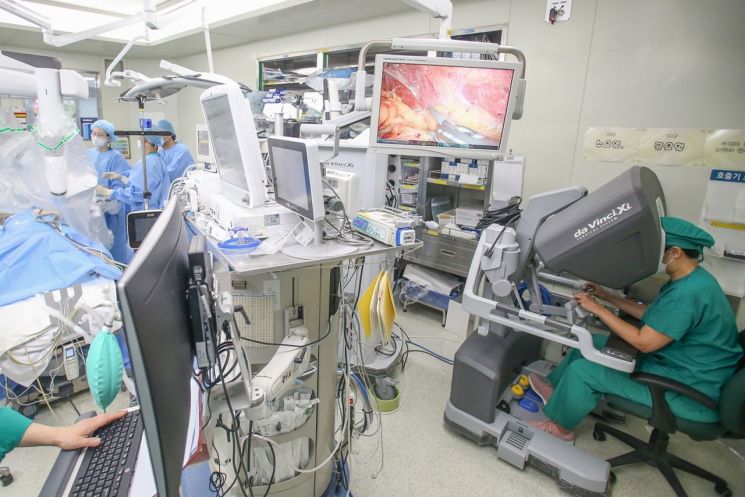 Professor Sung Tae-yeon (bottom right) of the Department of Endocrine Surgery at Seoul Asan Medical Center is performing robot-assisted adrenalectomy through the retroperitoneum on a patient with Cushing's syndrome.
[Asia Economy Reporter Lee Gwan-ju] Seoul Asan Medical Center announced on the 18th that retroperitoneal (dorsal) endoscopic and robotic adrenalectomy for patients suffering from severe hormonal disorders due to adrenal tumors has reached 1,000 cases as of last month.
The adrenal glands secrete steroid hormones that regulate the body's metabolic processes and immune responses. When conditions such as adrenal cancer or adrenal tumors cause abnormal hormone secretion, including pheochromocytoma and Cushing's syndrome, it can lead to metabolic diseases like hypertension, obesity, and diabetes, necessitating adrenalectomy through surgery.
Previously, laparoscopic adrenalectomy was performed by making four or five 1-2 cm incisions in the abdomen of a patient lying down and inserting laparoscopic instruments to remove the adrenal gland. However, since the adrenal glands are located deep within the abdomen, it was necessary to push aside and fix other organs such as the stomach, small intestine, large intestine, liver, and pancreas to access the adrenal glands. The organs touched during this process took an average of two days to recover, during which fasting was unavoidable.
In contrast, retroperitoneal adrenalectomy involves making a small incision on the dorsal side near the adrenal gland, considering that the adrenal glands are located just above the kidneys, deep behind the liver and stomach, and inserting an endoscope or robotic arm to remove the adrenal gland. Unlike laparoscopic adrenalectomy through the abdomen, this method does not disturb surrounding organs, eliminating the need for fasting and reducing complications. Hospital stays are also minimized, allowing discharge around two days after surgery.
Among the 1,000 cases, there were no instances requiring open surgery with abdominal incision or serious complications. The primary diseases included pheochromocytoma, Cushing's syndrome, and primary aldosteronism, each accounting for about 30%. Other cases involved medullary lipoma, early adrenal cancer, and adrenal metastases. Surgeries related to functional adrenal tumors (excessive secretion of specific hormones) were the most common, and all these patients were discharged safely without complications.
Notably, since the introduction of robotic surgery, the number of incision sites has been reduced to one or two, significantly decreasing postoperative pain and accelerating recovery. Seoul Asan Medical Center has performed over 300 retroperitoneal adrenalectomies using robotic systems. In 2018, the number of incisions was reduced to two using the Da Vinci robot, and since 2021, single-port robotic adrenalectomy with only one incision has been performed based on the Da Vinci SP system. However, in cases of advanced adrenal cancer, open surgery is performed considering patient safety and disease characteristics.
Professor Sung Tae-yeon of the Department of Endocrine Surgery at Seoul Asan Medical Center stated, “Retroperitoneal adrenalectomy has proven its superiority in terms of postoperative abdominal pain, analgesic use, complications, and recovery speed, establishing itself as the standard method for adrenalectomy. The endocrinology team at Seoul Asan Medical Center will continue to advance adrenalectomy techniques and do their best to help patients with adrenal diseases recover their health and improve their quality of life.”
© The Asia Business Daily(www.asiae.co.kr). All rights reserved.