[Asia Economy Reporter Donghyun Choi] More than half of small and medium-sized manufacturing enterprises with over 30 employees are experiencing difficulties implementing the 52-hour workweek system. They expressed a desire to introduce a 'monthly extended working hours system' to resolve issues related to the 52-hour workweek.
The Korea Federation of SMEs announced the results of a survey conducted on the 18th targeting 555 small and medium manufacturing companies regarding the "Implementation Status and Improvement Opinions on the 52-hour Workweek System." According to the survey, 42.4% of small and medium manufacturing companies reported difficulties in implementing the 52-hour workweek system. Notably, the larger the company, the higher the proportion reporting difficulties. Among companies with 30-49 employees (52.2%) and 50-299 employees (52.6%), which cannot utilize the 8-hour additional extended working hours system, more than half still face challenges in implementing the system.
The main reason cited for these difficulties was 'labor shortage' (39.6%). This was followed by 'difficulty in utilizing flexible working hours due to unpredictable advance orders' (32.3%) and 'burden of labor costs from additional hiring' (20.0%).
Among companies struggling with the 52-hour workweek system, the most common response to cope was 'introduction of flexible working hours such as flexible work schedules' at 23.4%. This was followed by 'utilization of the 8-hour additional extended working hours system' (22.6%) and 'hiring additional personnel' (22.1%). Notably, 20.9% of companies responded that they had no appropriate measures and were unable to respond.
Additionally, companies responding by expanding extended working hours through 'utilization of the 8-hour additional extended working hours system' (22.6%) and 'utilization of the special extended working hours system' (12.3%) accounted for 34.9%, indicating that more companies cope by expanding extended working hours than by using flexible working hours (23.4%).
More than half (52.0%) of companies with 5-29 employees responded that they are coping by utilizing the '8-hour additional extended working hours system,' which is temporarily operated until the end of this year. It is analyzed that if this system is discontinued, difficulties related to the 52-hour workweek system in small businesses will intensify further.
Among companies utilizing flexible working hours, 81.8% were found to use the flexible work schedule system. Among them, half (49.1%) reported operational difficulties due to limited eligibility and requirements of the system.
Among companies not utilizing flexible working hours, 73.3% responded that they have 'no intention to introduce it in the future.' Excluding companies that do not need to introduce the system, the reasons cited were 'lack of cost and administrative capacity to introduce it' (22.7%), 'preference for coping by expanding extended working hours such as special extended working hours' (17.4%), and 'inability to comply with complicated requirements and procedures' (16.7%). Additionally, more than half (54.2%) of companies planning to introduce the system identified the flexible work schedule system as the most suitable flexible working hours system. Other flexible working hours systems showed significantly lower utilization in small and medium enterprises.
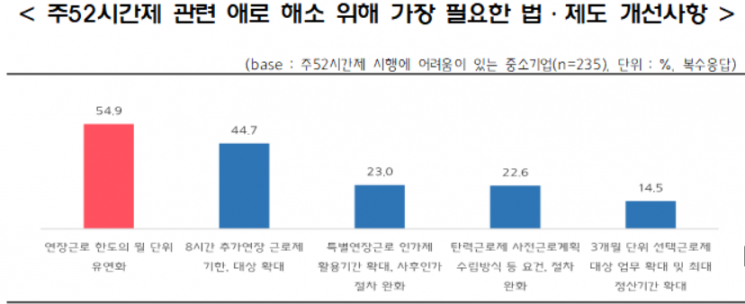
The most necessary legal and institutional improvement to alleviate difficulties related to the 52-hour workweek system was 'flexibilization of the extended working hours limit on a monthly basis,' which accounted for 54.9%. This was followed by 'extension of the period and scope of the 8-hour additional extended working hours system' (44.7%) and 'extension of the approval period for the special extended working hours system and relaxation of the post-approval procedure' (23.0%).
Lee Tae-hee, Head of the Smart Jobs Division at the Korea Federation of SMEs, emphasized, "Many small and medium enterprises still face difficulties implementing the 52-hour workweek system due to labor shortages, irregular order volumes, and flexible working hours systems that do not fit the workplace. As revealed in this survey, if both labor and management agree, institutional supplements such as the introduction of a monthly extended working hours system or expansion of the 8-hour additional extended working hours system should be promptly established to allow more flexible regulation of extended working hours."
© The Asia Business Daily(www.asiae.co.kr). All rights reserved.