Bereaved Family: "Temperature at the Time Was 5 Degrees... Nonsense"
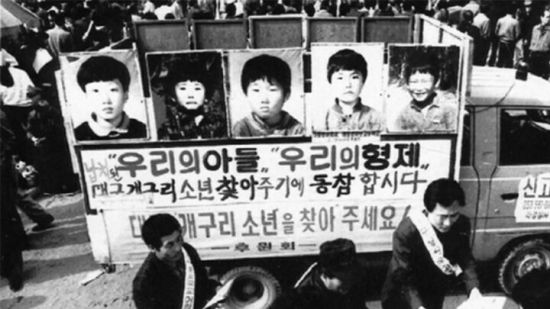 A nationwide campaign was launched to find the children during the 'Gaeguri Boys Missing Case' that occurred in Daegu in 1991.
 Photo by Yonhap News
[Asia Economy Reporter Na Ye-eun] A police officer who was in charge of the investigation of the so-called 'Frog Boys' case that occurred in Daegu in 1991 has claimed that the case was not a homicide.
The Frog Boys case refers to the incident where five elementary school students suddenly went missing on March 26, 1991, in Dalseo-gu, Daegu, and their remains were found near their home on Waryongsan Mountain 11 years later, on September 26, 2002.
At the time, the forensic team from Kyungpook National University concluded after six weeks of investigation that the children had been murdered, based on wounds found on their skulls. However, the perpetrator has not been identified to this day, and the case remains a long-unsolved mystery with many lingering doubts.
Recently, however, a police officer who was on the front lines of the investigation has argued that the cause of death was not homicide but 'hypothermia.' This claim was raised in the book Why Did the Children Go to the Mountain? by Kim Jae-san, head of the Daegu-Gyeongbuk bureau of Kukmin Ilbo, who was a field reporter at the time and based the argument on statements by former Daegu Police Department Violent Crimes Division Chief Kim Young-gyu.
On the 17th, CBS News Show introduced Kim’s claims from the book. Kim pointed out that among the five deceased children, three had wounds on their skulls, but the number and shape of these wounds varied. The police had tried to find the related weapons by examining the 'ㄷ'-shaped and 'V'-shaped marks on the skulls but ultimately failed to locate any matching tools.
While the forensic team at the time considered these wounds to have been inflicted before death and thus the cause of death, former Violent Crimes Chief Kim suggested that the skull damage might have occurred postmortem. He proposed that the fractures were caused by stones carried by floods during the 11 years before the remains were discovered.
In an interview with MBC, former Chief Kim said, "In the case of Woo Cheol-won, there are 25 trauma marks. That would require 25 weapons. None of the marks have the same shape. Not only the police but also the National Forensic Service searched all over South Korea for the weapons, but they could not find any that matched the wounds."
In conclusion, he argues that the children did not die from homicide but rather from hypothermia after losing their way on Waryongsan Mountain as it got dark. They had skipped lunch and were exposed to cold March weather and rain, which caused their body temperatures to drop fatally.
However, the bereaved families strongly oppose this view. According to CBS Radio, Naju-bong, chairman of the National Association of Citizens Searching for Missing Children, rebutted, "This is an absurd claim. Waryongsan is a place the children frequently visited. Its elevation is about 300 meters, so it is not a deep mountain."
He added, "On the day of the incident, March 26, 1991, there was only a light drizzle in the morning, and the temperature was around 5 degrees Celsius. Four of the five children attended a Taekwondo academy and were familiar with the mountain behind their neighborhood where they usually played. It makes no sense that they got lost there and died of hypothermia."
© The Asia Business Daily(www.asiae.co.kr). All rights reserved.

















