People Power Party to Hold Policy Forum with Government and SMEs on 17th
Seong Il-jong, Policy Committee Chair, Declares May Legislation for Proportional Representation Introduction
Fair Trade Commission 'Cautious' and Ministry of SMEs 'Minimal Legalization' Positions Announced
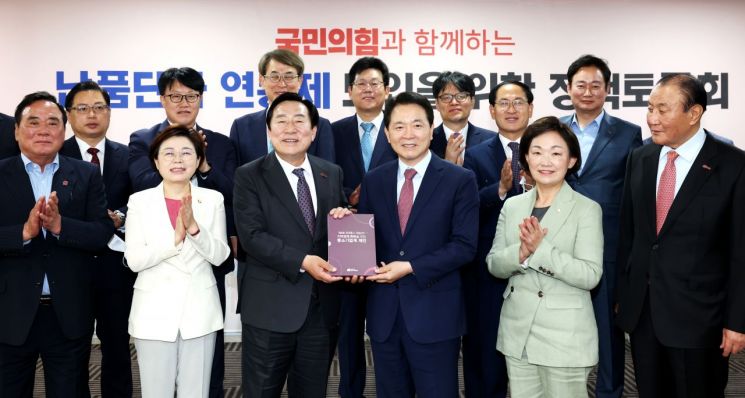
[Asia Economy Reporter Kim Bo-kyung] Ahead of the local elections, both ruling and opposition parties are united in calling for the introduction of a delivery price linkage system, aiming to win the support of the small and medium-sized enterprises (SMEs) sector. This move seeks to address the issue of rising manufacturing costs caused by the recent surge in international raw material prices being passed on to SMEs. However, since contract terms between companies are involved, legally enforcing such a system may conflict with the new government's philosophy of upholding market economy principles, drawing attention to how the linkage system will be implemented.
◆Ruling and opposition parties discuss delivery price linkage system with SME sector= On the morning of the 17th, the People Power Party's Policy Committee held a policy forum at the Korea Federation of SMEs in Yeouido, Seoul, to discuss the introduction of the delivery price linkage system. Attendees included Seong Il-jong, chairman of the Policy Committee, lawmakers Kim Jeong-jae and Han Mu-gyeong from the People Power Party, officials from the Fair Trade Commission and the Ministry of SMEs and Startups, and Kim Ki-moon, president of the Korea Federation of SMEs.
Yu Byung-jo, chairman of the Korea Curtain Wall Association, stated, "Prices of aluminum raw materials and steel pipes, which are auxiliary materials, have risen due to global supply chain instability, and have surged about twofold as of May due to the Ukraine crisis." Yang Chan-hoe, head of the Innovation Growth Division at the Korea Federation of SMEs, said, "Since 80% of SME sales are exclusively tied to specific large corporations, it is difficult to exercise bargaining power and conclude contracts fairly." President Kim emphasized, "The only solution to this problem is the delivery price linkage system," adding, "SMEs must receive fair prices to secure innovation capabilities and reduce the gap between large and small enterprises."
In response, Chairman Seong expressed his determination, saying, "We will amend the law to include provisions related to delivery prices to enforce the system and create a framework to ensure it works well," and pledged, "We will supplement this through legislation within May."
Earlier, on the 4th, the Democratic Party also held a meeting with the SME sector to discuss the introduction of the delivery price linkage system. About ten members of the Democratic Party's floor leadership, including floor leader Park Hong-geun, attended. The delivery price linkage system was also a campaign promise made by candidates from both parties in the presidential election. When the Presidential Transition Committee proposed providing incentives to companies that reflected raw material prices in delivery prices, the Democratic Party criticized it as a 'breach of promise.' With the local elections scheduled for the 1st of next month, both parties are reigniting interest in the delivery price linkage system to win SME support. Lawmakers Kim Gyeong-man from the Democratic Party and Kim Jeong-jae and Han Mu-gyeong from the People Power Party have already jointly proposed bills to introduce the delivery price linkage system (Win-Win Cooperation Act, Subcontracting Act).
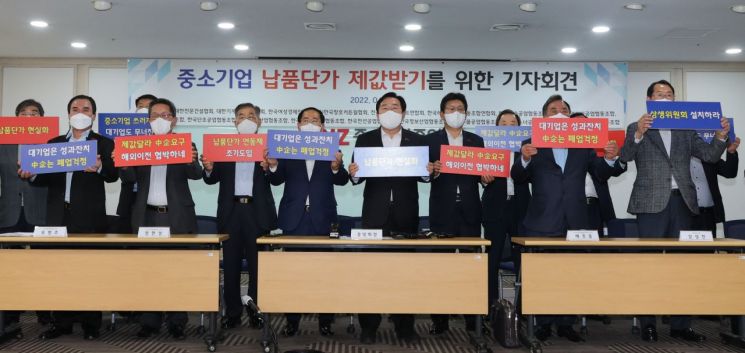
◆Two approaches to the linkage system: corporate incentives vs. legal obligation= Minister Lee Young of the Ministry of SMEs and Startups also expressed his commitment to introducing the delivery price linkage system. During his confirmation hearing on the 11th, Minister Lee mentioned a method requiring contracts between primary and subcontracting companies to include a clause stating that delivery prices must be linked. This means that the contracting parties agree in advance to adjust delivery payments according to raw material price fluctuations and include this agreement in the contract.
Regarding this, Kim Eun-ha, a research fellow at the KBIZ Small and Medium Business Research Institute, proposed two approaches to introducing the delivery price linkage system through standard contract revisions: an incentive method providing administrative and financial support to companies adopting the linkage system, and a legal approach mandating the inclusion of the linkage system in contracts. Kim explained, "South Korea's market structure is unfair, with large corporations and conglomerates exercising excessive market dominance," adding, "Addressing unfair economic order and the gap between large and small enterprises is a crucial task for sustainable economic growth."
She also explained that in the U.S. and Europe, adjusting delivery prices through contracts between parties is common, with contracts stipulating renegotiation when raw material price fluctuations exceed ±10%. This means that if raw material prices fall, delivery prices must also be reduced.
Chairman Seong also argued at the forum, "We will not force all burdens onto large corporations," stating, "When raw material prices decrease, delivery prices should also decrease. Linkage must be balanced, not only when prices rise but also when they fall." He added, "It should not be a situation where one side is forced to sacrifice; balance must be maintained."
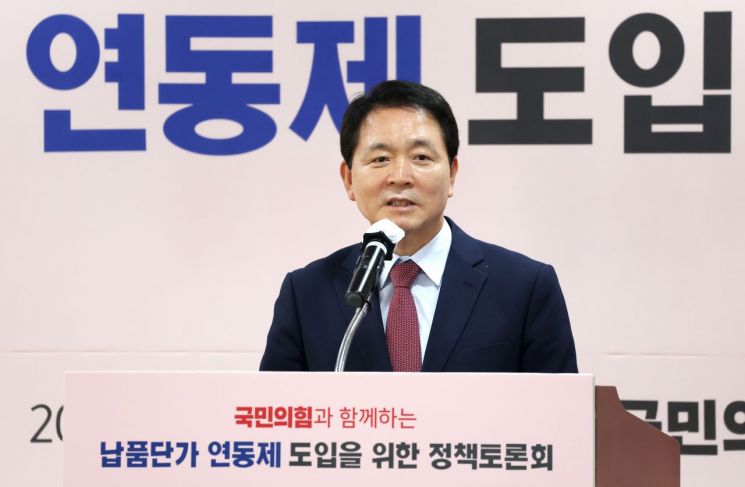
Until now, the delivery price linkage system has repeatedly failed to be introduced due to concerns over infringement on contractual freedom between companies, excessive government intervention in the market, and fears of consumer price increases. Yoo Hwan-ik, head of the Industrial Division at the Federation of Korean Industries, emphasized market economy principles at the forum, warning, "If the linkage system is legislated, it will undermine social trust beyond contractual relationships and create a conflict structure between suppliers and buyers," adding, "If product prices are guaranteed, innovation will be difficult and market distortion inevitable."
Song Sang-min, director of the Corporate Transaction Policy Bureau at the Fair Trade Commission, also maintained a cautious stance on legislation for the linkage system, stating, "Price is the most important competitive tool, almost sacred and inviolable." The Fair Trade Commission operates a delivery price adjustment reporting center to monitor the situation and favors resolving issues through trading practices and model contracts rather than legislation. The Ministry of SMEs and Startups expressed the view that "at least minimal legislation is necessary." Jeong Ki-hwan, director of the Win-Win Cooperation Policy Division at the ministry, said, "There could be a method to insert linkage clauses when drafting contracts and provide incentives to partner companies," but warned, "Excessive legal enforcement could cause side effects."
If the linkage system is introduced, there are also challenges in designing the system, such as determining which industries and raw materials it will apply to, setting linkage conditions and ratios, and deciding how to share the burden of raw material price increases among large and small enterprises and consumers.
The SME sector insists that the government must take the lead, but since the new government has established a fundamental principle emphasizing market autonomy, attention is focused on the direction the linkage system discussions will take. Professor Song Chang-seok of Soongsil University said, "A method combining delivery price adjustment consultation and the linkage system is necessary," adding, "The key is to enable equal bargaining power between companies to allow for swift resolution."
© The Asia Business Daily(www.asiae.co.kr). All rights reserved.
![Clutching a Stolen Dior Bag, Saying "I Hate Being Poor but Real"... The Grotesque Con of a "Human Knockoff" [Slate]](https://cwcontent.asiae.co.kr/asiaresize/183/2026021902243444107_1771435474.jpg)


















