Rising Oil Prices Boost Demand for Steel Pipe Products 'Windfall Gains'
Performance Expected to Soar if Export Restrictions Ease
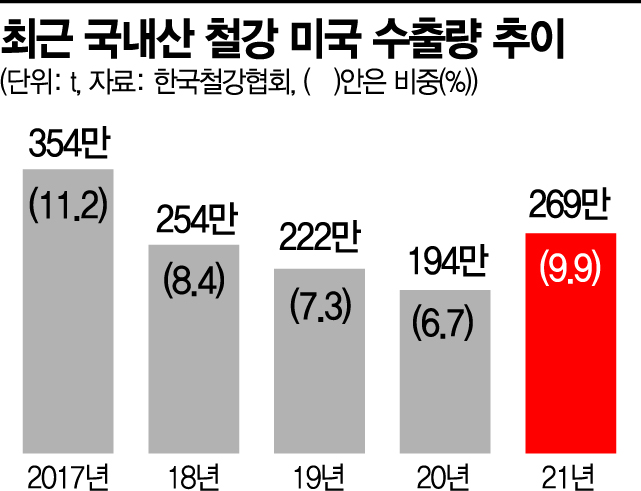
[Asia Economy Reporter Donghoon Jeong] Expectations are rising for the easing of steel export restrictions following U.S. President Joe Biden's visit to South Korea. This is because there is a growing possibility that the protectionist measures strengthened during the Donald Trump administration could be reconsidered during this visit.
According to the government and industry sources on the 17th, 'economic security' is expected to be one of the main agenda items at the upcoming Korea-U.S. summit scheduled for the 21st. In particular, the easing of the application of Section 232 of the Trade Expansion Act, which imposes tariffs of over 25% on steel imports citing national security protection, is one of the biggest issues in the steel industry.
The U.S. has maintained the protectionist trend triggered by the U.S.-China trade conflict since 2018 until recently. Especially, Section 232 of the U.S. Trade Expansion Act, announced in May 2018, is a law focused on restricting steel imports, which significantly curtailed the export volume of domestic steelmakers.
At that time, South Korea avoided uniform tariff application but agreed to limit exports to the U.S. to 70% of the average export volume (3.83 million tons) from 2015 to 2017. Accordingly, domestic steelmakers were restricted to exporting 2.68 million tons even if there was demand in the U.S. Steel exports to the U.S. decreased from 3.64 million tons in 2017 to 2.68 million tons last year.
In contrast to South Korea, the EU and Japan secured eased application of these measures through negotiations last year. In October last year, the U.S. agreed with the EU to allow duty-free imports of up to 3.3 million tons of EU steel annually and to impose a 25% tariff on imports exceeding that amount under a Tariff Rate Quota (TRQ) system. Japan also secured a TRQ agreement from the U.S. last month. Accordingly, from April this year, the U.S. will apply duty-free tariffs on up to 1.25 million tons of Japanese steel and impose a 25% tariff on excess imports. As competing countries' steel products gained higher price competitiveness in the U.S. market than before, domestic steelmakers inevitably suffered losses.
President Biden is the highest-ranking U.S. leader to visit South Korea in 10 years since former President Barack Obama's visit in 2012. As domestic companies have announced large-scale investments in the U.S. in sectors such as semiconductors and secondary batteries in line with Biden's visit, it is highly likely that Biden will offer 'visit gifts' to the Korean government and companies. Meetings with business leaders are also being planned during his visit.
If steel export restrictions are eased, the steel industry could see a significant improvement in performance. The steel industry has shown favorable results this year as well as last year due to product price increases driven by rising raw material costs. Especially, the first quarter of this year was a boon due to high oil prices. The surge in demand for oil and gas facilities in the U.S. raised prices for steel pipe products. Hyundai Steel (sales of 6.9797 trillion won) and SeAH Steel (448.8 billion won) recorded their best-ever first-quarter results this year. An industry insider stated, "Due to the Russia-Ukraine war and economic sanctions on Russia, oil and gas prices have risen compared to pre-war levels, but inventory levels remain low. The increase in fossil fuel drilling operations in North America is sustaining strong demand for steel pipes."
© The Asia Business Daily(www.asiae.co.kr). All rights reserved.
![Clutching a Stolen Dior Bag, Saying "I Hate Being Poor but Real"... The Grotesque Con of a "Human Knockoff" [Slate]](https://cwcontent.asiae.co.kr/asiaresize/183/2026021902243444107_1771435474.jpg)
















