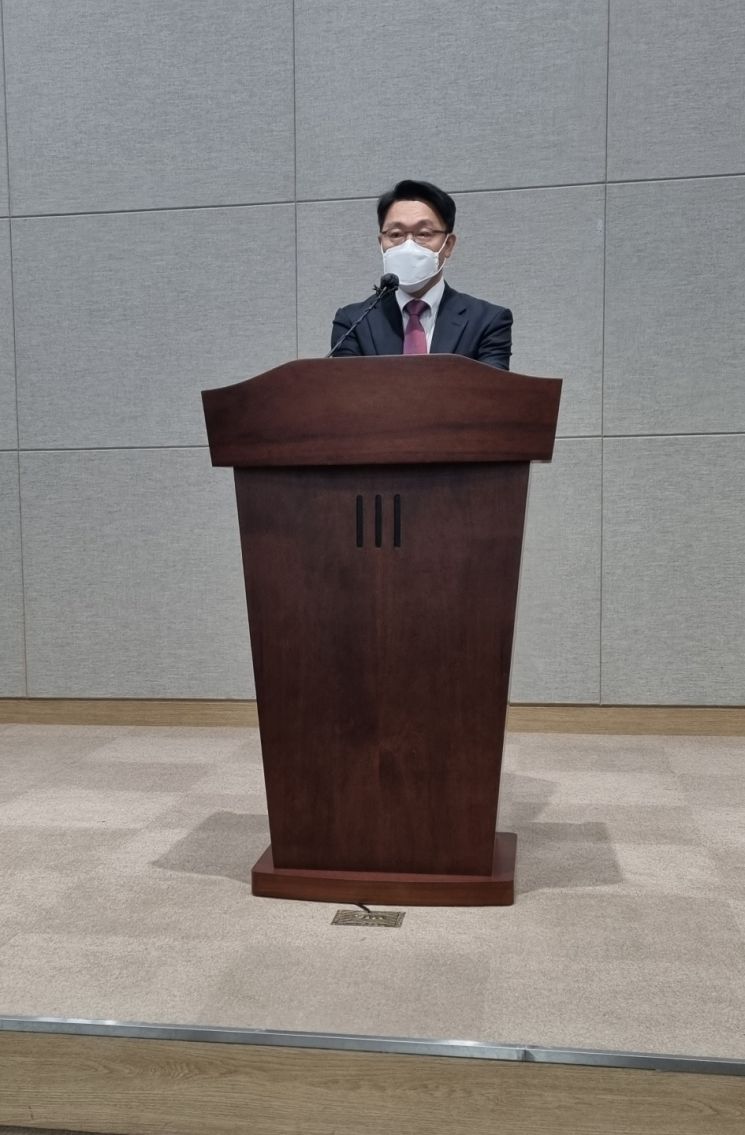
 Kim Jin-wook, Chief of the High-ranking Officials' Crime Investigation Agency, is delivering opening remarks at a press briefing held on the 16th in the training hall on the first floor of the Government Complex Gwacheon./Photo by Choi Seok-jin
[Asia Economy Reporter Choi Seok-jin, Legal Affairs Specialist] Kim Jin-wook, Chief of the High-ranking Officials' Crime Investigation Office (HCIO), stated on the 16th regarding Article 24, Paragraph 1 of the HCIO Act, known as the 'transfer request right,' which President Yoon Seok-yeol had identified as a 'toxic clause' during his candidacy and pledged to abolish, that "it was not exercised arbitrarily" and "it was exercised exactly twice, in a legitimate and reasonable manner according to the conditions."
Article 24 (Relations with Other Investigative Agencies), Paragraph 1 of the HCIO Act stipulates that "if the Chief of the HCIO judges that it is appropriate for the HCIO to investigate a crime overlapping with another investigative agency's investigation, considering the progress and fairness concerns of the investigation, and requests a transfer, the relevant investigative agency must comply."
This means that when other investigative agencies such as the police or prosecution are investigating crimes involving high-ranking officials under the HCIO's jurisdiction, the HCIO Chief's request for transfer to the HCIO must be followed, effectively establishing the HCIO's priority investigative authority over crimes involving high-ranking officials.
President Yoon had identified this provision as a 'toxic clause' during his candidacy and pledged to abolish it upon election. The recently announced national agenda of the Yoon administration also includes a plan to "abolish Article 24 of the HCIO Act, which grants the HCIO priority investigative authority over high-ranking official corruption cases, allowing investigations to be conducted jointly with the prosecution and police."
At a press briefing held at the HCIO office in the Government Complex Gwacheon on the same day, Chief Kim responded to related questions by saying, "I brought the national agenda implementation plan, which states that for the normalization of the HCIO, abolishing the HCIO Chief's transfer request and priority investigative authority under Article 24, Paragraph 1 of the HCIO Act to allow joint investigations with the prosecution and police would be appropriate for mutual checks and balances," referring to the content announced as part of the Yoon administration's national agenda implementation plan.
He stated, "Was Article 24, Paragraph 1 of the HCIO Act exercised arbitrarily? It was not. It was exercised exactly twice."
Chief Kim said, "The first case was the incident involving Superintendent Cho Hee-yeon. After a long audit by the Board of Audit and Inspection, they requested us to investigate and take action on suspected violations of Article 123 of the Criminal Act concerning abuse of authority and obstruction of rights. The request was in the form of investigative reference materials," recalling, "I remember it was on April 23 last year, the same day the National Investigation Headquarters filed a complaint for violation of the National Public Officials Act related to improper influence during the hiring process."
He pointed out that compared to the broadly defined violation of the National Public Officials Act, the crime of abuse of authority and obstruction of rights is difficult to constitute or prove, and many acquittals have been issued by the Supreme Court.
Chief Kim explained the reason for exercising the transfer request right at that time, saying, "According to Article 24, Paragraph 1 of the HCIO Act, when the HCIO's investigation overlaps with another investigative agency's, both investigations started simultaneously (at the HCIO and the National Investigation Headquarters). The two agencies applied different legal interpretations to the same facts, but from the perspective of protecting the suspect's human rights, I thought this was undesirable and that it was better for one agency to handle the investigation exclusively."
He added, "In our judgment, the statutory penalty for abuse of authority is more severe, and since we handle more serious crimes, we thought it was appropriate to exercise the transfer request right under Article 24, Paragraph 1 rather than transferring the case to the National Investigation Headquarters, which had started investigating a lesser crime."
Chief Kim also expressed some disappointment over criticism that the HCIO "stole credit" from the police by exercising this transfer request right.
He said, "Some views say that the Special Investigation Headquarters or the police had their credit stolen, but in fact, we took the case and investigated it, which caused us more criticism. People asked why we investigated a case without prosecution authority as our first case."
He continued, "In the end, we did not request prosecution, right? Because we received a lot of criticism, it is quite disappointing to hear that we 'stole credit'."
Chief Kim emphasized, "That (stealing credit) is not true, and if you look at the facts, it was a case where the transfer request right under Article 24, Paragraph 1 was exercised reasonably and properly according to the conditions."
Regarding another case, he said, "I cannot provide specific details, but there was a case where we requested a transfer to the prosecution due to investigation interference and obstruction, but the prosecution refused," adding, "The prosecution conducted more investigation and said there was no fairness controversy as mentioned in Article 24, Paragraph 1."
This appears to refer to the case involving three incumbent prosecutors linked to the 'Kim Hak-eui illegal deportation investigation interference' incident, where the HCIO requested the prosecution to transfer the case instead of directly deciding on prosecution after the prosecution's investigation.
Chief Kim criticized, "It has been almost a year. The exercise of Article 24, Paragraph 1 was in vain. The prosecution should have either transferred the case to us or taken action after further investigation. As far as I know, I have not heard any such news yet."
He reiterated, "Regarding Article 24, Paragraph 1, we exercised the transfer request right twice legitimately according to the conditions."
Chief Kim said, "However, it cannot be said that the next Chief will exercise Article 24, Paragraph 1 arbitrarily. Therefore, during my term, I think it would be good to establish and implement reasonable and objective internal and external control measures regarding the standards, procedures, and methods for exercising the transfer request right under Article 24, Paragraph 1 to dispel perceptions of arbitrariness or unreasonableness."
He added, "Ultimately, it means relinquishing the HCIO Chief's authority and choosing to be checked. I am willing to do so and intend to pursue it."
During the briefing, Chief Kim also suggested various measures when asked about specific internal and external control methods related to Article 24, Paragraph 1 of the HCIO Act.
He said, "Regarding the standards, methods, and procedures for exercising Article 24, Paragraph 1, we have advisory committees and investigation advisory groups, many advisory bodies, so we should listen to opinions as an agenda and carefully create an effective system," proposing, "For example, it is possible to have a prior consultation procedure with the prosecution or police before exercising the transfer request right."
He continued, "There may be cases where the other side's investigation is almost complete and only disposition remains. The term 'progress of investigation' is used. In such cases, if the case is transferred and we handle the disposition, that would be 'case hijacking' or 'credit stealing.' In that sense, it is possible to derive several detailed standards and procedures reasonably."
Chief Kim also suggested, "When the HCIO Chief exercises the transfer request right, a certain body should review or provide opinions, and the HCIO Chief must report later on cases where the transfer request right was exercised. For national security issues, reports could be made to the National Assembly regularly under confidentiality conditions. Wouldn't that be sufficient? If it can be verified."
Finally, he said, "If such control measures are established, I believe reasonable and objective measures can be derived. If good opinions are given, we can hold public hearings and gather public opinion. When people talk about the 'omnipotent power of the HCIO' or the 'omnipotent power of the HCIO Chief,' Article 24, Paragraph 1 is always mentioned like a bitter herb. Rationally resolving this is the HCIO Chief voluntarily relinquishing their authority, which I think can actually help gain public trust in the HCIO. It is better than exercising authority opaquely without clear standards," he concluded.
© The Asia Business Daily(www.asiae.co.kr). All rights reserved.

















