Report of the Korea Research Institute for Human Settlements
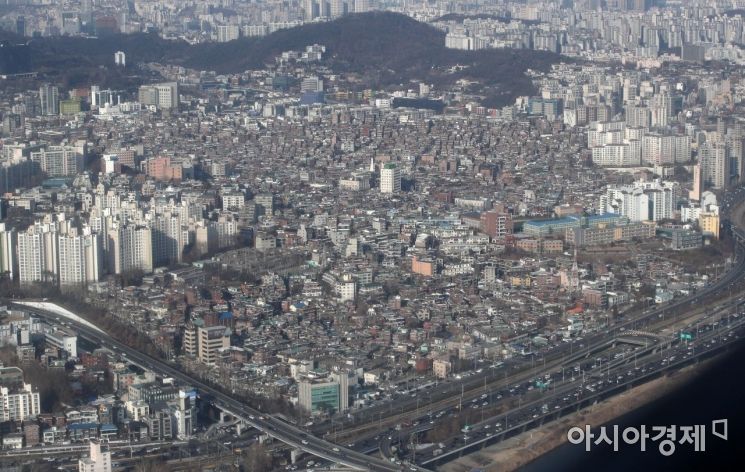
An analysis revealed that public rental housing, one of the housing welfare systems for low-income groups, results in an average monthly rent reduction of about 300,000 KRW per household.
On the 16th, the Korea Research Institute for Human Settlements published a report titled "Analysis of Policy Effects and Performance Enhancement Measures of Public Rental Housing and Housing Benefit Systems," analyzing the policy effects of public rental housing and housing benefit systems and proposing policy improvement measures.
Public rental housing and housing benefit policies are core policies within housing welfare. In 2020, out of the Ministry of Land, Infrastructure and Transport's housing welfare policy budget of 30.4 trillion KRW, the expenditure on public rental housing (investment amount) was 4.3942 trillion KRW (14.5%), and the expenditure on housing benefits was 1.7246 trillion KRW (5.7%).
The stock of public rental housing was 1.66 million units, accounting for 7.8% of the national housing stock (2019), and the number of households receiving housing benefits was 1.189 million, representing 5.8% of general households (2020).
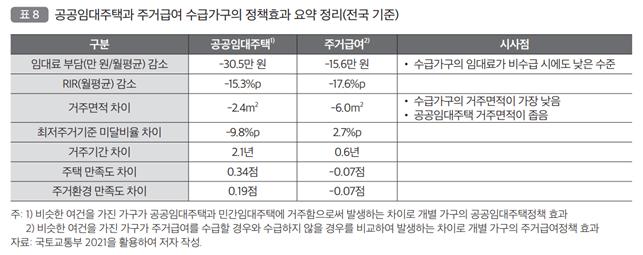
Senior Research Fellow Kang Mina stated, "Housing welfare policies effectively support 80.8% of low-income target households (fourth income quintile non-homeowner public rental housing demand households). Public rental housing stock supports 57% of demand, and housing benefits support 68.1% compared to estimated targets, significantly contributing to reducing individual household housing cost burdens and improving housing conditions."
Kang analyzed that public rental housing results in an average monthly rent reduction effect of about 300,000 KRW per household, while housing benefits provide an average monthly rent reduction effect of about 160,000 KRW per household and a decrease in the rent-to-income ratio (RIR).
She added that the added value generated by policies such as new construction of public rental housing (208 trillion KRW ripple effect), housing cost reduction (4.9 trillion KRW ripple effect), and housing benefits (16 trillion KRW ripple effect) accounted for 0.08% of GDP (2016?2019), indicating that public rental housing construction and housing benefits contribute to regional economic revitalization through new construction investment and consumption promotion.
Accordingly, the institute proposed expanding the targets of public rental housing and housing benefits and improving them into complementary policies that allow for choice and predictability. Policies ensuring benefits are similar regardless of the number or content of support policies were also suggested.
Kang emphasized, "The criteria for selecting beneficiaries should be unified so that administrators and applicants can easily and conveniently determine eligibility. The minimum housing standards should be raised and prioritized during selection, applying sizes appropriate to household members to establish effective standards for actual target households."
She also added, "Housing welfare policy authority should be decentralized to local governments to promote supply plans and projects suited to each region, and balanced policy distribution and development among regions should be pursued."
© The Asia Business Daily(www.asiae.co.kr). All rights reserved.
![Clutching a Stolen Dior Bag, Saying "I Hate Being Poor but Real"... The Grotesque Con of a "Human Knockoff" [Slate]](https://cwcontent.asiae.co.kr/asiaresize/183/2026021902243444107_1771435474.jpg)

















