India's 'Wheat Export Suspension' Measure... Government Says "Limited Short-Term Domestic Impact"
Price Increases Inevitable if Crisis Prolongs... Some Self-Employed Already Showing 'Stockpiling' Moves
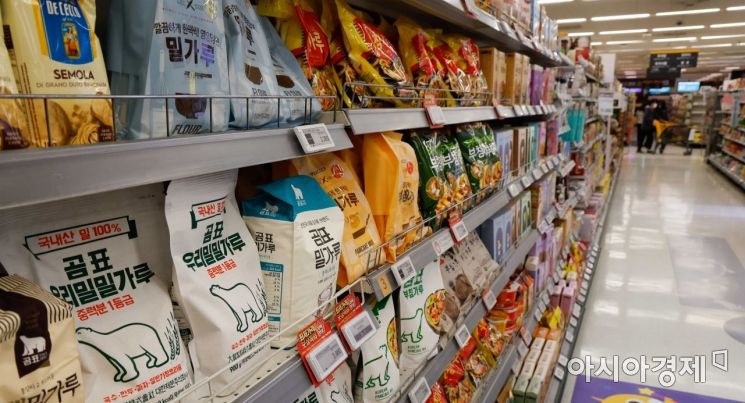 On the 16th, as the Indian government immediately banned wheat exports to secure its food security, making further price increases for domestic snacks and bread more visible, wheat flour is displayed at a large supermarket in Seoul. Photo by Jinhyung Kang aymsdream@
[Asia Economy Son Sun-hee (Sejong)·Song Seung-yoon Reporter] Following Indonesia's palm oil, India has abruptly banned wheat exports, which is expected to deliver another shock to food prices. The food industry is expressing concerns that a 'flour crisis' could unfold following the edible oil shortage. Since Russia's invasion of Ukraine, 'food protectionism' has been gradually spreading among major global grain producers. However, the government expects the short-term impact of this Indian government measure to be limited.
According to the Ministry of Agriculture, Food and Rural Affairs on the 16th, the amount of feed wheat imported from India this year is about 740,000 tons. Considering that the total annual feed wheat import volume is 1.1 million tons, India accounts for about 70%. However, feed wheat imports vary significantly each year in terms of source countries and quantities. In fact, India had not exported wheat domestically for the past five years, but imports resumed this year due to improved domestic harvests and rising international wheat prices. A ministry official explained, "The sources and quantities of feed wheat imports are not fixed but determined annually based on bidding prices, so comparing the annual proportion of imports from India is not very meaningful."
India ranks third in the world in wheat production but consumes most of it domestically. It ranks eighth globally in export volume (4%), so the Ministry of Agriculture, Food and Rural Affairs says the short-term impact on domestic supply is limited. According to the government, quantities of milling wheat are secured until early August (including contracted volumes until the end of October), and feed wheat quantities are secured until early October (including contracted volumes until January next year).
However, the food industry is growing increasingly anxious as wheat prices have been rising since last year, and this export ban crisis has erupted. Among some self-employed business owners, signs of 'hoarding' have been detected. Some wholesalers are even saying that flour prices could rise by more than 30% this year.
Domestic food companies mainly use wheat imported from the United States or Australia, so there is no immediate problem. However, if the situation prolongs, the story changes. If international grain prices continue to rise, milling companies will have no choice but to raise flour prices, which will soon lead to product price increases. The 'Big 3' in the domestic ramen industry?Nongshim, Ottogi, and Samyang Foods?have already raised prices on some ramen products once since August last year and are now watching for further price hikes. In the confectionery industry, last month Haitai Confectionery and Lotte Confectionery raised prices of their flagship products, Honey Butter Chip and Pepero, by 13.3%, marking the start of price increases.
Meanwhile, the government announced on the 12th, through the '2nd Supplementary Budget Proposal,' that it will provide 70% of the price increase support from the national treasury to domestic flour milling companies on the condition of 'minimizing price hikes.' The government will bear 70% of the price increase compared to December last year, companies 20%, and consumers only 10%. To this end, a total budget of 54.6 billion KRW has been allocated in the supplementary budget. The supplementary budget will be used until the end of this year, and if the situation prolongs, related measures will be reflected in next year's budget proposal as well.
© The Asia Business Daily(www.asiae.co.kr). All rights reserved.

















