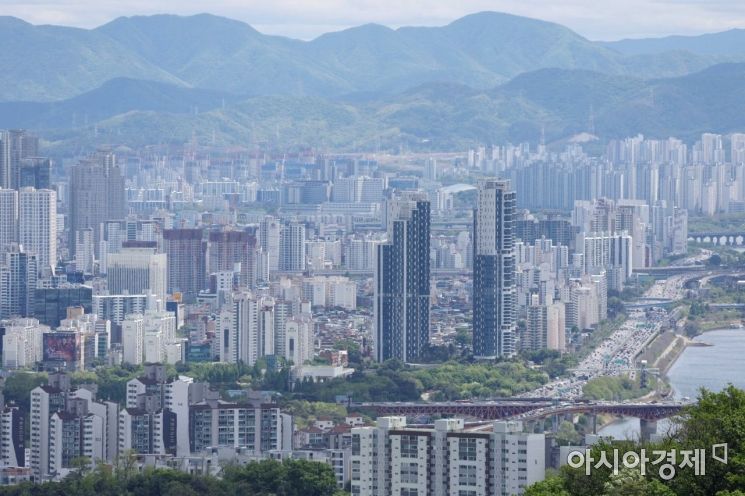
Warnings about instability in the housing lease market in the second half of this year are growing louder, but Seoul’s supply of new apartments for sale that could calm the situation is hardly appearing. With construction raw material prices continuing to rise relentlessly and expectations of various regulatory relaxations, construction companies are also postponing sales.
According to Real Estate R114 on the 16th, there are no new apartment sales scheduled in Seoul this week. This marks the second consecutive week of ‘zero sales’ following last week. The number of private apartment units (excluding rentals) planned for sale in Seoul this year is 34,620 units. However, as of the first week of May, only 3,561 units have been announced for resident recruitment, barely exceeding 10% of the originally planned volume. On the other hand, nationwide, 11 complexes totaling 5,037 units (4,052 general sales units) are scheduled for sale this week. Compared to last week’s nationwide supply of 3,859 units (2,957 general sales units), this is an increase of over 30%. Although the nationwide figures have increased, the supply drought is intensifying in Seoul, the epicenter of the housing market instability.
The direct factors suppressing apartment sales in Seoul include the skyrocketing raw material prices and rising wages, which contribute to overall cost increases. Behind the postponement of sales in projects such as ‘Dunchon Jugong,’ the largest reconstruction project since the founding of Korea, and ‘Daejo 1 District’ in Eunpyeong-gu, there are conflicts between the associations and construction companies over construction costs. The domestic construction price increase rate has reached its highest level since the 2008 financial crisis, and the construction cost index far exceeds the producer price index. In particular, compared to public construction projects that relatively stably procure materials through government-supplied materials, private apartment construction projects bear greater material cost risks.
Rising labor costs are also a burden. According to the Korea Construction Association’s Construction Industry Wage Survey report, the daily wage for a foreman was 153,186 KRW in 2019 but rose 23.6% to 189,313 KRW in January this year. During the same period, concrete workers’ wages increased 14.6%, from 198,242 KRW to 227,269 KRW. The possibility of the new government’s price adjustment (recalibration) of sale prices and the revision of the basic construction cost are also factors in deciding the timing of sales. The Ministry of Land, Infrastructure and Transport recently stated that if major material prices fluctuate by more than 15%, it may consider additional increases in the basic construction cost after June. From the construction companies’ perspective, it is advantageous to reflect the increased costs before launching sales.
There are concerns that if the supply contraction caused by the material shortage crisis prolongs, instability in the overall housing market could spiral out of control. Related construction organizations such as the Korea Housing Builders Association are demanding immediate reflection of material price increases in construction costs and temporary reductions in ancillary costs such as development charges. Choi Seok-in, senior research fellow at the Korea Research Institute for Construction Industry, said, “The government must urgently prepare measures to overcome difficulties at construction sites caused by rising raw material prices, including short-term countermeasures and policy fund support.”
© The Asia Business Daily(www.asiae.co.kr). All rights reserved.

















