Increase in Tenants in Their 30s
Decrease in Tenants Aged 50 and Above
Most Tenants in Gwanak-gu, Songpa-gu, and Yeongdeungpo-gu
[Asia Economy Reporter Kim Min-young] This year, the proportion of monthly rent in lease contracts in Seoul exceeded half, marking an all-time high.
According to Zigbang on the 16th, 51.6% of lease contracts signed in Seoul this year were monthly rent contracts. Based on the confirmed date, this is the first time that the proportion of monthly rent in lease contracts reached 51.6% according to the registration information plaza statistics.
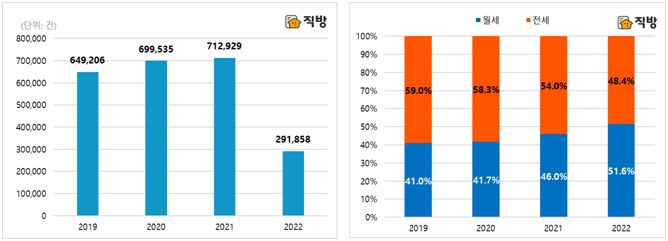
Looking at the ratio of Jeonse (lump-sum deposit lease) and monthly rent by year, the upward trend of monthly rent is prominent. Among the 649,206 lease contracts signed in 2019, the monthly rent ratio was 40.1%, which increased to 41.7% in 2020 and 46.0% in 2021.
This year, among 291,858 contracts with confirmed dates from January to April, 51.6% were monthly rent. This is analyzed to be due to a shortage of listings and increased financial burden caused by interest rate hikes, which relatively lowered the attractiveness of Jeonse. From the supply side, the number of officetel units moved in from 2017 to 2021 was 133,959, exceeding 80% of the 163,411 apartment units, and the characteristics of newly completed housing in Seoul during the same period being mainly small-sized also influenced this monthly rent trend.
The proportion of tenants in the youth group is increasing, while the proportion of middle-aged and older tenants is decreasing. The proportion of tenants in their 30s recorded 35.12%, up 4.4 percentage points from last year’s 30.72%. Tenants aged 20 and below slightly decreased to 26.56% this year from 27.21% last year, but showed an increasing trend over the past three years with 23.90% in 2019 and 26.09% in 2020.
On the other hand, the proportion of tenants aged 50 and above this year was 23.64%, continuously decreasing from 31.83% in 2019, 29.73% in 2020, and 27.84% in 2021. A Zigbang official said, "It is presumed that young demanders, who find it difficult to prepare funds due to loan regulations, have flowed more into renting rather than buying."
Among the 25 autonomous districts in Seoul, Gwanak-gu had the highest proportion of tenants at 9.32%. This was followed by Songpa-gu at 8.0%, Yeongdeungpo-gu at 7.06%, and Gangseo-gu at 6.03%. By age group, tenants in their 20s were most numerous in Gwanak-gu (15.44%), tenants in their 30s were most numerous in Yeongdeungpo-gu (8.75%), and tenants in their 40s and 50s were most numerous in Songpa-gu (8.97% and 8.92%, respectively).
Zigbang pointed out, "Considering the impact of housing demand and supply in the rental market, policy considerations for the housing stability of tenants, such as supply and institutional support for reducing housing costs and ensuring stable lease contracts for the younger generation, will be necessary."
© The Asia Business Daily(www.asiae.co.kr). All rights reserved.
![From Bar Hostess to Organ Seller to High Society... The Grotesque Con of a "Human Counterfeit" [Slate]](https://cwcontent.asiae.co.kr/asiaresize/183/2026021902243444107_1771435474.jpg)
















